Society has long warned us about the dangers of digital consumption, but there is a growing, unapologetic counter-culture defined by the screenmaxxers who spend every waking hour on their phones. In 2026, while tech giants face massive lawsuits over addictive algorithms and wellness gurus sell expensive offline retreats, a unique demographic is actively rejecting the pressure to disconnect. Logging anywhere from 12 to upwards of 18 hours of screen time daily, these individuals are challenging the modern consensus that less tech automatically equates to better mental health.
The Rise of the Anti-Detox Movement
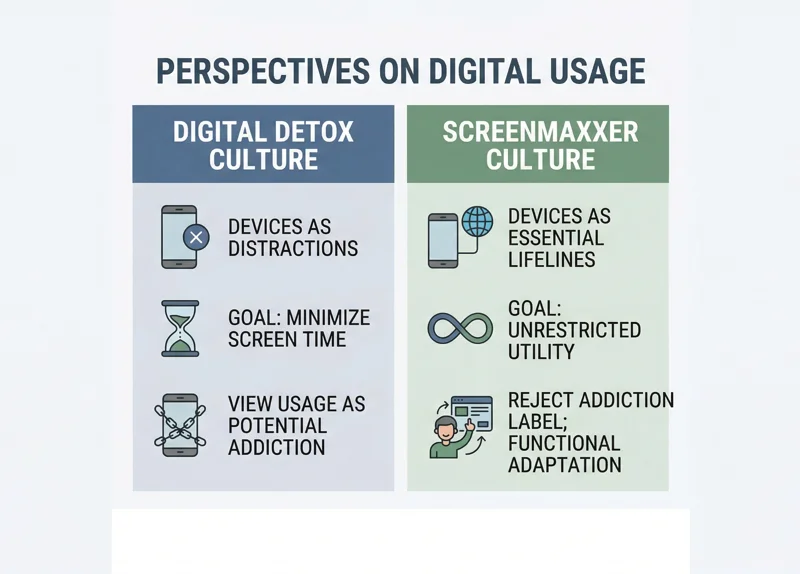
For over a decade, scientists, lawmakers, and psychologists have intensely studied the excessive screen time effects on human cognition and physical well-being. This scrutiny birthed a lucrative digital detox culture, complete with apps that lock your device and luxury camps that confiscate your electronics upon arrival. However, screenmaxxers view this societal push as deeply flawed. To them, the ongoing social media addiction debate is less about clinical pathology and more about a societal moral panic.
Rather than feeling ashamed of their smartphone usage habits, screenmaxxers argue that their devices are tools of empowerment. They point out that labeling high screen time as an “addiction” is often a convenient way to scapegoat technology for broader, systemic issues like economic burnout, lack of accessible public spaces, and general online social isolation. Instead of viewing their phones as toxic slot machines, they view them as vital conduits to the outside world.
| Ideology | Digital Detox Culture | Screenmaxxing Culture |
|---|---|---|
| View on Devices | Harmful distractions that require strict moderation. | Essential lifelines for global connection and utility. |
| Screen Time Goals | Minimize to the lowest possible functional level. | Unrestricted usage; screen time is not a metric of health. |
| Tech “Addiction” | A widespread clinical crisis requiring intervention. | Often a moral panic pathologizing everyday dopamine. |
“Any negative effect of ‘screen time’ I’ve ever seen has just been some other societal issue being pushed off on a convenient villain. Good screen time is vastly undervalued.”
Beyond the Scroll: The Real Reasons for Extreme Usage
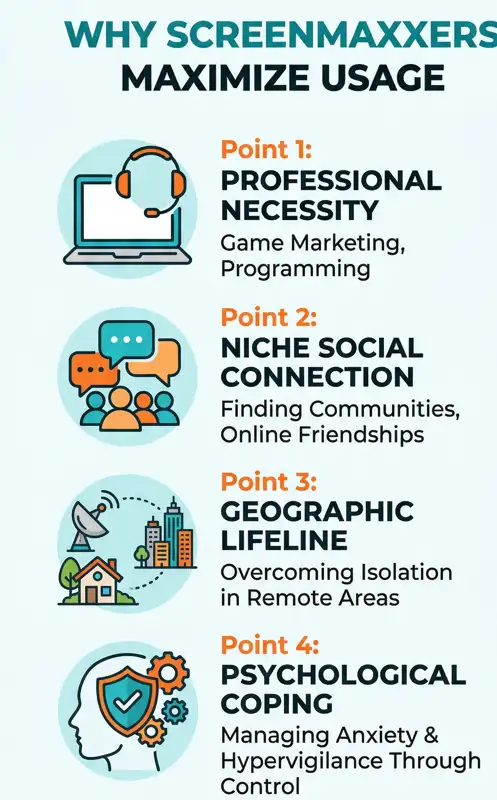
To understand screenmaxxers, one must look past the superficial assumption of mindless scrolling. For many, extreme screen time is an undeniable necessity tied to modern survival and socialization. Remote workers living in rural areas often rely entirely on digital interfaces to maintain their careers. For an influencer manager or a programmer residing hours away from the nearest major city, the screen is the only bridge to their industry, peers, and livelihood.
Furthermore, screens serve as an antidote to geographic and social isolation. Finding niche communities that share specific interests is incredibly difficult in a small town. Platforms like Discord or specialized bulletin boards allow individuals to cultivate deep, meaningful friendships that have lasted for decades. Cutting out screen time, for them, wouldn’t result in a sudden burst of outdoor productivity; it would simply result in profound boredom and loneliness.
Interestingly, extreme screen usage also plays a role in psychological coping mechanisms. For individuals dealing with obsessive-compulsive tendencies or trauma-induced hypervigilance, having a constant stream of information can feel grounding. It provides an illusion of control—the ability to know exactly what is happening in the world, track family news, and remain constantly updated. While mental health professionals advocate for varied coping strategies, many users report that this constant monitoring keeps their anxiety at manageable levels, proving that the nature of screen time is highly subjective.
| Driving Factor | How Screenmaxxers Utilize Devices |
|---|---|
| Professional Demands | Constant connectivity required for global gaming, IT roles, and digital marketing. |
| Niche Socialization | Bypassing geographic isolation to find specific communities and lifelong friends online. |
| Psychological Coping | Using endless information flow to manage anxiety, stay informed, and maintain a sense of control. |
“It helps me feel in control in a way, because I know I know as much as I can know. I can keep track of things, know what I have the power to change and what I don’t.”
As the debate continues, it is crucial to recognize that the digital landscape is not one-size-fits-all. If you are interested in the ongoing psychological research regarding technology usage, you can read more from the American Psychological Association on technology. Ultimately, while reducing screen time works wonders for some, the screenmaxxers are proof that humanity is adapting to the digital age in incredibly diverse, unapologetic ways.
Frequently Asked Questions
What exactly is a “screenmaxxer”?
A screenmaxxer is an individual who spends nearly all of their waking hours (sometimes up to 18 hours a day) on digital devices and actively rejects the idea that they need to reduce their screen time.
Why do screenmaxxers reject digital detox culture?
They believe the push to disconnect is a moral panic that unfairly pathologizes technology. They argue that screens are essential tools for connection, accessibility, and modern living.
Is spending 18 hours on a phone considered an addiction?
The medical community heavily debates this. While some view excessive use as a behavioral addiction, screenmaxxers argue their use is highly functional and fulfills practical or social needs, not just a dopamine loop.
For people living in remote areas or those with niche interests, geographic socialization is difficult. Screens provide access to global communities, allowing them to build and maintain deep friendships.
Can high screen time be a coping mechanism for anxiety?
Yes. Some individuals with conditions like OCD or hypervigilance use constant access to news, social media, and information to feel a sense of control and safety in an unpredictable world.
Are screenmaxxers primarily young teenagers?
Not necessarily. The screenmaxxing lifestyle spans various age groups, including middle-aged professionals, remote workers, and parents who use their devices to stay connected during unconventional hours.
Do screenmaxxers experience the negative physical effects of screen time?
Like anyone using devices heavily, they can experience eye strain or sedentary habits, but many arrange their environments to accommodate their lifestyle, arguing the psychological and social benefits outweigh the physical drawbacks.
Disclaimer: This article is for informational purposes only and does not constitute medical or psychological advice. Perspectives on screen time and digital addiction vary widely among experts.