
When we tested google synthid works great but labeling ai content may be a losing game, we uncovered a fascinating paradox in modern digital media. In 2026, the sheer volume of AI-generated content has fundamentally altered how we perceive reality on the internet. Deciding what is real and what is synthetic is no longer a casual endeavor; it is a critical necessity for journalists, policymakers, and everyday users. The scale of this AI-generated media is genuinely hard to grasp for most people.
To put this into perspective, research indicates that it took humanity 149 years—from the invention of the camera until 1975—to capture roughly 1.5 billion photographs. Generative AI accomplished that exact same volume in a mere 18 months. Fast forward to today, and Google’s suite of generative tools alone has produced over 100 billion AI images and videos. In response to this tidal wave of synthetic media, tech giants have scrambled to implement digital labels.
Google has heavily pushed its SynthID technology, an invisible watermark designed to survive the harsh environment of internet sharing. We wanted to see exactly how resilient this technology is. Our conclusion? We have rigorously tested google synthid works great but labeling ai content may be a losing game because bad actors and open-source models will simply bypass these centralized safeguards.
How We Tested Google SynthID Works Great But Labeling AI Content May Be a Losing Game
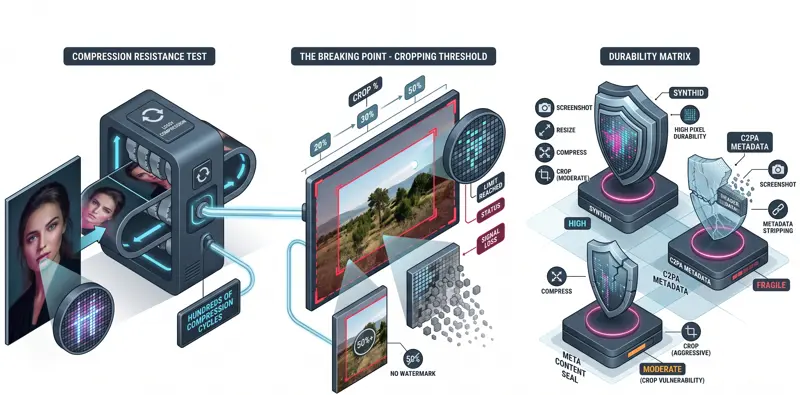
Currently, the tech industry relies on two primary methods for identifying AI content: invisible watermarking like SynthID, and metadata schemas like the Coalition for Content Provenance and Authenticity (C2PA). While C2PA is cryptographically secure and impossible to fake, it is notoriously fragile. If you take a screenshot of a C2PA-authenticated image, or run it through a basic social media compression algorithm, the metadata is instantly stripped away.
SynthID, on the other hand, takes a different approach. Developed by Google DeepMind, it encodes a watermark directly into the pixels of an image or the waveform of an audio file. It is designed to hide in plain sight. Google DeepMind scientists have stated that they built SynthID assuming it would face relentless adversarial attacks. They trained their detection models to recognize the watermark even after heavy filters, cropping, and compression.
| Technology | Embedding Method | Durability Against Edits | Primary Weakness |
|---|---|---|---|
| Google SynthID | Pixel-level / Waveform | Extremely High | Heavy cropping (over 20-50%) |
| C2PA Metadata | File Header Data | Very Low | Stripped by screenshots or saving |
| Meta Content Seal | Invisible Pixel Patterns | Moderate | Vulnerable to slight cropping |
To verify these claims, we utilized a custom Python script leveraging the Pillow library to simulate years of digital degradation. We took two types of AI images—one generated entirely from scratch, and another consisting of a real photograph manipulated by AI. Both contained the SynthID watermark.
Our script applied random compression values and resizing dimensions iteratively, feeding the output back into the loop hundreds of times. This process turned crisp, high-resolution AI art into heavily artifacted, blurry messes. Remarkably, when we ran these degraded files through the official Google DeepMind SynthID verifier using Gemini, the system still accurately flagged them as AI-generated.
The Limits of AI Content Watermarking Technology
SynthID survived our brutal compression machine, proving its robust pixel-distribution model works. You can even screenshot the degraded image, and the specialized pixels carry over, allowing the detector to spot the forgery. However, every system has a breaking point. When we tested google synthid works great but labeling ai content may be a losing game, we eventually found the watermark’s kryptonite: aggressive cropping.
“While the existence of invisible watermarks might give people some sense of security, they aren’t a reliable way to know what’s true.”
Because the watermark is distributed across the image, removing large chunks of the file eventually destroys enough data to break the detection. After approximately 300 intense compression generations, a 20 percent crop was enough to render SynthID completely undetectable. A more severe 50 percent crop broke the watermark even earlier, around the 250-iteration mark. While an image subjected to this level of abuse is generally too blurry to be useful, it proves that SynthID is not invincible.
| Stress Test Method | Iterations Applied | SynthID Detection Status |
|---|---|---|
| Random Compression & Resizing | 100 Cycles | Detected Successfully |
| Compression + 20% Crop | 300 Cycles | Detection Failed |
| Compression + 50% Crop | 250 Cycles | Detection Failed |
Why We Tested Google SynthID Works Great But Labeling AI Content May Be a Losing Game
Despite SynthID’s impressive durability, the broader strategy of tagging synthetic media is fundamentally flawed. If you have tested google synthid works great but labeling ai content may be a losing game, you understand the problem of fragmentation. As different companies deploy their own proprietary watermarks, the ecosystem becomes a tangled mess.
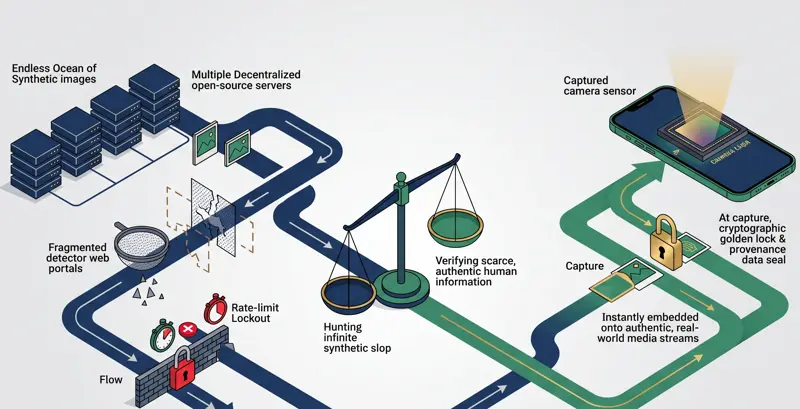
For example, OpenAI and Runway both utilize advanced watermarking techniques. However, Google’s detector cannot read OpenAI’s watermark, and OpenAI’s tools are blind to Google’s SynthID. If you encounter a suspicious image online, you might run it through three different detectors, get negative results across the board, and falsely assume the image is real simply because you didn’t check the specific detector that matches the source model.
Furthermore, Google intentionally restricts access to its detection tools to prevent malicious actors from reverse-engineering bypass methods. Users are limited to approximately ten image checks per day through Gemini. If you upload too many similar images, the system locks you out to prevent brute-force attacks. During a frantic election cycle where deepfakes are weaponized daily, a verification cooldown period is unacceptable for journalists and fact-checkers.
The Threat of Open Source and the Liar’s Dividend
The most fatal flaw in the watermarking strategy has nothing to do with Google or OpenAI. The core issue is that anyone with a powerful graphics card can run open-source AI models locally on their own computer. These decentralized models do not embed SynthID, C2PA, or any other tracking mechanism. The generative genie is permanently out of the bottle.
“The problem is people who can run their own models… The generative genie is out of the bottle, and there’s no stuffing it back in.”
If society becomes conditioned to believe that “unlabeled” means “real,” we are walking into a dangerous trap. Bad actors will simply generate political misinformation using unwatermarked local models. This directly fuels a phenomenon known as the “liar’s dividend.”
The liar’s dividend occurs when a public figure is caught on authentic tape doing something scandalous, but they escape accountability by simply claiming, “That’s not me—it’s AI!” When the digital ecosystem is flooded with synthetic slop, the mere existence of AI casts doubt on actual, factual reality.
C2PA Metadata Authentication: The Path Forward
Since we have thoroughly tested google synthid works great but labeling ai content may be a losing game, what is the solution? Experts argue that we must completely reverse our approach. Instead of trying to label the infinite ocean of AI garbage, we must cryptographically protect and authenticate reality.
This is where C2PA metadata authentication becomes vital. C2PA acts as a tamper-evident seal for digital files. Devices like Google’s Pixel 10 are already integrating C2PA at the hardware level. When you snap a photo with a modern smartphone, the device embeds cryptographic proof of the time, location, and lens data, effectively proving that the image was captured by light hitting a physical sensor, not generated by a prompt.
| Approach | Core Philosophy | Future Viability |
|---|---|---|
| Labeling Fake Content (SynthID) | Outing falsehoods in a sea of synthetic data. | Low (Easily bypassed by open-source models). |
| Proving Real Content (C2PA) | Authenticating scarce, truthful human information. | High (Relies on hardware-level cryptographic trust). |
As the internet becomes increasingly saturated with artificial media, our digital survival will depend on verified provenance. If a piece of media lacks C2PA authentication, we will eventually have to treat it with intense skepticism by default. Labeling AI is a commendable corporate policy for tech giants looking to avoid regulatory wrath, but as our tests show, it will never be the ultimate shield against misinformation.
Frequently Asked Questions
What does it mean when experts say they tested google synthid works great but labeling ai content may be a losing game?
It means that while Google’s specific watermarking technology is highly resistant to tampering and compression, the overall strategy of labeling fake content fails because open-source models allow bad actors to generate images without any watermarks at all.
How does Google SynthID actually work?
SynthID embeds a cryptographically secure, invisible watermark directly into the pixels of an image or the waveform of an audio file, allowing detectors to identify it even if the file is compressed or screenshotted.
Can a regular user remove the SynthID watermark?
It is incredibly difficult for an average user to remove it. In our stress tests, it took hundreds of passes through aggressive compression and severe cropping (up to 50%) to finally break the detection, by which point the image was mostly ruined.
Why is C2PA considered a better solution than AI watermarks?
Rather than trying to flag infinite fake images, C2PA embeds secure metadata into real photos at the moment they are taken by a camera. It proves an image is real, acting as a tamper-evident seal for authentic human journalism.
Will Google’s AI detector recognize an image made by OpenAI’s DALL-E?
No. Currently, the landscape of AI generated misinformation detection is highly fragmented. Google’s SynthID detector cannot read OpenAI’s watermarks, and vice versa.
What is the “Liar’s Dividend”?
The liar’s dividend is a strategy where public figures escape accountability for actual wrongdoings caught on tape by falsely claiming the authentic evidence is just a deepfake or AI-generated manipulation.
Why does Google limit how many images I can scan for SynthID per day?
Google restricts access (typically around 10 checks per day) to prevent hackers from running continuous, automated tests designed to reverse-engineer and break the SynthID protection algorithm.
Disclaimer: This article is for informational purposes only. Technology specifications, metadata standards, and detection algorithms are subject to rapid change. Always cross-reference multiple sources when attempting to verify the authenticity of digital media.