There is a massive buzz in the home theater community this year, mainly because sonys new true rgb tv looks amazing in action but is it an oled killer. During an unprecedented, highly exclusive hands-on session at Sony’s Tokyo headquarters, we were granted rare access to pre-release prototypes of what the company is calling “True RGB.” While exact model numbers, release dates, and pricing remain heavily guarded secrets, the visual performance we witnessed was nothing short of revolutionary. By stepping away from traditional white LED backlighting and embracing a next-generation architecture featuring independently controlled red, green, and blue diodes, Sony is aggressively aiming to redefine high-end consumer displays for 2026 and beyond.
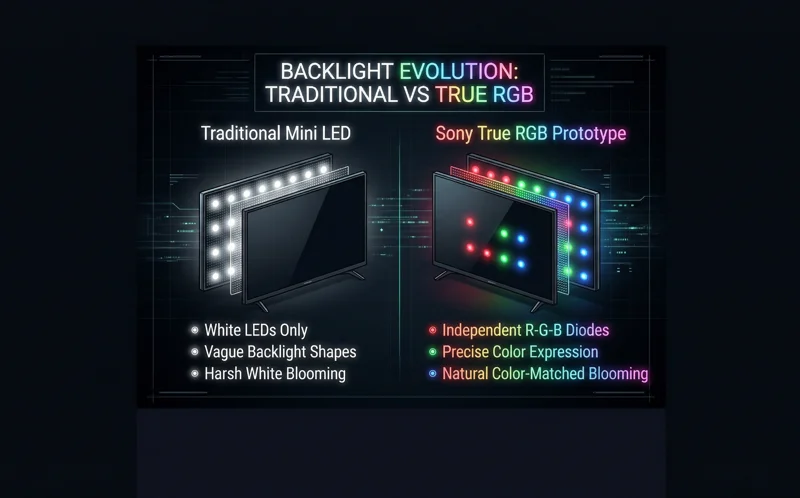
Is the New "True RGB" Mini LED TV the Ultimate OLED Killer?” src=”https://mobileservicescenter.com/wp-content/uploads/2026/04/featured_05c4a1.webp” style=”width: 100%; height: auto; border-radius: 8px; margin: 20px 0; box-shadow: 0 4px 6px rgba(0,0,0,0.1);”/> The Exclusive Hands-On & Tech Breakdown Walking into the testing rooms at Sony HQ, the sheer confidence of the engineering team was palpable. To prove their point, they placed the unreleased True RGB flagship directly next to their current heavyweight, the 75-inch Bravia 9. To make the comparison completely transparent, the LCD layers were stripped away, exposing the raw backlight grids of both televisions. This side-by-side demonstration immediately highlighted a profound difference in backlight operation. The Bravia 9, while an excellent display, relies on white LEDs that vary in brightness, often causing shapes in the backlight to look vague, washed out, and blended into one another. In stark contrast, the True RGB prototype utilizes cutting-edge, next-gen RGB TV backlight technology. The expression of pure color radiating from the bare backlight alone was exceptional. When paired with granular brightness control, the shapes and hues of the image were immediately recognizable even without the LCD layer applied. This massive hardware advantage translates into real-world picture performance that is characterized by punchier, richer, and impeccably consistent colors across the entire screen, regardless of the overall scene brightness. “By utilizing independently controlled red, green, and blue diodes in the backlight, Sony has managed to achieve a level of color purity and brightness consistency that fundamentally challenges the current display market.” Feature Traditional Mini LED (e.g., Bravia 9) Sony “True RGB” Prototype Backlight Diodes White LEDs only Independently controlled Red, Green, Blue LEDs Color Expression (Raw Backlight) Vague shapes, mostly varying shades of blue/white Vibrant, highly defined shapes and accurate colors Blooming Effect Noticeable white glow around bright objects Subtle, color-matched glow that blends naturally When pitted against competitor models from rival brands utilizing similar early-stage RGB tech, the Sony prototype dominated. The rival models suffered from noticeable color shifting—where a subject’s skin tone would inaccurately change based on the background color—and struggled heavily with extreme off-axis viewing angles. Sony’s solution maintained stunning vibrancy and control from virtually any angle, proving that their proprietary backlight drive algorithms are a massive step ahead. The OLED Dilemma & Final Verdict The ultimate test occurred in a completely blacked-out room, placing the Sony True RGB TV between a standard Bravia 9 and the industry-standard Sony BVM-HX3110 mastering monitor. Running real movie content in the ‘Professional’ preset, the True RGB was a revelation. It matched the BVM-HX3110’s exact color accuracy far closer than the Bravia 9 could. Furthermore, the nature of its blooming is entirely different. Because it uses colored light, any slight glow around a bright object on a dark background matches the object’s color, resulting in a much subtler, more natural visual artifact compared to the harsh white glow of traditional LEDs. Performance Metric Sony True RGB Mini LED Premium OLED Displays Peak Brightness & Color Volume Extremely high; zero color washout at peak brightness Excellent, but physically limited by heat and ABL Absolute Black Levels Deep, but struggles slightly in complex mixed-light scenes Perfect, true black due to individual pixel shut-off 3D Solidity & Image Density Excellent, but slightly lacks the absolute depth of OLED Unmatched pixel-level contrast creates incredible depth However, despite this monumental leap in LED capabilities, the “OLED killer” title might still be slightly out of reach. OLED panels possess an inherent physical advantage: pixel-level contrast control. While watching the True RGB display, there is still a very subtle lack of the absolute solidity, density, and three-dimensionality that a top-tier OLED provides. In incredibly tricky mixed-light scenes, OLED still delivers the deepest blacks. You can read more about standard display advancements on Sony’s official electronics portal. “While True RGB pushes Mini LED technology to breathtaking new heights of brightness and color volume, the absolute pixel-perfect contrast of OLED remains a difficult physical hurdle to completely overcome.” Is it an OLED killer? Perhaps not entirely, but it certainly offers a compelling, next-generation alternative for home theater enthusiasts who prioritize massive color volume, searing brightness, and cinematic authenticity over absolute black levels. We will know exactly where it stands once final production models arrive. Frequently Asked Questions Question: What exactly is Sony’s new True RGB technology?
It is an advanced Mini LED backlight system that utilizes independently controlled red, green, and blue diodes instead of the traditional white LEDs found in most current televisions.
How does True RGB compare to the current Sony Bravia 9?
The True RGB prototype offers significantly punchier, richer, and more consistent colors, alongside a much more natural-looking blooming effect due to its fully colored backlight.
Is the Sony True RGB TV definitively better than OLED?
It excels heavily in brightness, overall color volume, and completely eliminates burn-in risk, but OLED technology still maintains a slight edge in absolute black levels and pixel-level contrast.
What sizes will the Sony True RGB TV be available in?
Sony has not yet announced official retail models, sizes, or specifications, though a 75-inch prototype was extensively shown during the Tokyo HQ demonstrations.
Did Sony reveal the price for the True RGB TV?
No, pricing and official release dates are still heavily guarded secrets and will be revealed at a later date.
How does the new colored backlight handle blooming?
Because the backlight uses colored diodes, any minor blooming around bright objects matches the color of the object itself, making it much less noticeable and far more natural than a traditional white glow.
Can the True RGB match the quality of a professional mastering monitor?
In strictly controlled tests against the industry-standard Sony BVM-HX3110 mastering monitor, the True RGB TV performed exceptionally well, getting incredibly close to true reference-level color accuracy.
Disclaimer: This article is for informational purposes only. The details discussed are based on pre-release prototypes previewed at Sony’s Tokyo headquarters, and final retail specifications, pricing, and performance may vary.