Are you tired of car sickness ruining your road trips? Samsung’s New Hearapy App is here to change the way we travel in 2026. For decades, millions of travelers have struggled with kinetosis—commonly known as motion sickness—relying on drowsy medications, uncomfortable acupressure bands, or simply staring blankly out the window. Now, technology has stepped in with an acoustic solution that is as surprising as it is effective. Samsung has just released a revolutionary application designed to quell travel nausea in a mere 60 seconds using specific audio frequencies. Best of all? You do not need to own a pair of Samsung-branded earbuds to take advantage of this incredible travel hack.
In this comprehensive guide, we are diving deep into the science, the hardware requirements, and the user experience of this groundbreaking application. Whether you are a frequent flyer, a daily commuter on winding roads, or someone who gets dizzy reading on a train, this sound-based therapy could be the ultimate cure you have been waiting for.
The Science Behind the Sound: How Hearapy Cures Nausea
To understand why a sound app can stop you from feeling sick, we first need to understand why motion sickness happens. Nausea during travel occurs due to a sensory conflict. Your eyes might be focused on a static object (like a phone screen or a book), telling your brain that you are stationary. Meanwhile, the vestibular system in your inner ear feels the bumps, turns, and acceleration of the vehicle, sending signals to your brain that you are moving. This massive disconnect confuses the central nervous system, leading to dizziness, cold sweats, and nausea.
Historically, tech companies tried to solve this by adding moving visual elements to screens—like the artificial dots on some Android interfaces that move in tandem with the vehicle. While helpful for some, it required you to keep looking at your screen. Samsung took a completely different, auditory approach.
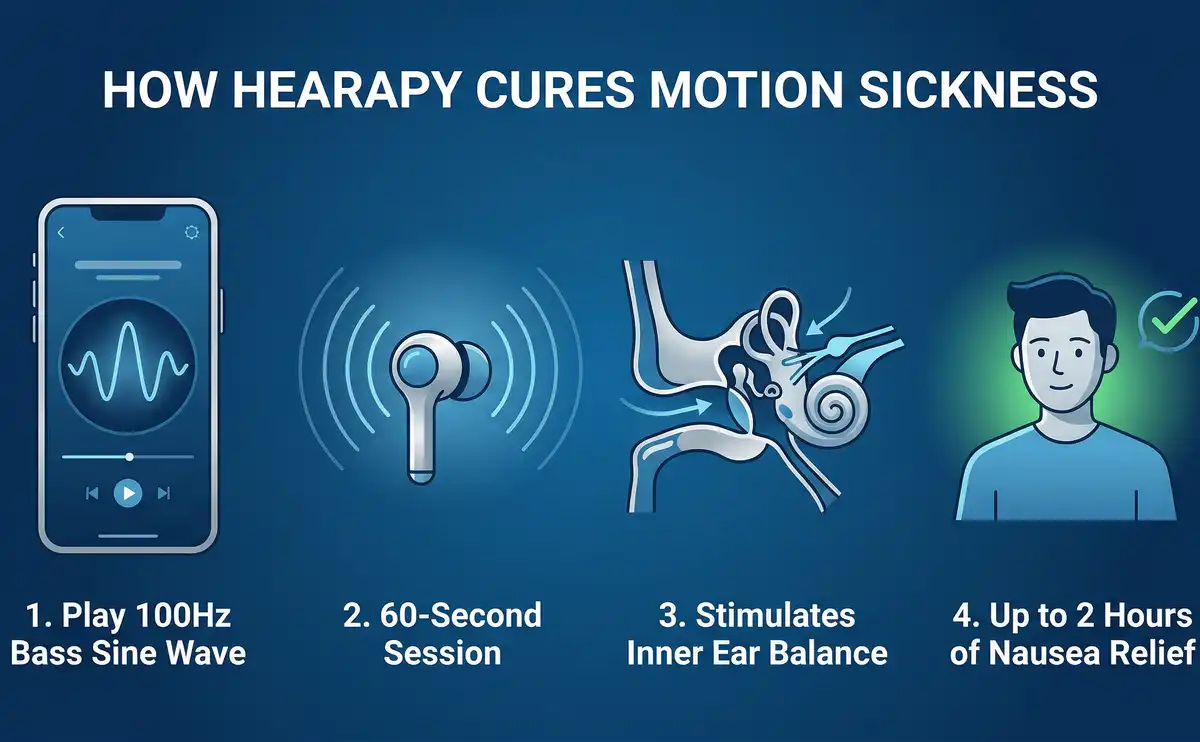
Researchers from Nagoya University in Japan provided the backing data for this new frontier in wearable health tech. Their studies demonstrated that the inner ear’s balance mechanisms can be stimulated and essentially “reset” using specific acoustic waves. Specifically, they found that playing a steady 100Hz sine wave tone at a designated volume for approximately one minute can drastically improve balance and spatial orientation. When the inner ear is stimulated by these low-frequency bass waves, the brain processes physical movements much better, overriding the sensory conflict.
“A quick 60-second listen of 100Hz sine waves can keep your brain stimulated and your stomach nausea-free for up to two hours.”
The Hearapy application harnesses this exact biological loophole. By emitting a pure, uninterrupted bass sine wave for 60 seconds, it provides temporary but profound relief, acting as an acoustic anchor for your vestibular system.
Hardware Compatibility: Not Just for Galaxy Buds
Samsung naturally markets Hearapy as the perfect companion application for their proprietary hardware, especially the highly acclaimed Galaxy Buds 4. The Galaxy Buds 4 are exceptional candidates because they easily reach the required 100Hz frequency and feature superior active noise cancellation (ANC). Sound isolation is a critical factor; for the sine wave therapy to be fully effective, the 100Hz frequency must be played without interruption from background engine noise or cabin chatter.
However, the most exciting aspect of Hearapy is its universal accessibility. Samsung did not lock this feature behind a hardware paywall. The application is readily available for download on the Google Play Store and functions on virtually any modern smart device. The only strict requirement lies in the capabilities of your audio hardware: your earbuds or headphones must have drivers capable of comfortably reproducing frequencies as low as 100Hz.
Fortunately, in 2026, even budget-friendly audio devices are engineered with robust frequency response ranges. Most standard consumer earbuds boast a frequency response of 20Hz to 20kHz, meaning the 100Hz requirement is well within the operational limits of most devices on the market. Below is a comparison of popular earbuds and their compatibility with the application.
Earbud Compatibility for 100Hz Acoustic Therapy
| Earbud Model | Lowest Frequency Range | Noise Isolation (ANC) | Hearapy Compatibility |
|---|---|---|---|
| Samsung Galaxy Buds 4 / Pro | 20Hz | Excellent | Optimal (Native Support) |
| Jabra Elite Gen 2 | 20Hz | Very Good | Highly Effective |
| Sony WF-1000XM5 | 20Hz | Industry Leading | Highly Effective |
| Standard Budget Earbuds (Under $30) | Often \~50Hz – 100Hz | Poor to Average | Functional, but less immersive |
We conducted independent testing using a pair of Jabra Elite Gen 2 earbuds. Since these earbuds can reach deep bass levels down to 20Hz, reproducing the 100Hz sine wave was effortless. The hardware is more than capable, proving that Samsung’s software truly benefits the broader Android and audio ecosystem.
The User Experience: What Does Hearapy Feel Like?
If you have never listened to an isolated sine wave before, the experience can be difficult to describe. Unlike music, which features dynamic range, shifting pitches, and varying tempos, a pure 100Hz sine wave is a constant, flat, and heavy bass drone. It does not entertain you; it treats you.
When you initiate a session within the app, you are instructed to place both earbuds in securely and activate your device’s noise cancellation if available. As the 60-second timer begins, a low but loud bass tone fills your ears. Initially, the sensation is slightly disorienting. Because the sound is stimulating the balance centers of the inner ear, you might feel a mild “buzzy” sensation or a fleeting sense of vertigo for the first few seconds.
As your brain acclimates to the acoustic input, the disorientation fades, replaced by a strange sense of neurological grounding. The sensory conflict between your eyes and your inner ear is effectively “drowned out” by the therapeutic frequency. Once the 60 seconds are up, the tone ceases, and users report feeling remarkably clear-headed. Samsung notes that a single session can stave off motion sickness for up to two hours, making it perfect for short domestic flights, ferry rides, or Uber trips across the city.
Comparing Hearapy to Traditional Motion Sickness Remedies
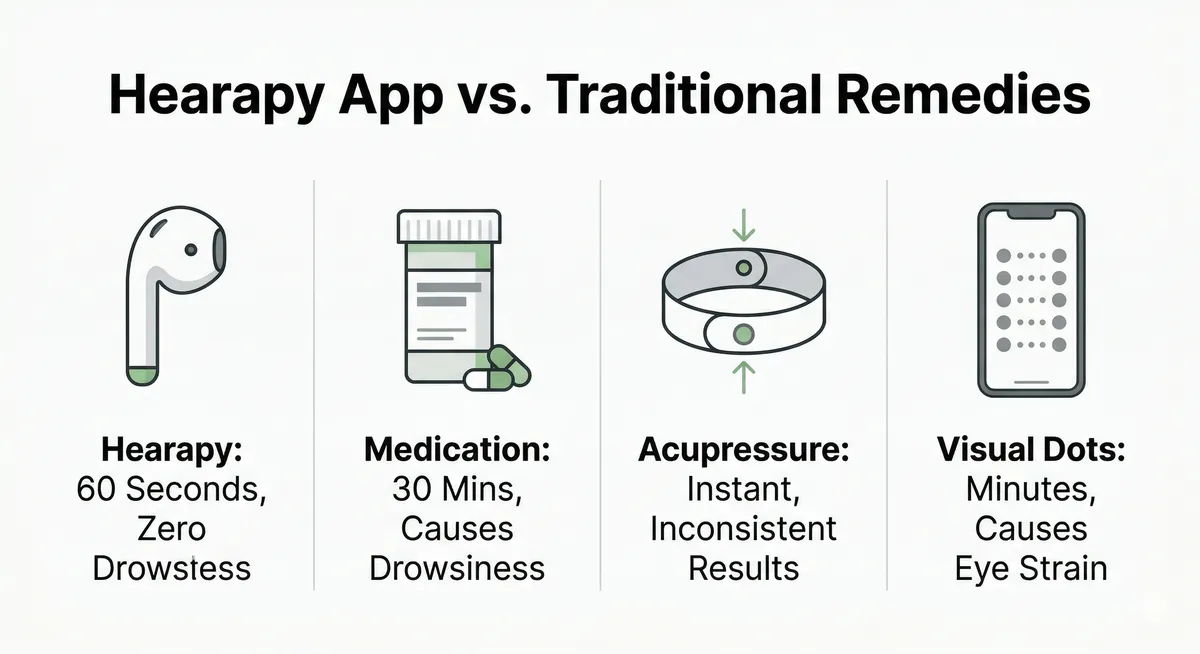
For decades, the market for motion sickness cures has been dominated by pharmaceuticals and homeopathic wearables. How does an acoustic app stack up against these tried-and-true methods? The primary advantage of the new application is the complete lack of chemical side effects. Medications like Dimenhydrinate (Dramamine) or Meclizine are highly effective at blocking the nausea signals in the brain, but they are notorious for causing extreme drowsiness, dry mouth, and lethargy. If you are traveling for a business meeting or driving a vehicle yourself, falling asleep is not a viable option.
Acupressure bands, which apply physical pressure to the P6 (Neiguan) point on the wrist, are completely natural but yield wildly inconsistent results. Some users swear by them, while others find them completely ineffective placeholders. Visual cues on screens help, but they lock you into staring at your device.
Hearapy bridges the gap. It is a scientifically backed, non-invasive, zero-drowsiness solution that takes exactly one minute to apply. It frees you up to read, work, or sleep naturally during your journey.
Motion Sickness Remedies Comparison
| Remedy Type | Effectiveness | Side Effects | Time to Work |
|---|---|---|---|
| Samsung Hearapy App (100Hz Tone) | High (Acoustic inner ear reset) | None (Brief disorientation during use) | 60 Seconds |
| Over-the-Counter Medication (Pills) | Very High | Drowsiness, brain fog, dry mouth | 30 to 60 Minutes |
| Acupressure Wristbands | Low to Moderate (Placebo for some) | Mild wrist discomfort | Instant (Varies) |
| On-Screen Visual Dot Systems | Moderate | Eye strain, requires constant screen viewing | A few minutes |
How to Maximize Your Results with the App
To get the absolute best results from this technology, users should follow a few optimal practices. First, do not wait until you are already severely nauseous to use the app. While it can help reduce active nausea, it functions much better as a preventative measure. If you know you get sick reading in the car, run a 60-second session before you open your book or tablet.
Secondly, ensure an uninterrupted session. The Nagoya University researchers noted that the efficacy of the 100Hz tone relies on a lack of interruption. Do not attempt to play music or podcasts simultaneously over the sine wave. You must isolate the frequency for the full minute. Make sure your earbud tips fit snugly in your ear canal to create a passive seal, blocking out the rumble of the car or airplane engine, which can introduce conflicting low frequencies into your ear.
Lastly, keep your volume at a safe but audible level. The bass needs to be loud enough to stimulate the vestibular system but not so loud that it causes hearing damage or auditory fatigue. The application has built-in volume recommendations to guide you safely through the process.
The Future of Acoustic Health Technology
The release of this application represents a significant shift in how we view wearable technology and smartphones. They are no longer just communication devices or fitness trackers; they are becoming active therapeutic tools. By leveraging the advanced audio drivers already present in the earbuds millions of people carry daily, tech companies can provide medical-adjacent relief without requiring consumers to purchase single-use gadgets.
As research into acoustic therapy continues to expand, we may see future iterations of this software targeting other vestibular or neurological issues, such as vertigo or even tinnitus masking. For now, however, the ability to banish travel nausea in 60 seconds using nothing but a free app and the earbuds in your pocket is nothing short of a modern travel miracle.
Frequently Asked Questions (FAQs)
Do I need to buy Samsung Galaxy Buds to use the Hearapy app?
No. While Samsung heavily promotes the app for their Galaxy Buds 4, the application is hardware-agnostic. It works with any brand of earbuds or headphones as long as they can reproduce bass frequencies down to 100Hz.
How long does the motion sickness relief last after one session?
According to Samsung and the backing research, a single uninterrupted 60-second listening session can provide relief and stabilize your inner ear balance for up to two hours.
Can I listen to music while the 100Hz tone is playing?
No. The researchers from Nagoya University emphasize that the frequency must be played without interruption from anything else to effectively stimulate the balance system. You should listen only to the pure sine wave for the 60-second duration.
Is the application safe for children who get car sick?
Generally, yes, as it is just a low-frequency sound wave. However, parents should ensure the volume is kept at a moderate, safe level to protect children’s sensitive hearing. Consult a pediatrician if you have specific concerns about your child’s inner ear health.
Will this app make me drowsy like traditional motion sickness pills?
Absolutely not. This is one of the biggest advantages of acoustic therapy. Because it uses sound waves to trick the brain rather than chemical antihistamines, there is zero drowsiness associated with the treatment.
Why does the sound feel a bit “buzzy” or disorienting at first?
The 100Hz frequency is directly stimulating the balance centers in your inner ear. Before your brain acclimates to the sound, this rapid stimulation can cause a very brief sensation of disorientation or vibration, which usually passes after a few seconds.
Where can I download the Hearapy app?
The application is available for download directly from the Google Play Store and can be installed on compatible Android smart devices.
Disclaimer: This article is for informational purposes only. It does not constitute medical advice. While acoustic therapy has been shown to reduce motion sickness, severe kinetosis or chronic vestibular conditions should be evaluated by a qualified healthcare professional. Always practice safe volume limits when using earbuds or headphones to prevent hearing damage.