The Samsung Health Monitor app has finally unlocked one of the most anticipated features for wearable technology enthusiasts in the United States: blood pressure tracking. For Google Discover targeting, here are two optimized title suggestions.
After a grueling six-year wait following its initial launch in South Korea, Samsung is rolling out this highly requested tool to American users. By creatively classifying the tool as a [Internal Link: smartwatch wellness feature], the tech giant has bypassed years of regulatory roadblocks. However, while your wrist can now monitor systolic and diastolic trends alongside your daily heart rate, a critical hidden limitation means you cannot throw away your traditional medical equipment just yet. This update represents a massive leap forward for the wearable tech industry in 2026, but understanding the nuances of how it actually works is essential for your health and safety.
The Long Road to US Availability
Wearable technology has rapidly evolved from simple step counters to comprehensive health suites. Yet, tracking blood pressure directly from the wrist has remained the elusive “holy grail” for manufacturers like Samsung and Apple. While electrocardiogram (ECG) and blood oxygen sensors quickly gained approval, blood pressure presents a unique physiological challenge.
Samsung first debuted this capability in South Korea more than half a decade ago. For years, American consumers watched with envy, relying on unofficial workarounds or simply waiting for the inevitable [Internal Link: Galaxy Watch 4 update] that would officially unlock the sensor’s full potential. The delay was primarily due to the stringent clearance processes required for medical devices in the United States. To provide accurate systolic and diastolic numbers, a device must undergo rigorous clinical validation.
To finally bridge this gap in 2026, Samsung took a strategic pivot. Instead of seeking clearance as a diagnostic medical device, they introduced the tracking under a different regulatory umbrella, a tactic that successfully brings the technology to the masses while clearly defining its clinical boundaries.
How the Galaxy Watch Measures Blood Pressure
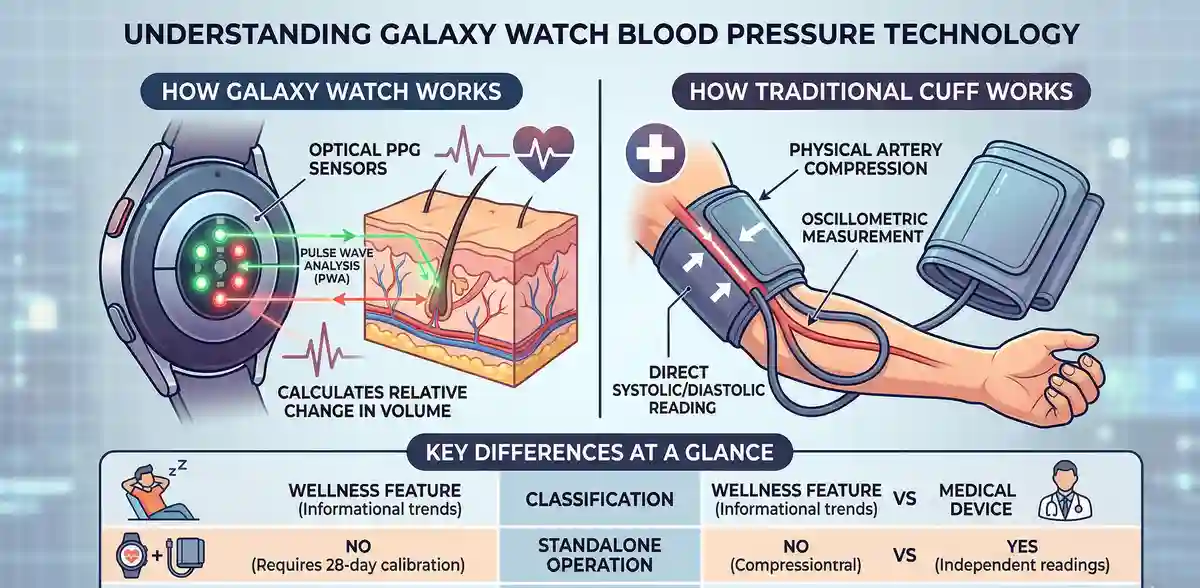
Unlike a traditional inflatable cuff that physically restricts blood flow to measure the pressure in your arteries (oscillometric method), your Galaxy Watch relies on optical sensors. Specifically, it uses Photoplethysmography (PPG) sensors built into the back of the watch casing.
These sensors shine an LED light into your skin and measure the amount of light reflected back. As your heart pumps blood, the volume of blood in the microvascular bed of your tissue changes, which in turn changes the light absorption. The smartwatch uses advanced algorithms to perform Pulse Wave Analysis (PWA), calculating the pulse transit time—the time it takes for the pulse wave to travel from your heart to your wrist.
While this technology is highly advanced, it cannot determine your absolute blood pressure from scratch. It can only measure the change in pressure over time. This brings us to the most significant caveat of the new feature.
The 28-Day Calibration Catch
Because the watch only measures relative changes in blood volume and pulse transit time, it requires a baseline to anchor its calculations. This means the Galaxy Watch cannot function as an independent, standalone [Internal Link: wearable blood pressure monitor].
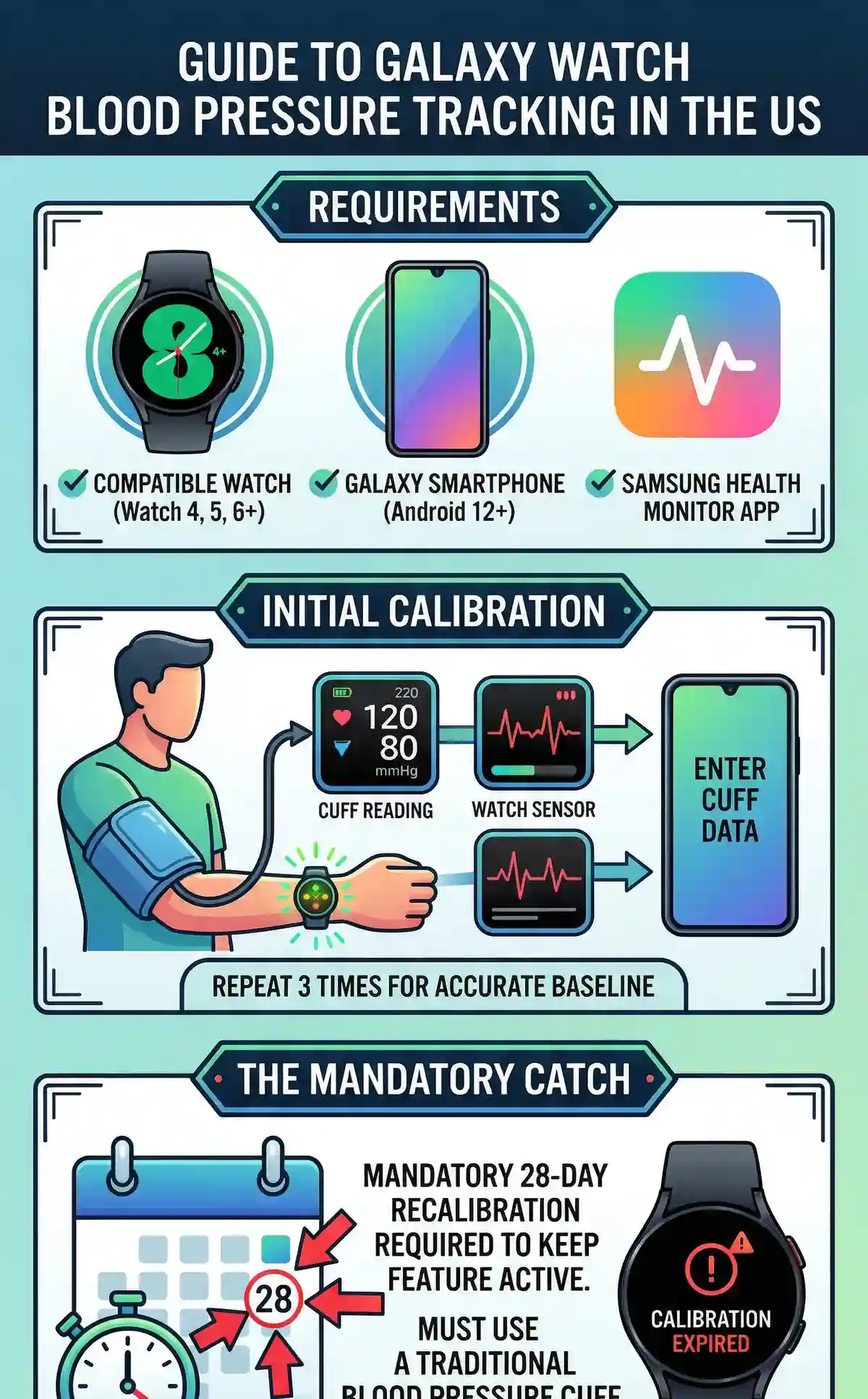
To use the feature, users are required to have an over-the-counter, traditional upper-arm blood pressure cuff. During the initial setup, you must take three simultaneous readings: one with the traditional cuff on your opposite arm, and one with the Galaxy Watch. You then manually enter the cuff’s precise systolic and diastolic readings into the companion application.
Furthermore, this calibration expires. To maintain accuracy, the system forces a mandatory recalibration every 28 days. If you fail to recalibrate using a traditional cuff, the watch will disable the blood pressure tracking feature until a new baseline is established.
“By classifying blood pressure tracking as a passive wellness feature rather than a diagnostic medical tool, wearable manufacturers can bring innovative tracking to consumers faster, albeit with mandatory calibration constraints.”
The Regulatory Loophole: Wellness vs. Medical Grade
How did Samsung finally manage to release this in the US after years of being stalled? The answer lies in terminology and software presentation. By labeling the tracking as a “wellness feature,” Samsung is clearly signaling to both consumers and regulators that the data is for informational and trend-tracking purposes only.
This approach echoes a similar workaround utilized by the fitness tracker maker Whoop last year. By avoiding claims that the device can diagnose, treat, or prevent hypertension, companies can navigate the complex landscape of health technology regulations. For more context on how authorities differentiate these tools, you can review the FDA digital health wellness guidelines.
Samsung has also announced that a “passive monitoring” update will arrive later this year, which will automatically track blood pressure trends in the background, providing users with a broader picture of their cardiovascular wellness without requiring them to initiate manual scans constantly.
Device Compatibility and Requirements
Not all Samsung wearables will benefit from this update. The rollout is specifically targeted at more modern hardware equipped with the necessary optical sensors and processing power.
Below is a breakdown of the hardware and software prerequisites required to activate this feature:
| Requirement Type | Specific Details |
|---|---|
| Smartwatch Hardware | Galaxy Watch 4, Watch 5, Watch 6, and newer models. |
| Watch Operating System | WatchOS 4.0 or higher. |
| Smartphone Compatibility | Must be a Samsung Galaxy smartphone (other Androids are excluded). |
| Phone Operating System | Android 12 or later. |
| Required Application | The latest version of the official companion application. |
Comparing the Wrist to the Cuff
To fully understand what you are getting with this new update, it helps to compare the smartwatch experience directly against the traditional medical cuff you will still need to keep in your bathroom cabinet.
| Feature | Galaxy Watch (Wellness App) | Traditional Medical Cuff |
|---|---|---|
| Measurement Method | Optical PPG sensors (Pulse Wave Analysis). | Oscillometric (Physical artery compression). |
| Portability | Extremely high (always on the wrist). | Low to Moderate (bulky, requires sitting down). |
| Diagnostic Capability | No (Informational trends only). | Yes (Used by medical professionals). |
| Standalone Function | No (Requires 28-day calibration). | Yes (Independent readings). |
How to Set Up Blood Pressure Tracking
If you meet all the hardware and software requirements, the setup process is relatively straightforward, though a bit time-consuming due to the mandatory calibration. First, ensure both your smartphone and smartwatch are updated to their latest respective firmware versions. The rollout is “phased,” meaning it might take a few weeks to appear for every eligible user in the US.
Open the designated health application on your paired Galaxy phone. You should see a new “Blood Pressure” widget. Tap it and carefully read the on-screen disclaimers. The app will then guide you through the calibration process. You will need to wrap your traditional cuff around your left arm and wear your smartwatch on your right wrist (or vice versa). You will run three separate tests, entering the numbers from the cuff into your phone each time to build the watch’s algorithm baseline. Once completed, you can take readings directly from your wrist for the next 28 days.
The Future of Wearable Vitals
The introduction of this feature to the US market marks a significant milestone in proactive personal health management. While the 28-day calibration requirement may feel cumbersome to some, the ability to effortlessly check cardiovascular trends while at the office, during a commute, or after a workout provides unparalleled convenience. As sensor technology and machine learning algorithms continue to advance, we may eventually see true, cuffless blood pressure monitoring. Until then, Samsung’s phased rollout is a welcome, albeit compromised, victory for wearable enthusiasts.
Frequently Asked Questions
Which Galaxy Watch models support blood pressure tracking in the US?
The feature is available on the Galaxy Watch 4, Galaxy Watch 5, Galaxy Watch 6, and newer models running at least WatchOS 4.0.
Do I need a Samsung phone to use the blood pressure feature?
Yes. Currently, the necessary companion application is exclusively supported on Samsung Galaxy phones running Android 12 or later. It will not work if your watch is paired with a non-Samsung Android device.
Why do I need a traditional cuff if the watch tracks blood pressure?
The smartwatch uses optical sensors to measure relative changes in blood flow, not absolute pressure. The traditional cuff provides the baseline numbers the watch needs to calculate your readings accurately.
How often do I need to recalibrate my Galaxy Watch?
You are required to recalibrate the smartwatch using a traditional blood pressure cuff every 28 days. If you miss this window, the feature will lock until recalibration is complete.
Is the Galaxy Watch blood pressure monitor FDA approved?
No. Samsung is offering this as a “wellness feature” rather than an FDA-cleared diagnostic medical device. It is intended for tracking personal trends, not for medical diagnosis.
Can I use this feature to alter my hypertension medication?
Absolutely not. You should never change your medication, diet, or health routines based on smartwatch wellness readings without first consulting a licensed healthcare professional.
When will the passive tracking update be available?
Samsung has stated that a passive monitoring feature, which allows the app to track blood pressure trends automatically in the background, will be added “later this year.”
Disclaimer: This article is for informational purposes only. The wellness features discussed are not intended to diagnose, treat, cure, or prevent any disease or medical condition. Always consult with a qualified healthcare provider for medical advice and before making any changes to your health regimen.