samsung galaxy s26 vs google pixel 10 the big differences between each flagship
The most affordable Samsung and Google flagship models are closer than ever in 2026, but that distinct $100 price difference does carve out a few major dividing lines between the two powerhouses. Samsung recently announced the Galaxy S26 at its Unpacked event, giving the base model a substantial battery boost but hiking its starting price by $100 over the previous iteration. This strategic move comes at a fascinating time when Samsung’s closest Android rival, Google, is actively bridging the gap between its base and Pro models. The tech giant added a dedicated telephoto camera to its latest-generation Pixel 10, effectively allowing the baseline Pixel 10 to reach the Galaxy S26’s camera versatility.
Both devices boast a 6.3-inch screen, three highly capable cameras on the rear, and exclusive software features, all while sharing the latest Android 16 perks. For example, both leverage Quick Share’s new ability to seamlessly send photos and files over AirDrop to Apple devices. However, the Google Pixel 10 undercuts its Samsung rival by $100, though it comes with half the storage, starting with 128GB. Is it worth saving the $100, or does the new Galaxy S26 base storage and feature set deserve its new premium price tag? Let us dive into this flagship smartphone comparison 2026 style to find out.
Design, Build, and Display Experience
Both Samsung and Google phones share the exact same display size but offer a remarkably different user experience right out of the box. The Galaxy S26 feels instantly more immersive due to its incredibly thin bezels, creating an almost edge-to-edge viewing canvas. On the flip side, the Pixel 10 wins the outdoor visibility test, getting significantly brighter in direct sunlight.
Durability is top-tier for both competitors. You will find an IP68 rating for dust and water resistance on each, and both are shielded by Gorilla Glass 2 Victus cover glass. Samsung’s $899 flagship phone features a stunning 6.3-inch AMOLED screen with a resolution of 2,340 by 1,080 pixels (at 411ppi). Conversely, the Pixel 10 packs a 6.3-inch OLED display with a resolution of 2,424 by 1,080 pixels (at 422ppi). While the latter has a slightly higher pixel density, the difference is virtually negligible in day-to-day use.
Where you will notice a difference is outdoor legibility. The Pixel 10 achieves a blistering 3,000 nits of peak brightness, outshining the S26’s 2,600 nits. Both phones support a buttery-smooth 120Hz high refresh rate. However, the Galaxy S26 features an LTPO panel that automatically dials down to 1Hz to be ultra-efficient during static tasks. The Google Pixel 10 can only drop to 60Hz, meaning its screen is inherently less battery-efficient.
| Feature | Samsung Galaxy S26 | Google Pixel 10 |
|---|---|---|
| Display Size & Type | 6.3-inch AMOLED (1-120Hz) | 6.3-inch OLED (60-120Hz) |
| Peak Brightness | 2,600 nits | 3,000 nits |
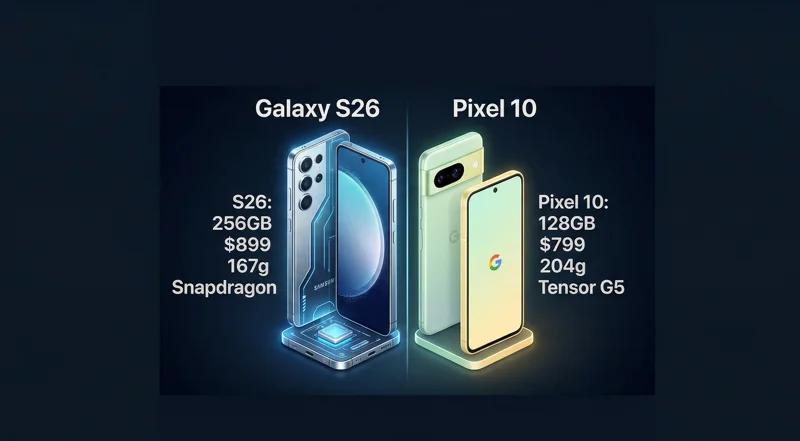
| Weight | 167 grams | 204 grams |
| Starting Price & Storage | $899 (256GB) | $799 (128GB) |
When it comes to ergonomics, the Galaxy S26 and Pixel 10 are considered compact phones by today’s massive standards. However, the S26 is definitively more pleasing to hold and comfortable to use for extended periods thanks to its lightweight design. At just 167 grams, it weighs considerably less than the chunky 204-gram Pixel 10. For context, Samsung’s massive S26 Ultra is just 10 grams heavier than Google’s standard phone. One advantage for Google, however, is that the Pixel 10 includes built-in magnets for attaching to wireless chargers and wallet accessories natively, whereas the S26 requires a specialized case to achieve the same magnetic utility.
The Camera Systems: AI Tricks and Hardware Upgrades
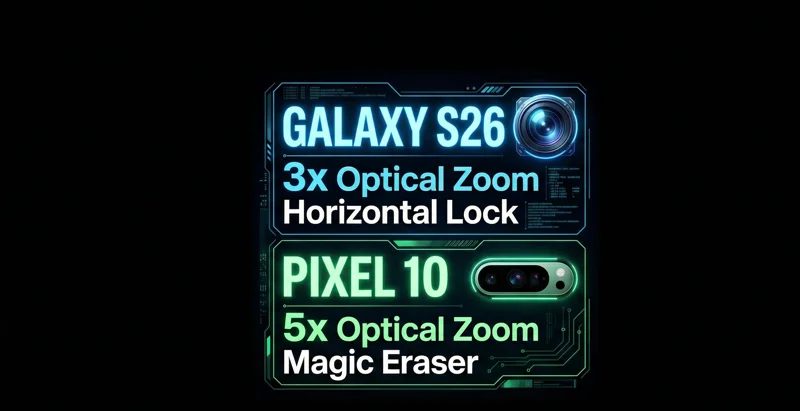
Both devices boast three rear cameras, accompanied by a heavy dose of AI processing. Samsung equips its model with a 50-megapixel wide, a 12-megapixel ultrawide, and a 10-megapixel 3x telephoto lens. The Pixel 10 counters with a 48-megapixel wide, a 13-megapixel ultrawide, and the highly anticipated 10.8-megapixel 5x telephoto camera.
You can expect exceptionally reliable performance from both. In broad daylight, shots are crisp, vibrant, and feature excellent dynamic range.
“For no apparent hardware improvements, the shots taken on the S26 were still pretty stellar, proving software optimization is king.”
The new Pixel 10 telephoto camera is a massive leap for Google’s base model, bringing a 5x optical zoom that finally levels the playing field against Samsung’s traditional zooming dominance. While some reviewers note the Pixel’s 5x lacks minute details in the deepest shadows compared to optical equivalents, it preserves incredible textures, like the ombre petals of roses or the sharp ridges of hydrangea leaves.
| Camera Spec | Samsung Galaxy S26 | Google Pixel 10 |
|---|---|---|
| Main (Wide) | 50-megapixel | 48-megapixel |
| Ultrawide | 12-megapixel | 13-megapixel |
| Telephoto | 10-megapixel (3x Optical) | 10.8-megapixel (5x Optical) |
| Special Features | Horizontal Lock Stabilization | AI-assisted Magic Eraser |
Samsung also introduced gimbal-like stabilization with a new “Horizontal Lock” feature on the Galaxy S26 series, offering incredibly steady videos in chaotic environments. While Google offers a similar suite of AI features, many users find them to be fun party tricks rather than essential daily tools, aside from the excellent AI-assisted Magic Eraser.
Battery Life and Processing Power
Both brands recognized the need for endurance and gave their small flagship models a battery boost. The Galaxy S26 features a 4,300-mAh battery (up from 4,000-mAh), while the Pixel 10 packs a massive 4,970-mAh cell (up from 4,700-mAh). Despite the size difference, both will easily last an entire day on moderate use. Surprisingly, the S26 performs slightly better in battery drain tests due to its highly efficient screen and chipset.
Snapdragon 8 Elite Gen 5 vs Tensor G5
The performance debate is highlighted by the clash of the titans: Snapdragon 8 Elite Gen 5 vs Tensor G5. The Samsung Galaxy S26 is powered by Qualcomm’s Snapdragon 8 Elite Gen 5, specifically optimized for Galaxy AI. The Pixel 10 relies on Google’s custom in-house Tensor G5 chipset. In raw metrics like Geekbench 6.0 and 3DMark Wild Life Extreme, the S26 consistently scores higher. If you are a heavy mobile gamer pushing 3D graphics, the Galaxy S26 remains the superior choice.
| Hardware | Samsung Galaxy S26 | Google Pixel 10 |
|---|---|---|
| Battery Capacity | 4,300-mAh | 4,970-mAh |
| Chipset | Snapdragon 8 Elite Gen 5 | Google Tensor G5 |
| Gaming Performance | Excellent (Higher 3DMark Scores) | Good (Optimized for AI tasks) |
Software Ecosystem: One UI vs. Pixel UI
Both the Galaxy S26 and Pixel 10 are launching with Android 16 software updates out of the box. Both companies also commit to a phenomenal seven years of OS and security updates. However, the user interface philosophies are worlds apart. The Galaxy S26 runs a highly customizable One UI, whereas the Pixel 10 delivers the core, clean Android experience devoid of third-party bloatware.
Power users often lean towards Samsung’s One UI due to modules like Good Lock, which allows for deep system customization, transparent widgets, and tailored gesture controls. Conversely, Pixel UI lovers praise its fluid, minimalist aesthetic and features like “Magic Cue,” which proactively surfaces contextual information precisely when you need it.
The Verdict: The $100 Truth About Storage
The true deciding factor for many buyers is the storage value. The Google Pixel 10 might technically be $100 cheaper, starting at $799, but that is only for the 128GB model. If you wish to upgrade to 256GB on the Pixel, the price jumps to $899—exactly the starting price of the Galaxy S26, which includes 256GB as its base storage.
“In my opinion, 256GB of storage is a nonnegotiable in 2026, especially when considering how these phones capture higher-quality, massive photo and video files that quickly clog up 128GB.”
If you value a clean, straightforward Android experience, the Pixel 10 is fantastic. To explore more about Google’s latest offerings, you can visit the Official Google Store. However, if you want a lighter phone, better gaming performance, and double the baseline storage for your money, the Samsung Galaxy S26 is arguably the smarter investment.
Frequently Asked Questions (FAQs)
Which phone has better battery life, the Galaxy S26 or Pixel 10?
Despite the Pixel 10 having a larger battery capacity (4,970-mAh), the Galaxy S26 (4,300-mAh) often performs slightly better in endurance tests due to its highly efficient LTPO display and Snapdragon processor.
Does the base Pixel 10 have a telephoto lens?
Yes, for the first time, Google has included a dedicated 10.8-megapixel 5x optical telephoto lens on the base Pixel 10 model, bridging the gap with the Pro versions.
How much base storage does the Galaxy S26 come with?
The Samsung Galaxy S26 comes with a minimum of 256GB of base storage for its $899 starting price.
Are both phones waterproof?
Yes, both the Samsung Galaxy S26 and the Google Pixel 10 feature an IP68 rating, making them highly resistant to dust and water submersion.
Which phone is better for mobile gaming?
The Galaxy S26 is superior for high-end 3D gaming, thanks to the raw processing power of the Qualcomm Snapdragon 8 Elite Gen 5 chipset.
How long will these phones receive software updates?
Both Samsung and Google have committed to providing seven years of Android OS and security updates for the Galaxy S26 and Pixel 10, ensuring exceptional longevity.
Does the Galaxy S26 have built-in magnets for wireless chargers?
No, unlike the Pixel 10 which features built-in magnets natively, the Galaxy S26 requires a specialized magnetic case to attach seamlessly to magnetic accessories.
Disclaimer: This article is for informational purposes only. Prices, specifications, and hardware details are based on available data and reviews as of 2026. Please verify with official manufacturer websites before making a purchasing decision.