The tech industry is bracing for a massive shift as insiders adopt a specific phrase to describe the upcoming hardware war: pull the rug out mark gurman explains apples plan to launch smart glasses this year to stop metas momentum. As we navigate through 2026, the wearable technology market has seen a surge in popularity, largely driven by the unexpected success of Meta’s Ray-Ban collaboration. However, after years of intense speculation, Tim Cook and the Apple engineering team are finally ready to step into the arena, targeting a September or October announcement that could change the wearable landscape forever.
Rather than jumping straight into complex augmented reality displays like the Vision Pro, Apple is reportedly taking a more strategic, foundational approach. By focusing on audio, camera integration, and advanced artificial intelligence, the Cupertino giant aims to disrupt the holiday buying cycle and establish its dominance in a market that Meta has comfortably ruled over the last couple of years.
“If you’re Apple, you really want these to be introduced before the holiday season, because you don’t want one more cycle for Meta to get momentum selling these glasses.”
Launch Strategy and the Meta Rivalry
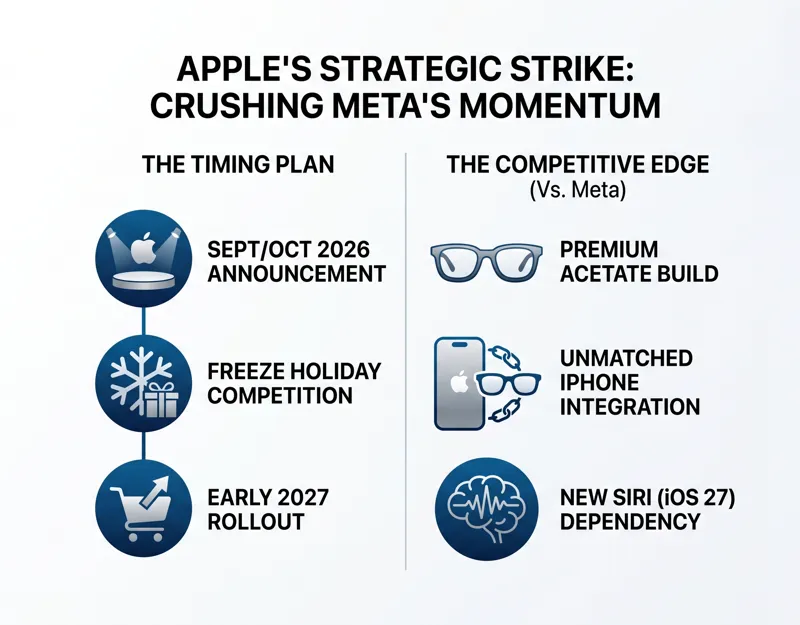
The timing of Apple’s entry is no accident. With competitors like Google and brands such as Warby Parker preparing their own smart eyewear for the end of the year, Apple needs a definitive countermove. The plan involves a high-profile announcement this fall, even if the actual consumer rollout doesn’t happen until early 2027. This strategy is designed to make consumers pause their holiday purchases, effectively freezing Meta’s momentum by promising a superior, deeply integrated alternative on the horizon.
Furthermore, standard upgrades like the iPhone 18 Pro and the rumored iPhone Fold might not generate the massive investor excitement Apple desires. Introducing an entirely new product category—display-free Apple smart glasses—provides the necessary spark to ignite market enthusiasm and capture consumer imagination.
| Competitor | Expected Announcement | Display Type | Primary Assistant |
|---|---|---|---|
| Apple | September / October 2026 | Display-Free (Audio/Camera) | New Siri (iOS 27) |
| Meta (Ray-Ban) | Currently Available | Display-Free | Meta AI |
| Google / Samsung | Late 2026 | Android XR | Gemini |
Premium Build and Unmatched Integration
Apple rarely enters a market without intending to set the standard for premium build quality, and their smart glasses will be no exception. Moving away from the basic plastics used by competitors, Apple has reportedly opted for high-end acetate, ensuring the frames feel luxurious and durable. Current leaks suggest the company has developed at least four distinct styles, offering sophisticated color palettes including ocean blue, light brown, and classic black.
However, the true selling point will be the ecosystem. The seamless handshake between an iPhone and Apple smart glasses is something third-party manufacturers simply cannot replicate. From effortless pairing to integrated notification management, the Apple ecosystem will transform these glasses into the ultimate iPhone accessory.
“While the iPhone is compatible with competing wearables, no third-party product is going to play as nicely with the iPhone as smart glasses developed by Apple.”
Visual Intelligence and Daily Use Cases
Without a heads-up display, how will these glasses actually function? The magic lies in audio feedback combined with spatial camera context, often referred to as Visual Intelligence. Powered by proprietary Apple silicon, these glasses will allow users to seamlessly capture high-resolution photos and videos. More importantly, they will actively read the user’s environment. For more insights on tech industry movements, you can follow Bloomberg Technology News.
Imagine walking down a busy city street. Instead of simply hearing “turn left in 400 feet,” the built-in cameras recognize your surroundings, allowing the assistant to say, “turn left by the gray hotel.” Additionally, smart visual reminders could alert you to pick up specific items as soon as your glasses spot them on a store shelf.
| Hardware Feature | User Benefit / Use Case |
|---|---|
| Premium Acetate Frames | High durability and luxury aesthetic compared to standard plastic. |
| Context-Aware Cameras | Advanced turn-by-turn directions using visual landmarks. |
| Built-in Spatial Audio | Discreet notification reading and hands-free phone calls. |
The Siri Factor: A Make-or-Break Moment
The success of this entire endeavor hinges on one critical, historically problematic element: Siri. Apple glasses without a highly intelligent, responsive voice assistant are essentially just standard sunglasses with a camera. Apple has promised a smarter Siri since the launch of the iPhone 16, but significant delays have plagued its rollout.
Now, reports indicate that iOS 27 will finally introduce the long-awaited Siri overhaul, potentially infused with Google’s Gemini intelligence to catch up with market leaders. This new iteration will act more like an advanced chatbot, utilizing a new “extensions” feature to allow third-party AI interfaces to function within the Apple ecosystem.
“They need to get this new Siri out the door in order to make these smart glasses functional or usable in any proper way.”
Expanding the Wearable Ecosystem
Recognizing that smart glasses might not appeal to everyone, Apple is aggressively expanding its AI wearables portfolio. Alongside the glasses, the company is reportedly developing AirPods equipped with infrared (IR) cameras to measure surroundings, as well as an AI-powered pendant. Apple is throwing everything but the kitchen sink at the wearable market in 2026 to ensure they do not miss out on the next major wave of consumer technology.
| Upcoming Apple Wearables | Core Functionality |
|---|---|
| Apple Smart Glasses | Visual intelligence, photo capture, audio navigation. |
| Camera-Equipped AirPods | IR environmental scanning for contextual spatial audio. |
| AI Pendant | Screenless, voice-activated AI assistance on the go. |
Frequently Asked Questions

Will the first Apple smart glasses have a screen inside the lenses?
No, Apple is reportedly launching display-free glasses first, focusing on audio, camera capabilities, and AI assistance similar to Meta’s Ray-Ban glasses.
When are the Apple smart glasses expected to be announced?
Industry insiders expect Tim Cook to announce the glasses around September or October of 2026, though they may not ship until early 2027.
What material will the Apple smart glasses be made of?
The glasses will reportedly feature premium acetate frames rather than standard plastic, offering a more luxurious and durable build.
Using onboard cameras and Visual Intelligence, the glasses will provide context-aware audio directions, such as telling you to turn at a specific landmark rather than just giving distances.
What operating system update is required for the new Siri?
The highly anticipated, revamped version of Siri is expected to launch with iOS 27, which is crucial for the functionality of the smart glasses.
Are Apple glasses the only wearable being developed?
No, Apple is also reportedly working on an AI pendant and new AirPods equipped with IR cameras to map the user’s surroundings.
Why is Apple announcing them before they are ready to ship?
The strategy is to generate hype and make consumers wait for the Apple product, thereby disrupting the holiday sales momentum of competitors like Meta and Google.
Disclaimer: This article is for informational purposes only. The details regarding unreleased Apple products, including smart glasses, iOS updates, and launch timelines, are based on industry rumors and expert analysis, and are subject to change by the manufacturer.