
PS5 price tags are officially skyrocketing, sending shockwaves through the gaming community as Sony announces its second major cost increase in less than a year. The 2026 console market is currently facing an unprecedented storm of economic instability, ranging from aggressive new U.S. trade tariffs to a devastating geopolitical crisis in the Middle East. As semiconductor supply chains buckle under the weight of a severe helium shortage caused by attacks on Qatar’s natural gas facilities, gamers are the ones footing the bill for the PlayStation 5, the Digital Edition, and the high-end PS5 Pro.
The 2026 Console Shock: Unpacking the New Costs
For gamers hoping to upgrade their living room entertainment setups this year, the financial barrier to entry has just been raised significantly. By the end of next week, the cost of acquiring a Sony PlayStation will be approximately 30 percent higher than it was at this exact time last year. This drastic inflation is a direct result of compounding international crises converging on the consumer electronics sector.
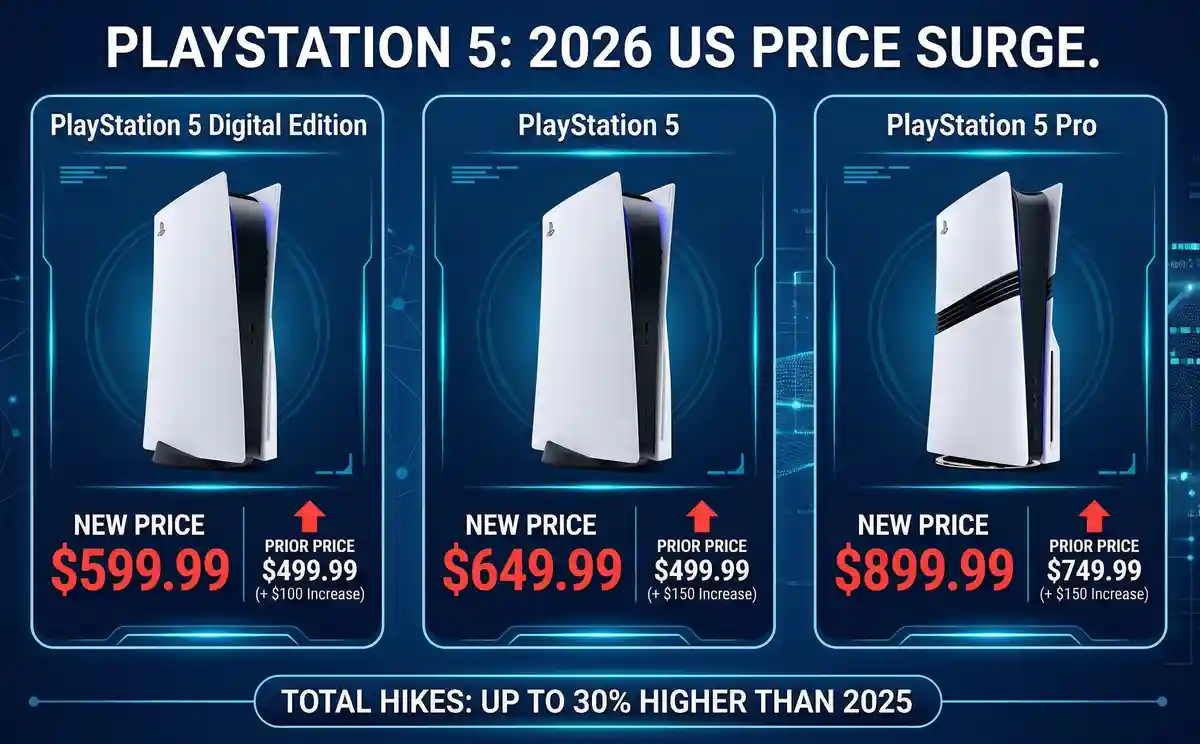
According to the latest announcements from the Japanese tech giant, the standard edition of the PlayStation 5, which includes the physical disc drive, will now retail for a staggering $649.99 in the United States. This represents a clean $100 increase. The Digital Edition, favored by those who prefer to download their libraries exclusively, has not been spared either, seeing a parallel $100 bump to reach $599.99. However, the most severe blow has been dealt to the enthusiast market. The premium PS5 Pro, designed to push the boundaries of current-generation graphical fidelity, is being hit with an eye-watering $150 markup, bringing its new retail price to $899.99.
| Console Model | Previous Price (USD) | New 2026 Price (USD) | Total Increase |
|---|---|---|---|
| PlayStation 5 Digital Edition | $499.99 | $599.99 | +$100.00 |
| PlayStation 5 Standard Edition | $549.99 | $649.99 | +$100.00 |
| PlayStation 5 Pro | $749.99 | $899.99 | +$150.00 |
This is not an isolated incident confined to North American borders. The company has implemented similar price hikes across other major regions, including the United Kingdom, broader Europe, and its native Japan. This global pricing adjustment underscores the reality that the pressures Sony is facing are not regional anomalies, but rather symptoms of a fractured global supply chain.
The Domino Effect: U.S. Tariffs and Global Economics
To understand why a video game console is suddenly experiencing hyperinflation, one must look beyond the gaming industry and analyze the broader global economic landscape. One of the primary drivers of this price surge is the recent implementation of aggressive U.S. tariffs. These trade barriers, imposed on all of the nation’s trading partners, have upended traditional global trade routes. Tariffs act as a direct tax on imported goods, and when hardware is manufactured overseas and shipped to American ports, those increased border costs are inevitably passed down to the end consumer.
Sony had already attempted to absorb some of the initial macroeconomic shocks. Just last August, the company bumped up the price of the PlayStation by $50. However, the sheer volume of these new economic penalties has proven too vast for corporate margins to swallow entirely. In addressing the deeply unpopular move, Sony published a statement on its official blog, citing these relentless pressures.
“We know that price changes impact our community, and after careful evaluation, we found this was a necessary step to ensure we can continue delivering innovative, high-quality gaming experiences to players worldwide.”
While the corporate phrasing points to a necessity for innovation, the reality for consumers is much starker. The cost of raw materials, international shipping, and cross-border taxation has created an environment where manufacturing complex consumer electronics is more expensive than it has been in decades.
The Hidden Crisis: Helium, Semiconductors, and the Middle East
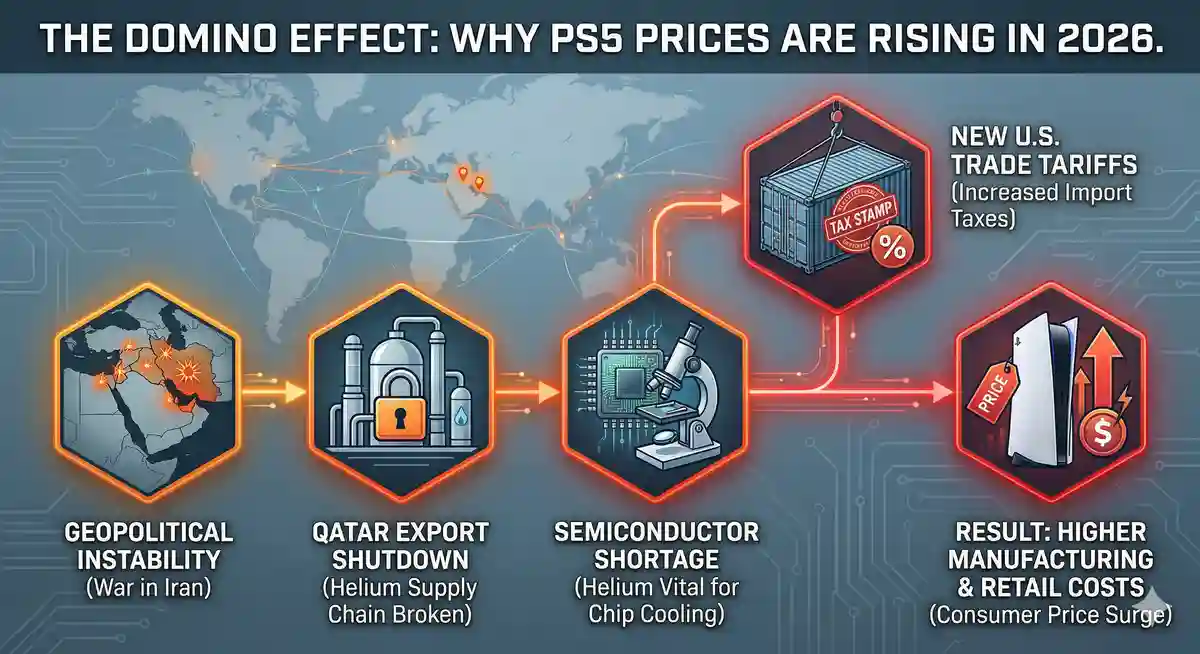
While tariffs play a massive role in the economic strain, there is a much more volatile catalyst at play that Sony did not explicitly name in its consumer-facing blog post: geopolitics and the raw materials essential for tech manufacturing. The ongoing war in Iran, which has entered its fourth week, has created a massive bottleneck for energy and manufacturing supplies worldwide. This conflict has spilled over into the broader region, directly threatening the core ingredients required to build modern electronics.
Specifically, an attack launched last week on Qatar’s natural gas export facility forced a complete shutdown of operations. While natural gas disruptions primarily impact global energy grids, this specific shutdown has a secondary, devastating effect on the technology sector. Qatar is not just a hub for natural gas; it is a vital producer of helium. According to data from the U.S. Geological Survey (USGS), Qatar supplies roughly one-third of the world’s helium.
Why Helium is Crucial for Gaming Consoles
For the average person, helium is mostly associated with floating party balloons and blimps. However, in the high-stakes world of semiconductor manufacturing, helium is an absolutely critical element. The production of computer chips—the “brains” that power everything from the PS5 to your smartphone—requires incredibly precise, highly controlled environments. Helium is used extensively in semiconductor fabrication plants (fabs) to control the temperature of silicon wafers during the manufacturing process. Its unique thermal properties allow it to rapidly cool the components without reacting chemically with the sensitive materials.
Qatar’s state-owned gas company confirmed that the facility shutdown would slash its helium exports by 14 percent. In an industry that operates on tight, just-in-time supply chains, a 14 percent drop in a raw material that makes up a third of the global supply is catastrophic. Lower supply intrinsically means higher prices. Industry analysts warn that if the regional war drags on for months or longer, the cost of helium—and by extension, the semiconductors required to build PlayStation 5 motherboards—will continue to spiral out of control.
| Supply Chain Factor | Current 2026 Status | Impact on Consumer Electronics |
|---|---|---|
| Global Helium Supply | Reduced by 14% (Qatar facility shutdown) | Spikes cost of semiconductor cooling processes |
| U.S. Trade Tariffs | Active against all trading partners | Increases import taxes passed to consumers |
| Manufacturing Output | Bottlenecked by energy strains | Limits console stock, driving up base value |
Sony’s Profit Margins vs. Consumer Pain
The bitter pill for many consumers to swallow is the juxtaposition of these massive price hikes against Sony’s overall financial health. While the company points to external supply chain pressures and tariff costs to justify the $100 to $150 increase on hardware, their recent earnings reports tell a story of immense corporate success. Just last month, Sony reported that its profit in the October-December quarter surged by an impressive 11 percent, reaching 377.3 billion yen (roughly $2.4 billion USD).
This massive influx of capital prompted the Japanese entertainment and electronics conglomerate to aggressively raise its full-year profit forecast to 1.13 trillion yen ($7.2 billion USD). For the gamer standing at the retail counter, asked to pay nearly $900 for a PS5 Pro, the knowledge that the manufacturer is enjoying record profitability feels deeply contradictory. It raises complex questions about corporate responsibility during periods of global inflation. Are these price hikes solely to offset the cost of helium and tariffs, or are they a strategic maneuver to protect and inflate record-breaking profit margins at the expense of player accessibility?
What This Means for the Global Gaming Industry
The PlayStation brand celebrated its 30th anniversary in North America and Europe last year, marking three decades of dominance in the living room entertainment space. However, this new pricing paradigm threatens to shift the demographics of who can actually afford to participate in the console ecosystem. Historically, consoles were marketed as the affordable, accessible alternative to expensive PC gaming rigs. At $899.99 for a PS5 Pro, that gap is closing rapidly.
Furthermore, Sony’s move sets a dangerous precedent for the broader industry. If the market leader can successfully implement two major price hikes in a single year without suffering a catastrophic loss in market share, competitors may feel emboldened to follow suit. The pressures of the helium shortage and U.S. tariffs apply equally to all hardware manufacturers. It is highly likely that the entire landscape of consumer electronics, from rival consoles to graphics cards and mobile devices, will experience a similar upward trajectory in pricing throughout the remainder of 2026.
As the global economic landscape remains fractured and geopolitical tensions in the Middle East continue to threaten essential semiconductor resources, the era of cheap, easily accessible high-end gaming hardware may be temporarily coming to an end. Gamers will need to brace themselves for a market where “next-generation” experiences come with a truly premium price tag.
Frequently Asked Questions
How much is the PS5 price going up in 2026?
Sony is raising the price of the standard PS5 and the Digital Edition by $100, bringing them to $649.99 and $599.99, respectively. The PS5 Pro is increasing by $150 to $899.99.
Why is Sony raising the cost of the PlayStation 5 again?
Sony officially cited “continued pressures in the global economic landscape.” This encompasses the rising costs of manufacturing, global energy bottlenecks, and increased cross-border taxation.
How do U.S. tariffs affect the cost of gaming consoles?
The U.S. recently imposed tariffs on all trading partners. These import taxes increase the cost of bringing electronics manufactured overseas into the American market, a cost that is subsequently passed down to the buyer.
What does helium have to do with the PlayStation supply chain?
Helium is an essential gas used to regulate temperatures during the manufacturing of semiconductors (computer chips). Without adequate helium, fabricating the chips that power the PS5 becomes drastically more expensive or impossible.
Why is there a global helium shortage right now?
An ongoing war in Iran led to an attack on a natural gas facility in Qatar, forcing it to shut down. Because Qatar supplies roughly one-third of the world’s helium, this shutdown slashed global helium exports by 14 percent.
When do these new Sony console prices take effect?
According to the announcement, the new price points for all PlayStation 5 models will officially take effect “next Thursday.”
Are other regions outside the U.S. affected by this hike?
Yes. Sony has confirmed that parallel price increases are being implemented globally, affecting markets including the United Kingdom, Europe, and Japan.
Disclaimer: This article is for informational purposes only. Economic data, pricing, and geopolitical supply chain impacts are based on current 2026 reports and are subject to change as global conditions evolve.