Porting Half-Life Alyx to Steam Frame How Valves Engineers Went from Theres No Way to Shipping Standalone is one of the most remarkable engineering stories in modern VR history. When Valve first discussed bringing a high-end showcase like Half-Life: Alyx to an ARM-based standalone headset, internal sentiment was deeply skeptical. However, as engineers experimented with the hardware, Porting Half-Life Alyx to Steam Frame How Valves Engineers Went from Theres No Way to Shipping Standalone transformed from an impossible dream into a shipping reality.
Introduction to Porting Half-Life Alyx to Steam Frame How Valves Engineers Went from Theres No Way to Shipping Standalone
The journey behind Porting Half-Life Alyx to Steam Frame How Valves Engineers Went from Theres No Way to Shipping Standalone required overcoming immense technical boundaries. Originally, Alyx was built by overinvesting resources without performance compromises for desktop PCs. Bringing this experience to standalone hardware meant rethinking optimization entirely.
When analyzing Porting Half-Life Alyx to Steam Frame How Valves Engineers Went from Theres No Way to Shipping Standalone, experts note that hardware advancements played a pivotal role. The inclusion of 16GB of RAM and sophisticated tracking opened new doors for developers.
This is never going to work – until brilliant engineering and open-source drivers changed the narrative completely.
The Technical Challenges of Porting Half-Life Alyx to Steam Frame How Valves Engineers Went from Theres No Way to Shipping Standalone
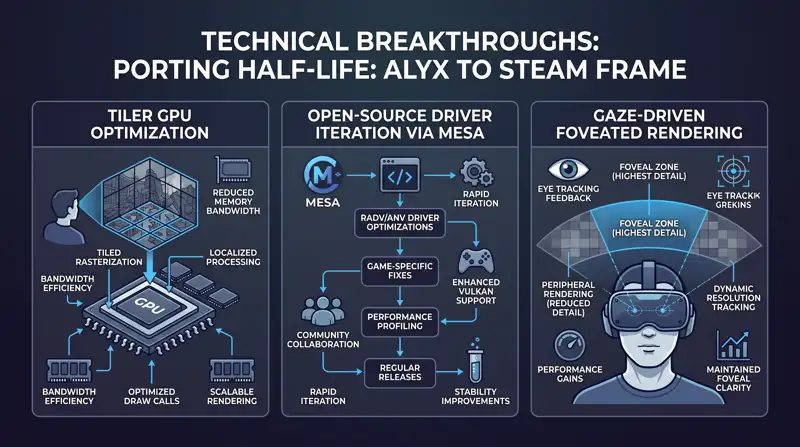
A major hurdle in Porting Half-Life Alyx to Steam Frame How Valves Engineers Went from Theres No Way to Shipping Standalone was the GPU architecture difference. Desktop GPUs use immediate-mode rendering, whereas the Steam Frame relies on a tiler GPU. This required a grueling year-and-a-half software audit to resolve countless micro-inefficiencies.
Furthermore, Porting Half-Life Alyx to Steam Frame How Valves Engineers Went from Theres No Way to Shipping Standalone relied heavily on open-source drivers. These tools allowed Valve engineers to iterate rapidly, testing fixes within minutes rather than weeks.
| Challenge | Desktop Standard | Steam Frame Solution |
|---|---|---|
| GPU Renderer | Immediate-mode | Optimized for tiler architecture |
| Driver Stack | Closed vendor cycles | Rapid open-source Mesa iteration |
| Memory Limits | High VRAM capacity | Managed via 16GB unified RAM |
The Secret Sauce: Foveated Rendering and Eye Tracking
Eye tracking served as the shining star for Porting Half-Life Alyx to Steam Frame How Valves Engineers Went from Theres No Way to Shipping Standalone. Without gaze-driven foveated rendering, the project would have been unshippable on mobile silicon.
By leveraging fragment density maps, engineers successfully focused processing power precisely where the player was looking, maintaining visual fidelity without sacrificing frame rates.
| Feature | Technology | Impact |
|---|---|---|
| Gaze Tracking | Eye-tracking sensors | Drives foveated rendering accurately |
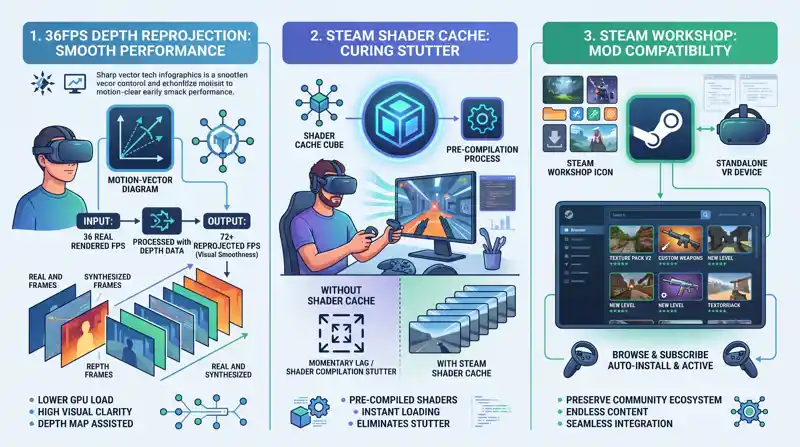
| Frame Rate | 36fps baseline | Enhanced smoothly via depth reprojection |
| Shader Caching | Steam Shader Cache | Eliminates stutter during gameplay |
Foveated rendering and eye tracking were the absolute silver bullet that made this native port possible.
Preserving Community Content and Workshop Compatibility
A crucial philosophical choice during Porting Half-Life Alyx to Steam Frame How Valves Engineers Went from Theres No Way to Shipping Standalone was refusing to alter game content. Modders and creators rely heavily on the Half-Life: Alyx Workshop.
By keeping the core content untouched, Valve ensured that community-made levels and mods continued to work seamlessly, preserving the ecosystem’s vibrant community spirit.
| Asset Type | Compatibility Status | Ecosystem Benefit |
|---|---|---|
| Steam Workshop Mods | Fully Supported | No creator rework needed |
| Cloud Saves | Cross-Platform | Syncs between PC and standalone |
| Controller Input | Adapted Translation | Maintains familiar ergonomics |
The Broader Industry Impact of Porting Half-Life Alyx to Steam Frame How Valves Engineers Went from Theres No Way to Shipping Standalone
The success of Porting Half-Life Alyx to Steam Frame How Valves Engineers Went from Theres No Way to Shipping Standalone proves that native standalone hardware can achieve staggering visual fidelity. Developers can learn more about hardware specs and developer tools directly via Steam Official Portal for ongoing updates.
Ultimately, this milestone challenges the entire gaming industry to push mobile and standalone platforms far beyond previously accepted limitations.
| Metric | Previous Belief | New Reality |
|---|---|---|
| Standalone Fidelity | Low-poly mobile games only | High-end PC AAA native execution |
| Driver Optimization | Months of vendor delay | Minutes via open-source Mesa stack |
| Expectation Setting | Accept hardware limits | Challenge and surpass old limits |
We had decided there were limits on what we could do, but they became inaccurate – we weren’t challenging ourselves enough.
Conclusion
In summary, Porting Half-Life Alyx to Steam Frame How Valves Engineers Went from Theres No Way to Shipping Standalone represents a monumental shift in VR engineering. Through relentless software grinding, open-source driver mastery, and innovative foveated rendering, Valve has set a new benchmark for standalone virtual reality gaming.
Frequently Asked Questions
What is the main achievement of Porting Half-Life Alyx to Steam Frame How Valves Engineers Went from Theres No Way to Shipping Standalone?
Bringing a high-end PC VR flagship game to run natively on a standalone ARM headset.
How was performance maintained during Porting Half-Life Alyx to Steam Frame How Valves Engineers Went from Theres No Way to Shipping Standalone?
Through eye tracking, foveated rendering, depth reprojection, and extensive driver optimizations.
Did Valve change the original game content for the headset?
No, Valve chose not to alter content to preserve full compatibility with Steam Workshop mods.
What role did open-source drivers play in the port?
They allowed engineers to test and iterate fixes within minutes instead of waiting weeks.
What frame rate does the game target on the headset?
It runs natively at 36fps and utilizes advanced depth reprojection for smooth visuals.
Does community content work on the standalone version?
Yes, Workshop levels and mods work without requiring creators to change their files.
What does this mean for future VR titles?
It proves developers can push standalone hardware much further than previously thought possible.
Disclaimer: This article is for informational purposes only and details the engineering achievements behind the Steam Frame hardware release.