
SEO Title Target: Google Pixel 10a Review: Specs, Flat Design, and 2026 Price
Clickbait Title Target: Google Just Killed the Camera Bump\! Why the Pixel 10a is the ONLY Budget Phone You Need\!
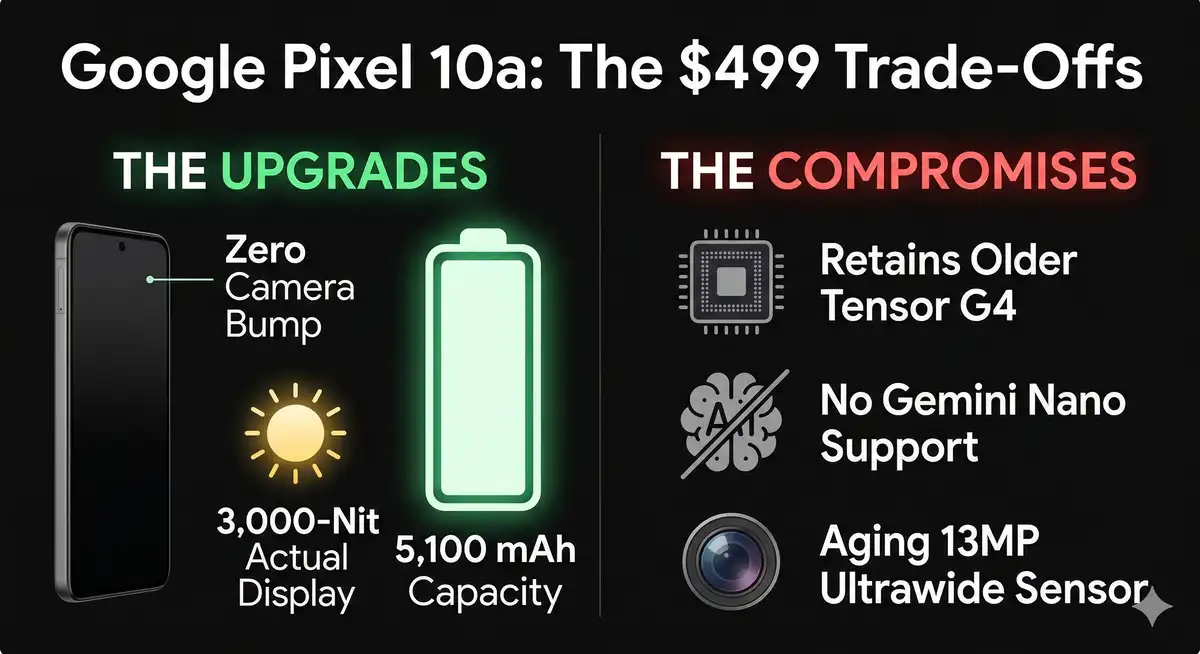
The Pixel 10a is officially here, and it has accomplished what many thought was impossible in the modern smartphone era: it completely eliminated the camera bump. For years now, smartphone makers have made the camera housings on devices bigger and bulkier in order to chase incremental photographic improvements. Even if that kind of aggressive design makes cameras technically better, at times it creates frustrating usability issues, such as the dreaded “table wobble” when trying to type on a flat surface. In 2026, Google has listened to consumer feedback and taken a radically new approach. By entirely removing the protruding lenses, they have crafted a perfectly flat phone that lies completely flush on surfaces, fundamentally changing the ergonomic feel of the modern budget device.
The Revolutionary Flat Design and Aesthetic Choices
While the eradication of the camera bump is a delightful and much-needed change in a world obsessed with massive rear lenses, Google hasn’t otherwise made drastic design overhauls with its newest budget smartphone. If you place it face-up next to its predecessor, the lineage is obvious. The Pixel 9a looked mostly the same, albeit with a very small camera bump that has now been completely smoothed out.
Aesthetics are always a major selling point in the United States market, and Google has provided an interesting palette for this generation. While traditionalists might opt for the plain old black unit, Google offers the phone in several striking, modern colors designed to appeal to younger demographics and those looking for a pop of personality in their tech.
| Color Name | Description | Availability |
|---|---|---|
| Obsidian (Black) | The classic, professional plain old black unit. | All storage variants |
| Lavender | A vibrant, playful mix of bright blue and purple. | All storage variants |
| Berry | A warm, eye-catching coral hue. | All storage variants |
| Fog | A sophisticated, muted gray-green tone. | All storage variants |
Build quality is where we start to see the compromises necessary to hit the aggressive $499 price tag. Build and specification-wise, this device goes toe-to-toe with the standard flagship, with a few key differences in material science. For instance, the premium model utilizes the highly durable Corning Gorilla Glass Victus 2 on both the front and the back. In contrast, the cheaper “a” series variant utilizes a plastic back—which is lighter and less prone to shattering, though less premium to the touch—and utilizes Corning Gorilla Glass 7i protection exclusively on the front display.
With the Pixel 10a, Google took a new approach of entirely removing the camera bump and making a flat phone that lies completely on surfaces.
Actua Display: Brighter, Faster, and Smarter
The visual experience is arguably the most important aspect of any modern mobile device, and this is an area where this budget phone truly shines. The screen size of 6.3 inches remains identical to last year’s device, offering a comfortable middle ground between compact one-handed use and expansive media consumption. However, the underlying technology has seen a massive upgrade. The display is now significantly brighter, peaking at an astonishing 3,000 nits.
Google has successfully ported over the Actua display series of screens that it utilized with the more expensive flagship devices in the same lineup. This integration is crucial for users in the United States who spend time outdoors, as it makes the screen vastly more usable and legible in bright, direct sunlight conditions. Whether you are navigating via Maps on a sunny dashboard or reading articles on the beach, the brightness is a game-changer.
Another major talking point is the refresh rate. The display panel itself is highly capable, engineered to reach a buttery-smooth 120Hz refresh rate for fluid scrolling and enhanced gaming. However, there is a catch that new buyers must be aware of: the unit ships out of the box with the software artificially capped at 60Hz to preserve battery life. Therefore, power users will need to manually navigate through the phone’s display settings to unlock the full 120Hz potential.
| Display Specification | Pixel 10a Details | Comparison to Pixel 9a |
|---|---|---|
| Screen Size | 6.3 inches | Same (6.3 inches) |
| Panel Technology | Actua Display (OLED) | Standard OLED |
| Peak Brightness | 3,000 Nits | Significantly Lower |
| Refresh Rate | Up to 120Hz (Ships at 60Hz) | Up to 120Hz |
| Glass Protection | Corning Gorilla Glass 7i | Corning Gorilla Glass 3 |
Battery Life and Charging Capabilities
Battery endurance is frequently cited as a top priority for smartphone buyers, and this is perhaps the device’s greatest hidden strength. In a surprising twist, the budget device actually features a larger power cell than its premium standard sibling. It houses a massive battery of 5,100 mAh, as compared to the 4,970 mAh found on the base flagship model. (For context, the massive Pro XL version houses a 5,200 mAh battery).
This massive capacity, combined with the efficiency of the chipset and the 1080p resolution, means the battery lasts easily throughout the entire day. Even under moderate to heavy use—including navigating regular social media apps, a few hours of high-definition video watching, and light mobile gaming—the device rarely requires a midday top-up. Plus, the brighter display makes the device better for an all-around experience in different lighting conditions without crippling the battery percentage.
| Device Model | Battery Capacity | Wired Charging Speed | Wireless Charging Speed |
|---|---|---|---|
| Pixel 9a (Previous Gen) | \~4,492 mAh | 23W | 7.5W |
| Pixel 10a (Current) | 5,100 mAh | Up to 23W+ (Estimated) | 10W |
| Pixel 10 (Flagship) | 4,970 mAh | 30W via USB-C | 15W (Magnetic) |
| Pixel 10 Pro XL | 5,200 mAh | 30W+ via USB-C | Fast Wireless Supported |
While the battery capacity and battery life are phenomenal, the charging speeds represent another compromise. The flagship model charges at a brisk 30W through USB-C, which is a step up from previous generations. Wireless charging is also distinctly tiered across the lineup: it is supported at 7.5W for the older 9a, bumped up to a slightly more respectable 10W for this current budget model, and jumps to 15W (with magnetic alignment capabilities) for the premium flagship.
Performance, Hardware, and the Tensor Compromise
When analyzing the internal hardware, there are only small differences between the previous budget model, the current one, and the base flagship, but most of them have to do with raw performance metrics and compute power. The most obvious hardware difference that tech enthusiasts will immediately notice is the silicon running the show.
To maintain the budget-friendly price, this device uses the older Google Tensor G4 chip. This is the exact same processor that was utilized in the previous generation’s budget offering. In stark contrast, the premium tier models have moved on to the highly advanced Tensor G5 architecture. Because it utilizes the older chip, that means there are absolutely no raw performance gains this year regarding CPU or GPU benchmarks. You might notice this lack of generational leap if you are a heavy multitasker who frequently switches between a lot of demanding apps or plays graphically intensive 3D games.
Because of the older chip and its 8GB RAM combo, the Pixel 10a can’t run the updated Gemini Nano AI model, which means it has fewer on-device AI features.
This processor decision, paired with the device’s 8GB RAM combo, creates a significant bottleneck regarding the current tech industry’s biggest buzzword: Artificial Intelligence. Due to these hardware limitations, the phone physically cannot run the updated Gemini Nano AI model locally on the device. Consequently, it has noticeably fewer on-device AI features than its more expensive cousins.
Software and AI: What You Get and What You Miss
The inability to run the full Gemini Nano model means that budget-conscious buyers are missing out on some of Google’s most heavily advertised 2026 software innovations. If you are deeply invested in the cutting-edge of mobile AI, this might be the deciding factor in upgrading to the flagship tier.
| Feature Missing from the “a” Series | Functionality Description |
|---|---|
| Notification Summaries | AI-driven condensation of long notification stacks into brief, readable bullet points. |
| Advanced Screenshot App | AI categorization and contextual search of all device screenshots. |
| Magic Cue | A predictive feature that offers contextual suggestions seamlessly across integrated apps like Gmail, Messages, and Maps. |
| Call Notes & Translation | On-device real-time transcription, call summarization, and live language translation during voice calls. |
However, it is not all bad news on the software front. The phone still features a highly optimized, clean version of Android. Crucially, Google offers an industry-leading seven years of software updates with this device. This extended support window is crucial for receiving both major operating system updates, along with security patches and Feature Drops that keep the device feeling fresh long after purchase.
Notably, some server-side AI features might make it to this device eventually through a Pixel Drop. These are Google’s periodic software updates that often bring new capabilities to older or budget models without relying entirely on local hardware compute. Furthermore, while this is not an exclusive feature to this specific tier, the phone boasts a newly updated Quick Share feature that now works seamlessly with Apple’s AirDrop protocol. This is a massive win for cross-platform compatibility in the US market, meaning users can simply transfer high-res photos and videos to a MacBook within a few taps. Previously, crossing the Android-to-Mac ecosystem divide meant users had to connect the device to their MacBook with a physical USB-C cable.
Camera Performance: Reliable, but Aging
Google’s smartphones have built their reputation on class-leading computational photography, and the budget line has historically been the absolute best camera you could buy for under $500. This year, the hardware story remains largely stagnant, relying heavily on software processing to carry the load.
The phone features a dual rear array consisting of a 48-megapixel main primary camera and a 13-megapixel wide-angle camera. If these numbers sound familiar, it is because this setup is exactly the same hardware utilized in last year’s device. Fortunately, the main camera performs fine for most conditions. Google’s legendary image processing algorithms ensure that daylight shots are crisp with excellent dynamic range, and it remains highly reliable even in challenging low-light indoor environments.
However, the secondary lens shows its age. Given the older and physically smaller sensor on the wide-angle lens, it tends to lose some fine details in the corners of the image, and frustratingly, it does not feature hardware autofocus, limiting its use for macro photography.
| Camera Feature | Specification / Capability |
|---|---|
| Main Camera | 48-Megapixel (Excellent daylight and low-light processing) |
| Ultrawide Camera | 13-Megapixel (Fixed focus, older sensor, softer details) |
| Zoom Capabilities | Up to 8x Super-Res Zoom (Digital) |
| Camera Coach AI | Assists in framing subjects perfectly within the viewfinder. |
| Auto Best Take | Merges multiple burst photos to create the perfect group shot where everyone is smiling. |
While the hardware is older, the software still provides some neat tricks. It features a new Camera Coach AI feature that can guide you in real-time to take a better shot of an object by helping frame it according to the rule of thirds in the viewfinder. There is also the returning fan-favorite Auto Best Take, which merges photos seamlessly to create the best composite from a bunch of rapid shots—incredibly useful when photographing a group where someone always blinks.
For zooming, the phone has support for up to 8x super-res zoom using software cropping. However, the processing and quality aren’t nearly as good as the premium models, which offer up to an astonishing 100x zoom through dedicated telephoto hardware and advanced AI upscaling.
Price, Value, and the Fierce Competition
In the fiercely competitive mid-range US smartphone market, pricing is everything. At exactly $499, the exceptionally good battery life, a brilliant 3,000-nit bright display, and the revolutionary flat design without a camera bump are the main things going in favor of this device. For this price, the phone undeniably offers good value for money in a light, ergonomic, and flat chassis. Yes, it has noticeably chunkier bezels than its more costly cousins, but honestly, they don’t make too much of a difference in daily use. After all, you’re getting the device for a much lower price than a thousand-dollar flagship.
At $499, good battery life, a bright display, and faster charging are the main things going in favor of the Pixel 10a.
However, the upgrade cycle recommendation is clear: if you already have last year’s model, there is virtually no reason to change. The performance is identical, the cameras are the same, and unless you absolutely despise the tiny camera bump on the older model, keeping your current phone is the smarter financial move.
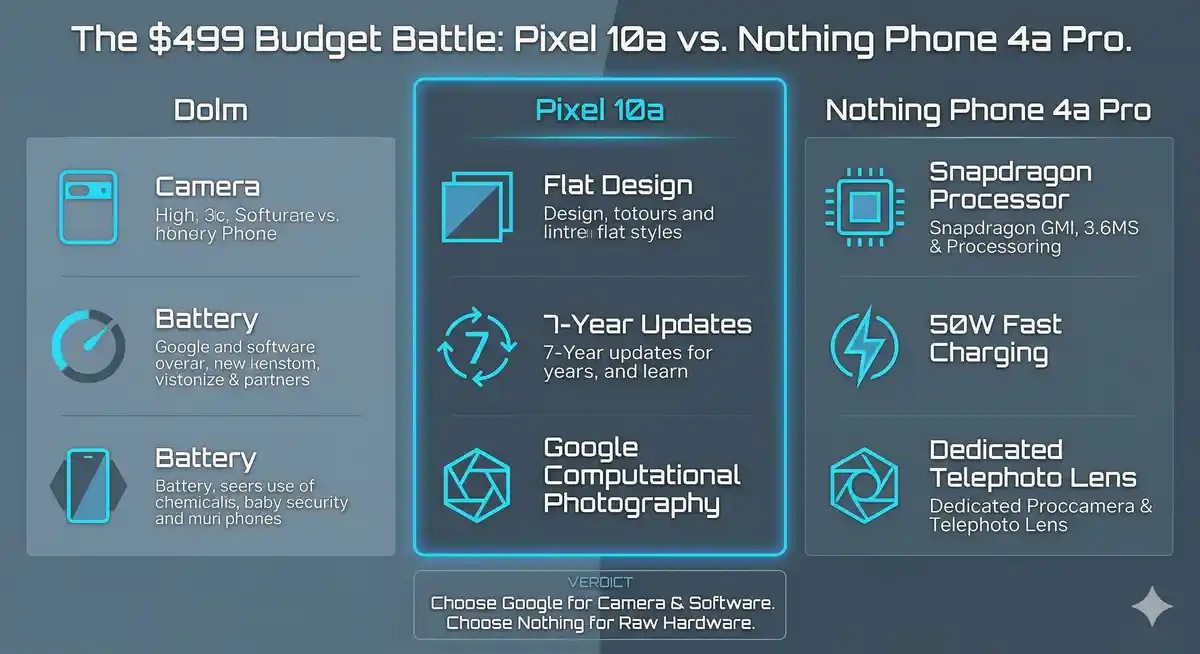
Furthermore, Google is not the only player in the sub-$500 arena. Also highly worth considering is the incredibly competitive Nothing Phone 4a Pro. Retailing also at $499, it poses a tough challenge with objectively better raw hardware specifications. For the exact same price, the Nothing device offers a bigger and brighter screen, a much more capable Qualcomm Snapdragon processor designed for gaming, a dedicated optical telephoto lens missing from Google’s budget offering, and vastly faster charging speeds maxing out at 50W. Consumers will have to weigh Nothing’s superior hardware against Google’s superior image processing and reliable seven-year update promise.
For more detailed information on Google’s entire 2026 hardware lineup, you can visit the Official Google Store.
Frequently Asked Questions
Does the new budget Google phone have a camera bump?
No. In a major design shift for 2026, the device has a completely flat back, entirely removing the camera bump so it sits flush on a table.
What processor is inside the device?
It utilizes the older Google Tensor G4 chip, the same processor found in the previous generation, meaning there is no year-over-year performance increase.
Can it run the Gemini Nano AI features?
No. Due to the older Tensor G4 processor and the 8GB of RAM, it cannot run the localized Gemini Nano model, meaning it misses out on features like Magic Cue and Call Notes.
How long will the battery last?
With a massive 5,100 mAh battery capacity—which is actually larger than the standard flagship model—it easily lasts a full day of moderate to heavy usage.
Does the screen support a high refresh rate?
Yes, the new Actua display supports up to a 120Hz refresh rate. However, it ships out of the box set to 60Hz, so you must manually enable the higher refresh rate in the settings.
How long will this phone receive software updates?
Google is promising an impressive seven years of software updates, which includes full Android OS upgrades, feature drops, and critical security patches.
Should I upgrade if I currently own the previous generation?
Generally, no. Because the camera hardware and processor are identical to last year’s model, the upgrade is only recommended if you desperately want the brighter screen, bigger battery, or the flat, bump-less design.
Disclaimer: This article is for informational purposes only. Specifications, features, and pricing are based on 2026 pre-release and launch data. Real-world performance, battery life, and software availability may vary by region and carrier. Please consult official manufacturer documentation before making a purchase decision.