
Physicist Famed Picard Maneuver on Star Trek Works as a fascinating proof that sci-fi tactical maneuvers can have grounding in real physics. Fans of Star Trek: The Next Generation have long admired Captain Picard’s brilliant warp trick used against enemy vessels. Now, scientific calculations show that the tactic is even more effective than the show suggested.
Introduction to Physicist Famed Picard Maneuver on Star Trek Works
When analyzing how Physicist Famed Picard Maneuver on Star Trek Works, researchers look closely at optical illusions and particle physics. Brazilian physicist Níckolas de Aguiar Alves demonstrated that the tactical warp jump would function remarkably well in practice.
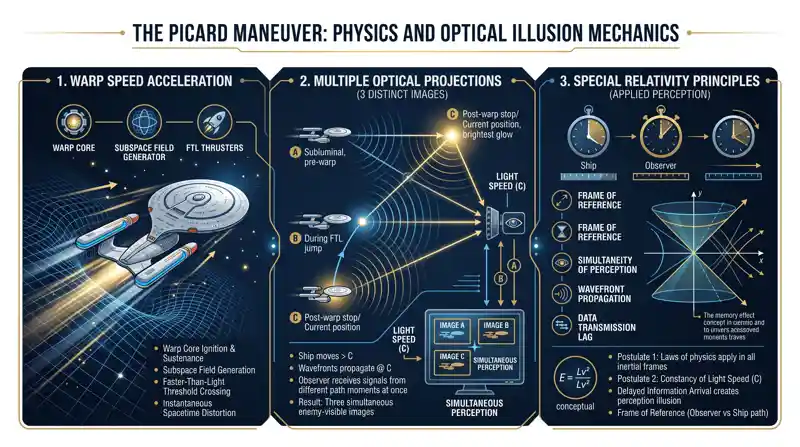
While faster-than-light space travel remains fictional, the underlying optics provide an extraordinary teaching tool. You can explore broader scientific discussions via Popular Science Official Portal for more details.
Science fiction meets hard physics as researchers validate Captain Picard’s legendary tactical warp trick.
The Physics Behind Physicist Famed Picard Maneuver on Star Trek Works
The core concept relies on how light and speed interact during sudden acceleration. When evaluating Physicist Famed Picard Maneuver on Star Trek Works, calculations reveal that accelerating past light speed creates multiple distinct visual copies of a vessel.
Instead of just two images, a ship accelerating twice during the maneuver actually generates three visible projections, confusing any opposing target.
| Maneuver Element | Show Depiction | Scientific Reality |
|---|---|---|
| Optical Illusion | Two distinct ship images | Three distinct images due to double acceleration |
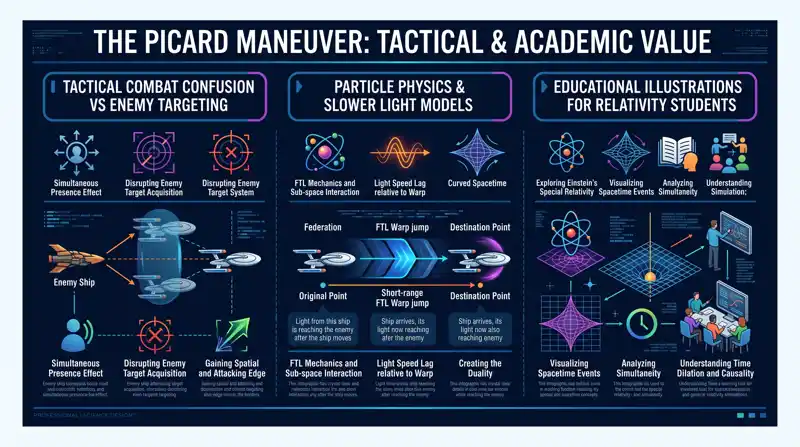
| Tactical Advantage | Confuses enemy targeting | Even higher tactical odds than portrayed |
| Underlying Principle | Warp speed jump | Relativity and slower light speed particle models |
Relativity and Educational Value
The implications extend far beyond science fiction entertainment. Discussions surrounding Physicist Famed Picard Maneuver on Star Trek Works highlight its value as an incredible illustration for students wrestling with complex relativity concepts.
By connecting pop culture to particle physics, educators can engage learners more effectively in advanced scientific theories.
| Physics Concept | Application | Educational Benefit |
|---|---|---|
| Special Relativity | Light propagation analysis | Simplifies abstract spacetime ideas |
| Particle Physics | Slower light speed models | Bridges real-world particle behavior |
| Optical Projections | Multiple image calculation | Demonstrates practical mathematical modeling |
Pop culture and physics collide to create brilliant educational illustrations for students of relativity.
Conclusion
Ultimately, examining how Physicist Famed Picard Maneuver on Star Trek Works proves that creative sci-fi writing often aligns with genuine scientific principles. It bridges entertainment and rigorous academic study beautifully.
Frequently Asked Questions
What is the Picard Maneuver in Star Trek?
It is a tactical warp trick where a ship jumps to warp speed right in front of an enemy, creating optical illusions of its position.
Who proved that the Picard Maneuver works in physics?
Brazilian physicist Níckolas de Aguiar Alves calculated and demonstrated the scientific validity of the maneuver.
How many optical images does the real maneuver create?
Calculations show it creates three visible images because the ship technically accelerates twice during the gambit.
Is faster-than-light travel possible in real life?
No, faster-than-light space travel remains outside the bounds of real physics.
Why is this study important for education?
It serves as an engaging illustration for physics students learning about relativity and light speed.
Which Star Trek series featured the original maneuver?
It originated in a first-season episode of Star Trek: The Next Generation.
Can everyday fans replicate this trick?
Only in theory and mathematical calculations, as real warp drives do not currently exist.
Disclaimer: This article is for informational purposes only and explores theoretical physics concepts inspired by science fiction.