The gaming world is experiencing a massive paradigm shift today as NVIDIA DLSS 4.5 and 6x Dynamic Multi-Frame generation officially make their public debut. If you ever wondered what the ultimate future of path-traced gaming would look like in 2026, the answer has arrived in the form of a mind-bending technological leap. For years, PC enthusiasts have chased the elusive dream of running visually spectacular, uncompromised path-traced games at competitive frame rates. Today, through the latest NVIDIA app beta update, that dream is a tangible reality, pushing boundaries further than anyone anticipated.
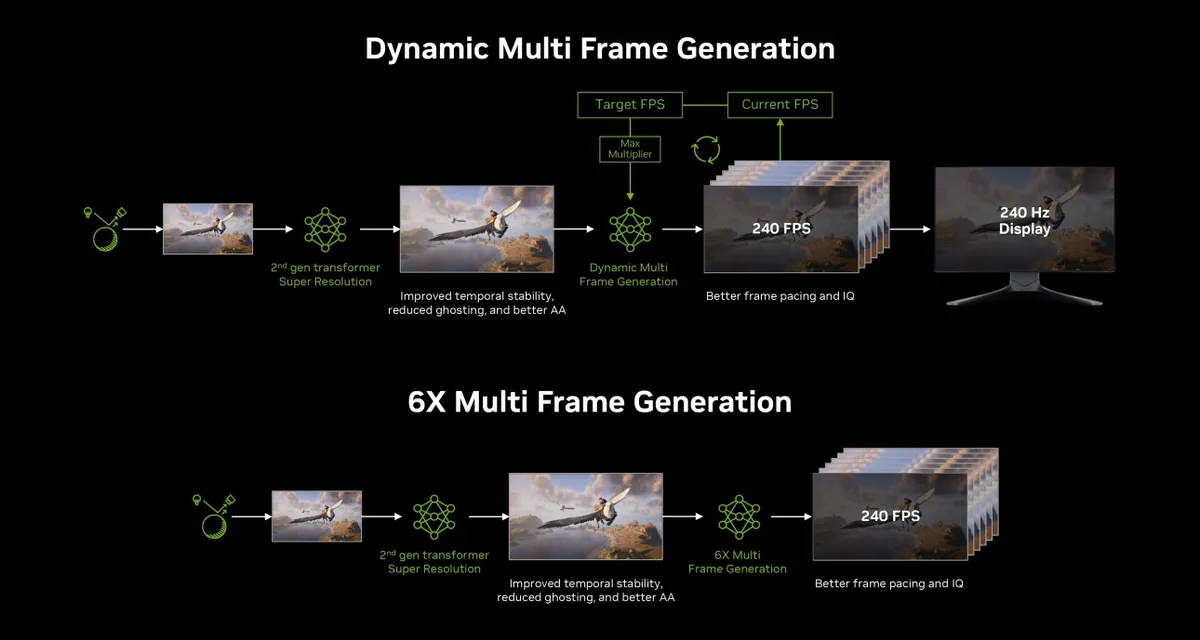
With the release of this highly anticipated technology suite, gamers can now experience what NVIDIA calls a “6x performance uplift.” Imagine playing a highly demanding, graphically intensive title that traditionally struggles to maintain a stable 60 FPS on ultra settings. By leveraging the power of generative AI and next-generation neural networking, this new upscaling and frame generation suite can instantly propel that same game to an astonishing 360 FPS. This article dives deep into the architecture, the hardware requirements, and the profound impact this will have on the future of interactive entertainment.
The Magic Behind Multi-Frame Generation 6x Mode
To truly appreciate the magnitude of this update, we must understand the core mechanics of the Multi-Frame Generation (MFG) technology. Earlier iterations of DLSS introduced the concept of generating a single intermediate frame between two traditionally rendered frames. With DLSS 4.5, the generative AI models have become so advanced that the GPU can now generate up to five additional frames following a single native frame.
This is not merely optical flow interpolation; this is pure, AI-driven predictive generation powered by a state-of-the-art neural network. The AI analyzes motion vectors, depth buffers, and the second-generation Transformer model to predict exactly where every pixel should be over the next several milliseconds of gameplay. The result is fluid, artifact-free motion that scales a baseline performance by six times.
“NVIDIA’s DLSS 4.5 technology suite enables the GPU to generate up to five additional frames following each traditionally rendered frame using generative AI, resulting in unprecedented visual fluidity.”
However, injecting five synthetic frames for every one real frame requires immense computational power and precise timing. If the frame pacing is even slightly misaligned, the player would experience severe input latency and visual ghosting. To combat this, NVIDIA has deeply integrated Reflex technology natively into the DLSS 4.5 pipeline, ensuring that the delay between a mouse click and the action on-screen remains imperceptibly low, even at 360 FPS.
Introducing Dynamic MFG: The “Automatic Transmission” of Gaming
While pushing 360 FPS is a monumental achievement, it presents a practical challenge: hardware limitations. A vast majority of PC gamers currently utilize monitors that max out at 144 Hz or 240 Hz. Pumping 360 frames per second into a 144 Hz display is computationally wasteful and can lead to aggressive screen tearing or micro-stutters. This is the exact problem that Dynamic MFG was engineered to solve.
Dynamic MFG acts as an intelligent governor for your graphics card. It continuously monitors your display’s maximum refresh rate capability and the raw input framerate coming from the upscaler. Based on this real-time telemetry, the technology determines the precise MFG multiplier needed at any given millisecond. NVIDIA aptly refers to this system as an “automatic transmission” for game rendering.
| Gaming Scenario | Base Render FPS | Monitor Refresh Rate | Dynamic MFG Multiplier Applied | Final Output FPS |
|---|---|---|---|---|
| Intense Path-Traced Combat | 40 FPS | 240 Hz | 6x (Maximum) | 240 FPS |
| Exploration / Open World | 60 FPS | 240 Hz | 4x | 240 FPS |
| Looking at Static Skybox | 120 FPS | 240 Hz | 2x | 240 FPS |
| Settings Menu / Pause | 144 FPS | 144 Hz | Off / 1x | 144 FPS |
Just like a modern sports car shifts gears seamlessly based on the driver’s demand and road conditions, Dynamic MFG shifts between 2x, 3x, 4x, 5x, and 6x multipliers. In a graphically heavy scene where the GPU can only output 40 native frames, it will kick into 6x mode to hit 240 FPS. But when you look at a static wall or enter a simple pause menu, the native framerate spikes, and Dynamic MFG downshifts to a 2x multiplier or turns off entirely to save power and reduce thermal output. It is a masterpiece of efficiency.
RTX 50 Series “Blackwell” Exclusivity
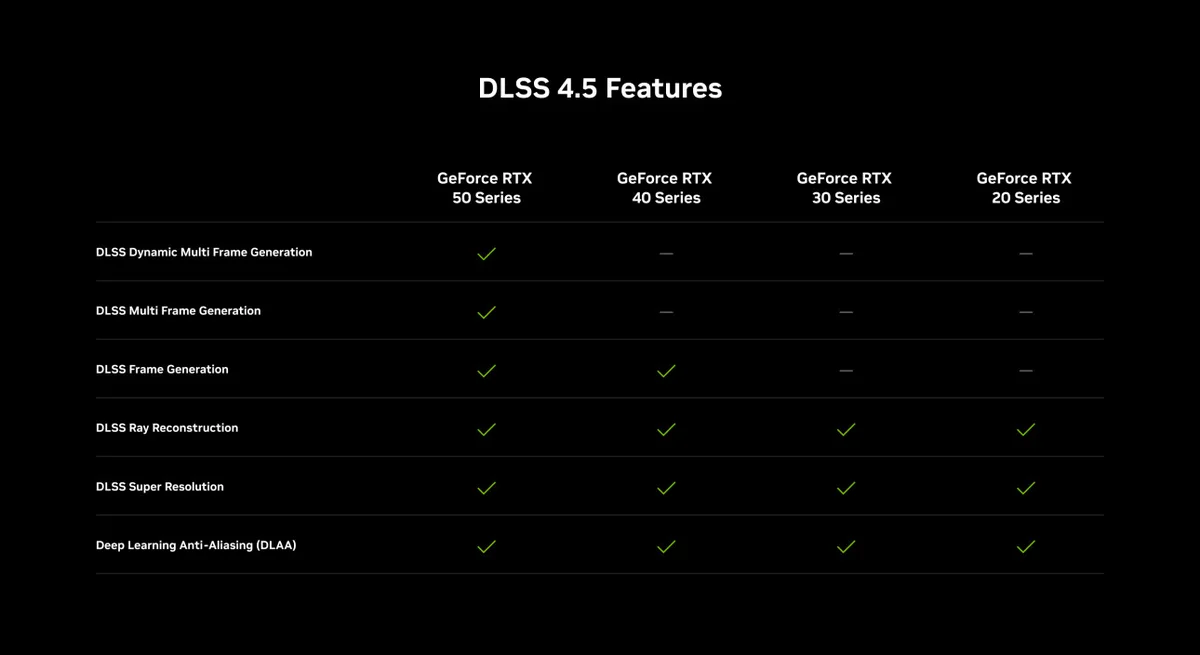
It is crucial to note that these groundbreaking features—specifically MFG 6x and Dynamic MFG—are strictly exclusive to NVIDIA’s new GeForce RTX 50 Series “Blackwell” GPUs. While previous generations like the RTX 40 “Ada Lovelace” series brought us DLSS 3 and frame generation, they physically lack the silicon required to handle 6x scaling dynamically.
The RTX 50 Series architecture introduces a new hardware component known as “hardware flip-metering.” This dedicated processing block is responsible for managing the complex cadence of injecting five AI-generated frames in between native renders without disrupting the render queue. Older architectures do not possess hardware flip-metering, meaning they cannot support the synchronization required for 6x Multi-Frame Generation. For gamers rocking Blackwell GPUs, the jump from 4x to 6x Multi Frame Generation alone delivers up to a 35% increase in 4K frame rates in fully path-traced titles.
“The technology determines which MFG multiplier is needed based on the display’s refresh rate capability, acting as an automatic transmission for modern graphics rendering.”
For users on older hardware, there is still good news. The regular DLSS 4.5 Super Resolution technology, which relies on the vastly improved second-generation Transformer model, is available. While it will not offer the explosive 6x performance boost, it provides a massive visual improvement, offering superior image reconstruction and anti-aliasing across over 400 supported games.
Supported Games and How to Access the Beta
To experience the full might of DLSS 4.5, users must jump through a few software hoops, as the technology is currently rolling out via an opt-in beta phase. First, you must download the latest NVIDIA App and navigate to the Settings menu to explicitly enable “beta and experimental features.” Furthermore, the GeForce Game Ready Driver 595.79 WHQL (or newer) is an absolute prerequisite. Without this specific driver, the operating system cannot interface with the hardware flip-metering on the Blackwell GPUs.
NVIDIA is working closely with top-tier game studios to roll out official support. Currently, a limited but highly impressive roster of games fully utilizes the 6x Dynamic MFG pipeline. These titles were specifically chosen to showcase the technology’s ability to handle high-speed action, complex physics, and demanding ray-tracing algorithms.
| Supported Title | Engine / Tech | Performance Uplift (Native to 6x MFG) |
|---|---|---|
| ARC Raiders Flashpoint | Unreal Engine 5 | 55 FPS ➔ 330 FPS |
| Marvel Rivals Season 7 | Custom / Path-Traced | 60 FPS ➔ 360 FPS |
| 007 First Light | Glacier Engine | 45 FPS ➔ 270 FPS |
| CONTROL Resonant | Northlight / Path-Traced | 35 FPS ➔ 210 FPS |
| Tides of Annihilation | Custom Voxel Engine | 50 FPS ➔ 300 FPS |
As you can see from the data above, the leap in performance is nothing short of revolutionary. Competitive shooters like Marvel Rivals Season 7 benefit massively from the hyper-fluid 360 FPS target, providing players with lower latency and unmatched motion clarity. Meanwhile, cinematic masterpieces like CONTROL Resonant can now be experienced with full path-tracing without sacrificing the smooth 200+ FPS experience that PC gamers demand.
For more details on the technical whitepapers and official developer documentation, you can visit the Official NVIDIA DLSS Developer Portal to see how studios are integrating these AI models.
The Future of PC Gaming in 2026 and Beyond
The introduction of NVIDIA DLSS 4.5 and 6x Dynamic Multi-Frame Generation marks a pivotal moment in graphics technology. We have officially crossed the threshold where AI is doing more heavy lifting in game rendering than traditional rasterization. By generating up to 80% of the pixels on the screen via AI, GPUs are freed from the brute-force calculations that used to bottleneck high-fidelity gaming.
As we move further into 2026, we can expect the list of supported games to grow exponentially. Game developers are no longer constrained by the fear of poor performance when implementing heavy graphical features like full path-tracing, volumetric fluid dynamics, or dense microscopic geometry. They can push the visual fidelity to the absolute maximum, knowing that DLSS 4.5’s generative AI will bridge the gap between their artistic vision and the player’s monitor.
The “automatic transmission” concept of Dynamic MFG also ensures that the PC gaming ecosystem becomes more power-efficient. By scaling back the frame generation multiplier during less demanding sequences, graphics cards will consume less electricity, generate less heat, and maintain a quieter acoustic profile. It is a win-win scenario that elevates every aspect of the PC gaming experience.
Frequently Asked Questions
What is NVIDIA DLSS 4.5?
DLSS 4.5 is the latest version of NVIDIA’s Deep Learning Super Sampling technology suite. It utilizes a second-generation AI Transformer model for superior image reconstruction and introduces the revolutionary 6x Multi-Frame Generation mode.
How does 6x Dynamic Multi-Frame Generation work?
It uses generative AI to create up to five entirely new frames between every traditionally rendered frame. The “Dynamic” aspect means it automatically adjusts the multiplier (from 2x to 6x) based on your monitor’s maximum refresh rate and the game’s current performance, preventing screen tearing and wasted processing power.
Do I need an RTX 50 Series graphics card to use this?
Yes, the 6x MFG and Dynamic MFG features are exclusively hardware-locked to the RTX 50 Series “Blackwell” GPUs due to their reliance on a new hardware component called hardware flip-metering.
What happens if I use DLSS 4.5 on an older RTX card (like the 30 or 40 series)?
Older RTX cards can still utilize the DLSS 4.5 Super Resolution technology for vastly improved image quality and anti-aliasing, but they will not have access to the 6x Multi-Frame Generation or Dynamic MFG performance boosts.
Which driver is required to enable these features?
You must install the GeForce Game Ready Driver 595.79 WHQL (or newer) and opt into “beta and experimental features” within the latest NVIDIA App.
Will my older games support 6x Multi-Frame Generation automatically?
No. While DLSS 4.5 Super Resolution is supported in over 400 games, the 6x MFG pipeline requires specific implementation by game developers. Currently, it is available in a select group of beta titles like ARC Raiders Flashpoint and Marvel Rivals Season 7.
Does 6x Frame Generation increase input lag?
Creating intermediate frames inherently adds a slight processing delay, but NVIDIA combats this by deeply integrating NVIDIA Reflex technology into the DLSS 4.5 pipeline, keeping input latency extremely low and unnoticeable for most players.
Disclaimer: This article is for informational purposes only. Features, hardware requirements, and game compatibility related to NVIDIA DLSS 4.5 and RTX 50 Series GPUs are subject to change based on official beta updates and software developments by NVIDIA and game studios.