No Gemini AI in iOS 26.5 is the harsh reality that developers and tech enthusiasts are facing today, as Apple’s latest software beta arrives completely devoid of the highly anticipated, next-generation Apple Intelligence features. For months, rumors had swirled that the Cupertino giant would finally integrate Google’s powerful Gemini models into its core operating system by the spring of 2026. However, with the release of the iOS 26.5 beta 1, it is now evident that users will have to wait longer. Apple’s focus has officially shifted toward a massive, comprehensive AI rollout scheduled for iOS 27 this coming fall.
The Missing Link: Why iOS 26.5 Beta Lacks Apple Intelligence
When Apple overhauled its versioning system to match the calendar year, moving from the iOS 18 cycle directly into the iOS 26 era, expectations were sky-high. The tech community anticipated rapid, iterative software updates that would progressively introduce advanced artificial intelligence. The initial promise of Apple Intelligence, showcased as far back as June 2024, included a completely revolutionized version of Siri, deep in-app actions, and on-screen awareness. Yet, these features remained absent through the releases of iOS 26.1 to 26.4.
With the launch of the iOS 26.5 beta, the absence of these tools is more noticeable than ever. Developers diving into the code have found standard bug fixes, performance improvements, and minor UI tweaks, but absolutely no signs of the robust generative AI capabilities that were promised. This strategic delay highlights Apple’s cautious approach to artificial intelligence. Instead of rushing a fragmented experience to the public, the company is opting to withhold the ultimate Siri upgrade until it can be seamlessly integrated into the next major ecosystem overhaul: iOS 27.
Breaking Down the Developer Beta Letdown
To understand the magnitude of this delay, we must look at what was originally slated for the spring release window. Apple intended to deliver “Personal Intelligence,” a suite of tools designed to understand user context dynamically. Below is a comparison of what the industry expected versus what iOS 26.5 actually delivered.
| Feature Category | Expected in iOS 26.5 | Actual iOS 26.5 Reality |
|---|---|---|
| Voice Assistant | Gemini-powered personalized Siri | Standard Siri with minor speed tweaks |
| Contextual AI | On-screen awareness and cross-app actions | No new contextual awareness tools |
| Generative Tools | Advanced text and image generation natively | Basic predictive text improvements |
Tracing the Delays: From 2024 to 2026
The journey to an AI-powered iPhone has been fraught with structural pivots and timeline adjustments. While competitors rapidly deployed large language models (LLMs) to their devices, Apple maintained its notoriously guarded, privacy-first approach. The initial Apple Intelligence features shipped throughout the late 2024 cycle, but they were largely superficial compared to the generative powerhouses dominating the market.
The turning point in the public narrative occurred on March 7, 2025, when Apple officially acknowledged the complexities of building a truly personal, secure AI assistant. In an unprecedented move, the company released a statement tempering expectations:
“It’s going to take us longer than we thought to deliver on these features and we anticipate rolling them out in the coming year.”
This admission was a clear signal that the underlying architecture required a massive overhaul. Apple’s internal models, while excellent at protecting user privacy, lacked the broad conversational depth and reasoning capabilities of industry-leading LLMs. The phrase “in the coming year” gave the company the breathing room it needed to negotiate one of the most significant tech partnerships of the decade.
The iOS Release Timeline Context
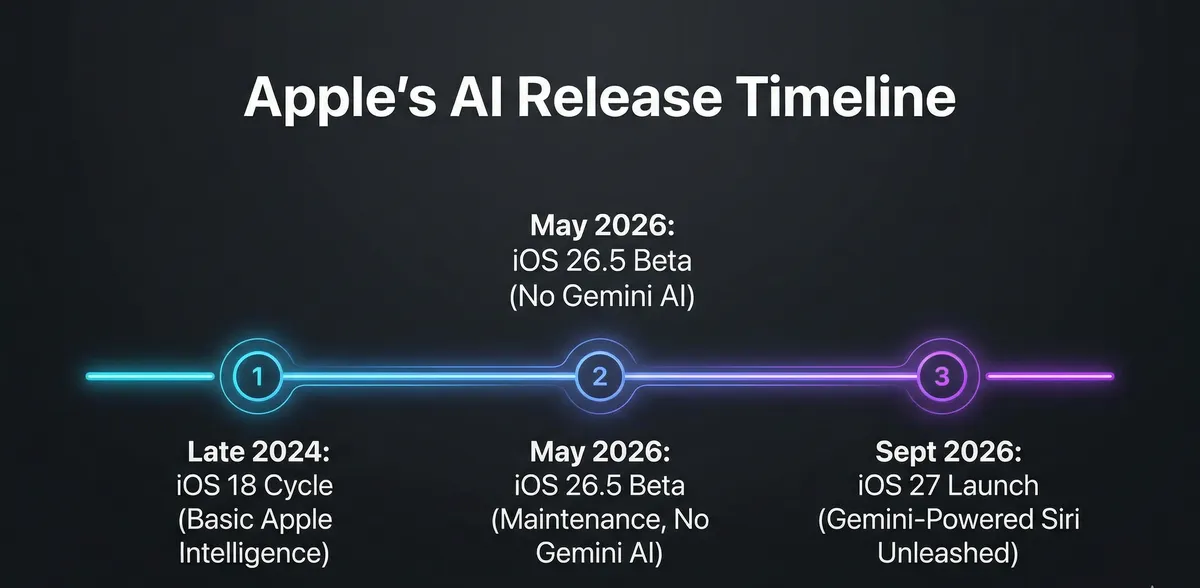
To fully grasp why iOS 26.5 is an AI placeholder, it helps to visualize Apple’s shifting roadmap over the past three years. The transition from legacy numbering to the year-based format (iOS 26) was meant to symbolize a new era, yet the software features lagged behind the marketing.
| Software Version | Release Window | Key Focus & AI Status |
|---|---|---|
| iOS 18.x Cycle | Late 2024 – Mid 2025 | Basic Apple Intelligence tools, minor Siri updates, ChatGPT integration. |
| iOS 26.0 – 26.4 | Late 2025 – Early 2026 | Year-based rebranding. Infrastructure updates. Gemini integration delayed. |
| iOS 26.5 | May 2026 | Maintenance release. No Gemini-powered AI features present. |
| iOS 27.0 | September 2026 | Expected launch of comprehensive Apple Foundation Models powered by Gemini. |
The Historic Apple-Google Collaboration of January 2026
The landscape shifted dramatically on January 12, 2026. Realizing that building a competitive, world-class LLM from scratch would take years they did not have, Apple announced a multi-year collaboration with Google. This partnership dictates that the next generation of Apple Foundation Models will be intrinsically linked with Google’s Gemini models and cloud infrastructure.
This joint announcement was a watershed moment for the tech industry. It married Apple’s unparalleled hardware integration and privacy frameworks with Google’s dominant AI research. The companies stated:
“After careful evaluation, Apple determined that Google’s Al technology provides the most capable foundation for Apple Foundation Models and is excited about the innovative new experiences it will unlock for Apple users.”
Despite this massive announcement in January, integrating such profoundly complex cloud technology into the iOS core safely is an arduous task. The iOS 26.5 beta timeline simply did not allow for the rigorous testing required to ensure that Apple’s strict Private Cloud Compute standards were met. Apple refuses to compromise on its industry-leading privacy, meaning that funneling Siri requests through Gemini frameworks requires a bespoke, heavily encrypted pipeline that is still under construction.
Building the Apple Foundation Models
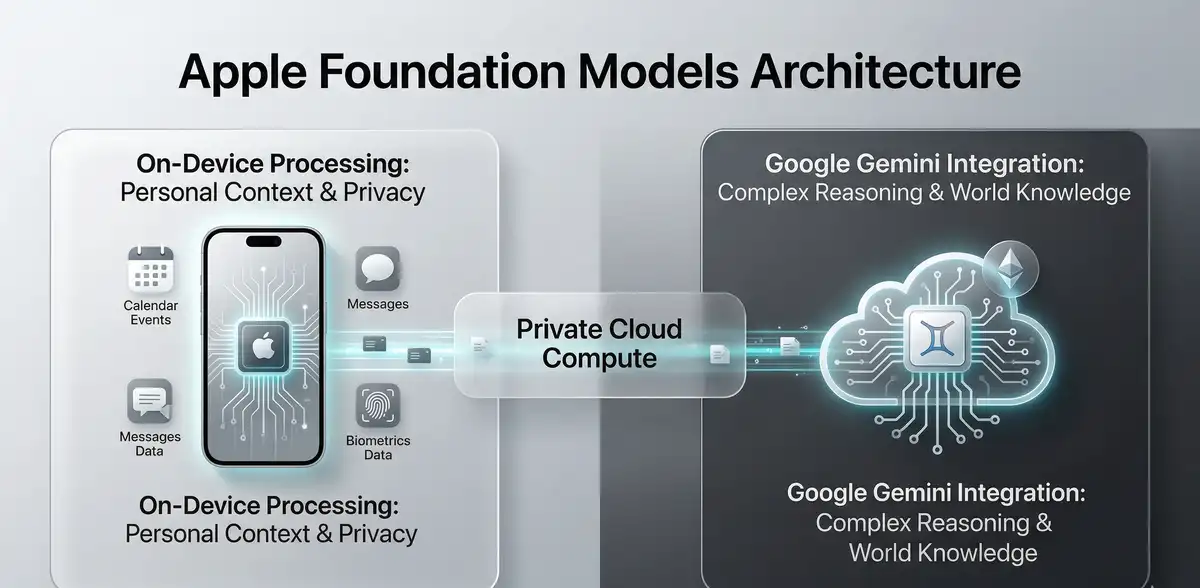
The collaboration with Google doesn’t mean Apple is simply slapping a Gemini wrapper on iOS. Instead, they are building hybrid “Apple Foundation Models.” These models will handle sensitive, personal data entirely on-device using Apple’s Neural Engine, while offloading complex, world-knowledge queries to Gemini via secure cloud channels. Here is how the labor is expected to be divided once the system launches in iOS 27.
| Task Type | Processing Location | Underlying Technology |
|---|---|---|
| Personal Context (Messages, Photos) | On-Device (iPhone/iPad) | Apple Proprietary Neural Models |
| Cross-App Automation | On-Device / Private Cloud Compute | Apple Foundation Models |
| Complex Reasoning & World Knowledge | Cloud Infrastructure | Google Gemini Integration |
Mark Gurman’s Predictions Validated
Prominent Apple analyst Mark Gurman had accurately forecasted this exact scenario. Earlier in 2026, when anticipation for an iOS 26.4 AI drop was peaking, Gurman reported that Apple’s internal timelines were shifting. He noted that the sheer complexity of the Gemini integration was causing Apple engineers to push the release out, first suggesting a slip to iOS 26.5, and ultimately warning that the entire package might be held back until the monumental iOS 27 release in September.
Gurman’s insights have proven remarkably accurate with today’s beta drop. By keeping iOS 26.5 as a standard maintenance update, Apple avoids the risk of shipping a buggy, half-baked AI assistant. This strategy ensures that when the new Siri finally debuts, it will be a polished, stable, and highly capable feature that can rival any AI assistant on the market. For more details on Apple’s corporate announcements and software updates, you can always check the Apple Newsroom.
Looking Ahead: What to Expect in iOS 27
With iOS 26.5 officially serving as the twilight of the current software generation, all focus is now heavily directed toward the Worldwide Developers Conference (WWDC) in June 2026. This is where Apple is fully expected to lay all its AI cards on the table. The first developer beta of iOS 27 is just a couple of months away, and it promises to be the most significant software evolution in iPhone history.
When iOS 27 drops, users can finally expect the fruits of the Apple-Google labor. A deeply personalized Siri that understands on-screen context, anticipates user needs, and generates high-quality content natively will redefine the Apple ecosystem. Until then, iOS 26.5 serves as a stable, albeit unexciting, bridge to the future of mobile artificial intelligence.
Frequently Asked Questions (FAQ)
Why is there no Gemini AI in iOS 26.5?
Apple requires more time to integrate Google’s Gemini models securely into its Private Cloud Compute architecture. The company chose to delay the features to ensure stability and privacy, pushing the major AI update to iOS 27.
When was Apple Intelligence originally announced?
Apple Intelligence was first announced in June 2024, but many of its advanced contextual and personal features were delayed over the subsequent years.
What is the Apple Foundation Model?
The Apple Foundation Model is Apple’s proprietary hybrid AI architecture that combines on-device processing for privacy with cloud-based capabilities, soon to be powered by Google’s Gemini.
Will my older iPhone support the iOS 27 AI features?
While Apple has not released official compatibility lists for iOS 27, advanced on-device AI typically requires newer hardware with robust Neural Engines, such as the iPhone 15 Pro series and later.
How does the Google partnership affect my privacy?
Apple has stated that its industry-leading privacy standards will remain intact. Personal data will be processed on-device, and only anonymized, complex queries will be routed securely to Gemini via Private Cloud Compute.
When will we see the first beta of iOS 27?
The first developer beta of iOS 27 is expected to be released immediately following Apple’s WWDC keynote in June 2026.
Did Mark Gurman predict this delay?
Yes, Bloomberg’s Mark Gurman correctly reported earlier in the year that Apple’s Gemini-powered enhancements were likely to slip past the iOS 26.4 and 26.5 releases, targeting iOS 27 instead.
Disclaimer: This article is for informational purposes only. The software timelines, features, and corporate partnerships discussed are based on current tech industry reports, beta software analysis, and official press releases as of early 2026. Final software capabilities may vary upon official release.