The tech and aerospace worlds are buzzing today because a historic moonshot on iphone astronaut reid wiseman snaps unbelievable photo of the lunar surface has just occurred during the Artemis II mission in 2026. During the Orion spacecraft’s final, tense approach for its highly anticipated lunar flyby, Commander Reid Wiseman accomplished something previously thought impossible for a commercial smartphone. Holding his Apple device up to the capsule window, he showcased a breathtaking, high-resolution image of the lunar surface that immediately captivated audiences watching the live feed back on Earth. This milestone marks a massive leap not just for space exploration, but for commercial consumer technology.
The Historic Artemis II Lunar Flyby and the Ultimate Smartphone Camera Test
The Artemis II mission is already in the history books for taking humans back to the moon’s vicinity for the first time in over fifty years. However, this mission brought a modern twist. Over the past few days, the Artemis II crew has been sharing photos taken directly from their pockets, marking the first time in history that the space agency has officially allowed astronauts to fly with the latest consumer smartphones. According to recent statements from the agency’s leadership, the integration of these devices was designed to test the resilience and capability of commercial tech in the harsh environment of deep space.
“We are witnessing a new era of space documentation where the line between highly specialized orbital equipment and the smartphone in your pocket is beautifully blurred.”
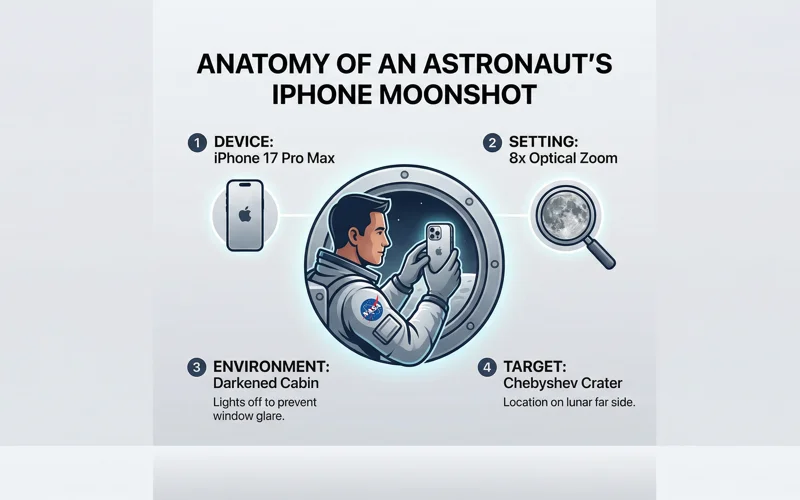
As the spacecraft initiated the flyby sequence designed to slingshot the capsule back toward Earth, the astronauts gathered at the Orion capsule’s windows. To eliminate glare and capture the best possible images, the crew turned off all interior cabin lights. It was during this moment of near-total darkness inside the spacecraft that Commander Reid Wiseman approached the live broadcast camera to share what he had just captured.
| Mission Event | Details & Context |
|---|---|
| Spacecraft | Orion Capsule (Artemis II Mission) |
| Key Maneuver | Lunar Slingshot / Flyby |
| Target Captured | Chebyshev Crater (Far side of the moon) |
Capturing the Chebyshev Crater: The Power of the iPhone 17 Pro Max
What Commander Wiseman showed to the livestream audience was nothing short of spectacular. He later confirmed via communications with Mission Control that the image was taken using his smartphone with an 8x optical zoom setting. Mission Control quickly analyzed the telemetry and the visual data, confirming that the stunning, heavily cratered terrain shown on the screen was none other than the Chebyshev crater. This specific geographical feature is located on the lunar far side, making this high-definition snapshot even more rare and valuable.
The feat highlights the incredible advancements in mobile photography, particularly computational photography and stabilization algorithms that allow a handheld device to take a crisp photo of a celestial body while traveling at thousands of miles per hour. While NASA continues to use traditional high-end optics, the immediate accessibility of the smartphone proved invaluable for spontaneous documentation.
| Device / Camera Model | Primary Usage on Artemis II |
|---|---|
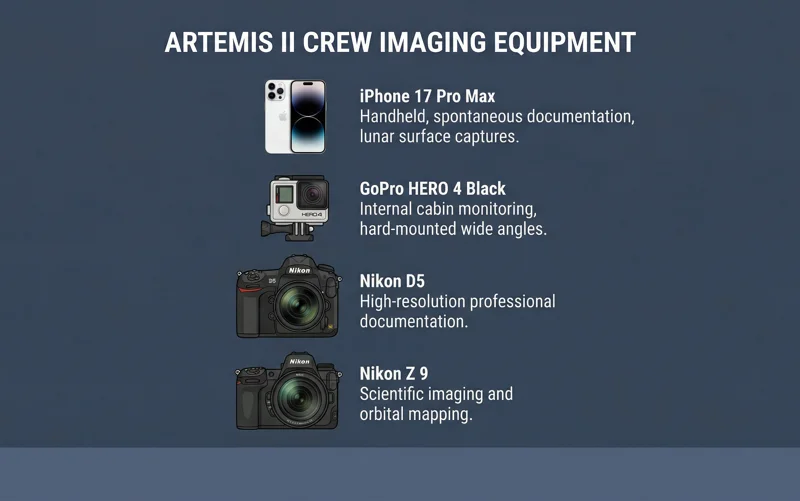
| Apple iPhone 17 Pro Max | Candid crew shots, quick window photography, 8x zoom lunar surface images |
| GoPro HERO 4 Black | Wide-angle internal cabin monitoring and external hard-mount action shots |
| Nikon Z 9 & Nikon D5 | High-fidelity, professional-grade scientific documentation and orbital mapping |
Smartphones Working Alongside Professional Gear in Space
It is important to note that the smartphones are not replacing NASA’s robust suite of imaging equipment; rather, they are supplementing it. In addition to the four flagship Apple devices onboard, the crew is actively utilizing a GoPro HERO 4 Black, a Nikon D5, and the cutting-edge mirrorless Nikon Z 9 to capture scientific images. The combination of these tools ensures that every angle of the historic Artemis II flight is documented.
“The inclusion of consumer tech alongside specialized orbital cameras democratizes space exploration, allowing the public to see the cosmos through the same lenses they use every day.”
Currently, the crew is completing their post-lunar flyby activities. This includes the massive data dump required to send these high-resolution images back to Earth. Enthusiasts and photography experts alike are eagerly waiting to see if Wiseman’s livestream photo will be included in the official media release. Once the data stream is complete, these images are expected to be hosted on NASA’s official web portals and their dedicated public image repositories.
| Image Processing Steps | Current Status |
|---|---|
| Capture during lunar flyby | Completed (via 8x zoom) |
| Livestream preview broadcast | Completed |
| Deep Space Network transmission | In Progress |
Frequently Asked Questions
Who took the photograph of the moon on a smartphone?
Commander Reid Wiseman took the photograph during the Artemis II mission.
What exact smartphone was used to capture the lunar surface?
The photo was taken using an Apple iPhone 17 Pro Max.
Which specific crater was captured in the photograph?
Mission Control confirmed that the image shows the Chebyshev crater, located on the far side of the moon.
What zoom level was utilized for the shot?
Commander Wiseman confirmed he used the phone’s 8x zoom feature to capture the detailed surface image.
Why did the crew turn off the cabin lights?
The cabin lights were turned off to eliminate reflections on the Orion capsule’s windows, ensuring a clear, unobstructed view of the moon.
Are there other cameras on board the Artemis II spacecraft?
Yes, the crew is also equipped with a GoPro HERO 4 Black, a Nikon D5, and a Nikon Z 9 for professional documentation.
Where can the public view the full-resolution photos once they are released?
Once transmitted back to Earth and processed, the images will be made available through NASA’s official public image accounts and galleries.
Disclaimer: This article is for informational purposes only. The details regarding the Artemis II mission and related hardware are based on currently available mission broadcasts and updates from the space agency.