
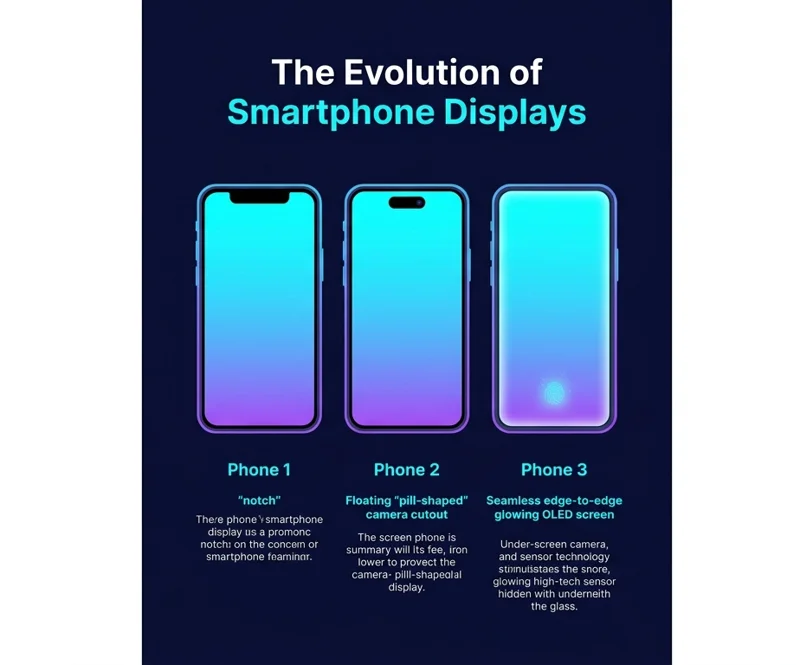
In the rapidly evolving world of smartphone design in 2026, it is officially confirmed that metalenz has figured out a way to make face id invisible. For years, consumers and manufacturers alike have wrestled with the physical limitations of front-facing camera hardware. The necessity of secure biometric authentication led to compromises in screen real estate, manifesting as unsightly notches, bulky bezels, and the more recent floating pill-shaped camera cutouts known as dynamic islands. However, the pursuit of a truly continuous, uninterrupted edge-to-edge display has finally yielded a breakthrough. Through the innovative application of optical metasurfaces and advanced polarization sensing, the era of the compromised screen is coming to an abrupt end.
This massive leap in under-display camera technology stems from the development of the Polar ID facial recognition system. Unlike traditional biometric authentication systems that rely on bulky, multi-lens arrays to project and read infrared dots, this new approach leverages the unique properties of polarized light. By capturing the distinct polarization signature of human skin, this technology achieves unprecedented levels of security while occupying a fraction of the physical space. More importantly, it functions flawlessly even when completely obscured beneath an active OLED display.
The Evolution of the Smartphone Display and the Notch Dilemma
To fully appreciate the magnitude of this technological leap, one must look back at the history of smartphone display engineering. The race to achieve a 100 percent screen-to-body ratio has been a central narrative in mobile technology for nearly a decade. Manufacturers initially reduced bezels, pushing the screen to the very edges of the device’s chassis. However, the front-facing camera, ambient light sensors, and facial recognition modules had to go somewhere.
This led to the introduction of the notch—a physical cutout at the top of the screen that became an iconic, albeit polarizing, design element. While some users quickly acclimated to it, purists argued that it ruined the immersive experience of watching videos or playing games. In response, the industry iterated, introducing hole-punch cameras and eventually the dynamic island concept. While these solutions cleverly masked the hardware with software integrations, the physical interruption of the display remained.
| Display Technology Era | Primary Drawback | Biometric Capability |
|---|---|---|
| The Notch (2017-2022) | Large, intrusive physical screen cutout | High (Infrared depth mapping) |
| Hole-Punch / Island (2022-2026) | Still interrupts continuous media viewing | Variable (Depends on manufacturer) |
| Polar ID Under-Display (2027+) | Requires complex display manufacturing integration | Superior (Polarization signature sensing) |
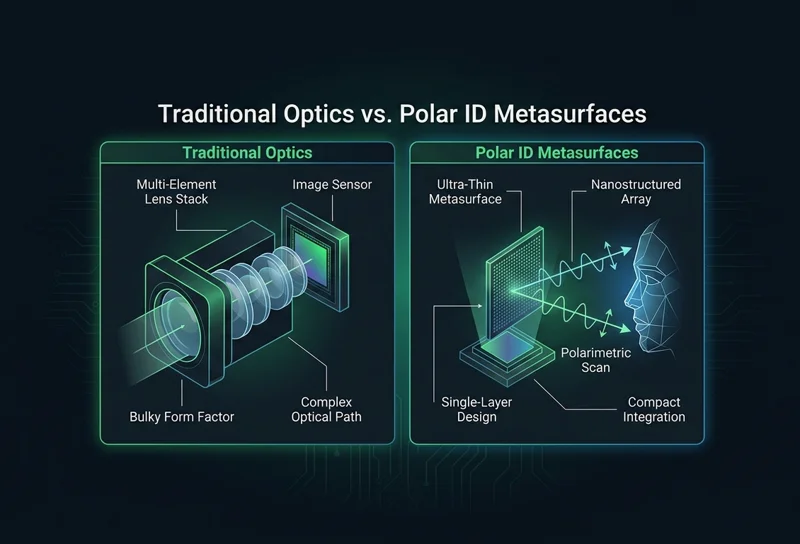
The core challenge has always been physics. Traditional optical lenses require space to refract light through multiple plastic or glass elements to achieve image clarity and correct aberrations. Stuffing these complex lens arrays underneath a screen severely degrades the image quality because the screen itself acts as an opaque barrier, distorting the light before it reaches the sensor. This is why early attempts at under-display cameras resulted in hazy, soft images that were completely inadequate for secure biometric authentication.
“The continuous display has always been the holy grail of mobile hardware design. Until now, the physics of light simply refused to cooperate with our aesthetic ambitions.”
Demystifying Optical Metasurfaces
The solution to this seemingly insurmountable physics problem comes in the form of optical metasurfaces. Instead of relying on the traditional method of curving glass to bend light, a metasurface uses a completely flat, microscopic plane covered in intricately designed nanostructures. These nanostructures act as tiny, highly engineered antennas that manipulate electromagnetic waves—in this case, light—with incredible precision.
Because the light manipulation happens at the nanoscale on a single, flat layer, the entire optical stack shrinks dramatically. A system that previously required four or five stacked lenses can now be replaced by a single, ultra-thin metasurface. Millions of these metasurfaces are already deployed in modern consumer electronics, primarily serving as time-of-flight sensors that assist with laser autofocus by quickly calculating depth information.
However, the true potential of this technology is realized when it is tuned to capture polarization data. Polarization refers to the orientation of the light waves. When light bounces off an object, the material properties of that object change the light’s polarization in a unique way. It is a fundamental property of light that traditional image sensors completely ignore, yet it holds vast amounts of invisible data.
The Superior Security of Polar ID Facial Recognition
By harnessing this polarization data, the new generation of biometric authentication system can distinguish between materials with absolute certainty. To understand this, consider how autonomous vehicles detect hazardous road conditions. Light reflecting off black ice has a distinct polarization signature compared to light reflecting off dry asphalt. The sensor does not need a high-resolution, full-color image to see the ice; it simply reads the polarization state.
When applied to human faces, this principle creates a nearly foolproof security system. Human skin reflects light with a specific, complex polarization signature that is completely unique. A highly detailed, incredibly realistic 3D silicone mask might fool a traditional depth-sensing infrared camera or a standard 2D camera system, but it cannot fake the polarization signature of living human tissue. The light bouncing off the silicone looks fundamentally different to the Polar ID sensor than light bouncing off real skin.
| Authentication Method | Primary Mechanism | Vulnerability to High-End 3D Masks |
|---|---|---|
| Standard 2D Face Unlock | RGB Camera Image Analysis | High (Can often be spoofed by photos) |
| Traditional 3D Face ID | Infrared Dot Projection & Depth Mapping | Low (Requires extremely precise 3D physical replicas) |
| Polar ID Technology | Polarization Signature Material Analysis | None (Cannot replicate human skin polarization) |
This breakthrough means that the Android ecosystem, which has historically lacked a universally adopted, highly secure facial recognition standard comparable to Apple’s Face ID due to the physical space required, can finally integrate top-tier security. Unlike standard RGB face unlock systems that fail in the dark or get blinded by bright sunlight, the polarization sensor remains reliable across diverse lighting conditions.
“We’ve moved beyond merely measuring the shape of a face. By analyzing the fundamental material properties of the user via polarized light, we have eliminated the possibility of spoofing entirely.”
Conquering the OLED Display Face Unlock Challenge
Proving the security of the sensor was only half the battle. The ultimate goal was to make it disappear. Integrating this technology beneath an active OLED screen is an engineering marvel. Modern smartphone displays are incredibly dense matrices of microscopic light-emitting diodes, wiring, and polarizing filters of their own.
To place a sensor beneath this matrix requires tight collaboration with display manufacturers. A specific, microscopic region of the OLED panel must be thinned out, creating tiny gaps between the pixels that allow light to pass through to the sensor hidden below. If not done perfectly, this thinned region becomes visible to the naked eye, creating an ugly blemish on the screen that defeats the purpose of an uninterrupted display.
The brilliance of using optical metasurfaces for this task is that they are highly resilient to the signal distortion caused by looking through the OLED matrix. While a traditional camera lens would capture a blurry, unusable mess, the Polar ID system is only looking for the polarization signature. Even though the light loses some intensity and experiences minor distortion as it passes through the microscopic gaps in the display, the core polarization data remains intact and readable. Extensive testing has proven that the system can still flawlessly authenticate a user or reject a 3D mask, even while operating completely invisibly beneath the screen.
The Rollout and Future of Consumer Devices
The timeline for this technological revolution is already set in motion. With mass production capabilities ramping up through strategic industry partnerships, the first wave of devices featuring the visible iteration of the Polar ID system will hit the market in 2027. This initial rollout will introduce the significantly smaller sensor footprint to laptops and smartphones, vastly improving bezel sizes and device internal layouts.
However, the true realization of the under-display dream is slated for the following year. By 2028, consumers will finally be able to purchase devices where the biometric authentication system is completely unseen. You will look at your phone’s pristine, unblemished screen, and it will securely unlock—a truly seamless, magical user experience where the technology gets entirely out of the way.
| Milestone Year | Technological Deployment | Consumer Benefit |
|---|---|---|
| Late 2023 | Strategic silicon manufacturing partnerships formed | Establishment of mass-production capabilities |
| 2027 | First-generation Polar ID hits the market | Smaller camera cutouts, Android ecosystem achieves top-tier security |
| 2028 | Under-display integration completed | Zero display interruptions; the true edge-to-edge screen arrives |
This timeline represents a fundamental shift in mobile hardware design. It marks the end of an era defined by compromises and workarounds. As display technologies continue to mature alongside these groundbreaking optical innovations, the devices of tomorrow will be defined by their purity of design. To understand more about the silicon ecosystems supporting these advancements, you can review Qualcomm’s official announcements regarding their mobile platform developments.
“The future of device interaction is invisible. We are building a world where seamless security is built right into the fabric of the hardware, entirely out of sight.”
In conclusion, the convergence of optical metasurfaces, polarization sensing, and advanced display manufacturing has solved one of the most stubborn design problems in the mobile industry. The bulky biometric arrays of the past are making way for microscopic, flat, and fundamentally more secure systems. As we move closer to the 2028 under-display rollout, the vision of the perfect, uninterrupted screen is finally becoming a reality.
Frequently Asked Questions
What is a biometric authentication system?
It is a security process that relies on the unique biological characteristics of an individual to verify their identity. Common examples include fingerprint scanners, iris recognition, and facial recognition technologies used to unlock electronic devices or authorize digital payments.
How do optical metasurfaces differ from traditional camera lenses?
Traditional lenses use curved glass or plastic to refract and focus light, requiring significant physical space and multiple stacked elements. Optical metasurfaces use a single, ultra-thin flat layer covered in microscopic nanostructures to bend and manipulate light at the sub-wavelength level, saving enormous amounts of space.
Why is Polar ID facial recognition considered more secure than standard face unlock?
Standard face unlock typically uses a 2D RGB image, which can sometimes be fooled by high-resolution photos. Polar ID reads the specific polarization signature of light reflecting off human skin. Because materials like silicone or photographic paper reflect polarized light differently than biological tissue, the system cannot be spoofed by masks or photos.
Will this under-display camera technology ruin the quality of the OLED screen?
No. By working closely with display manufacturers, the OLED panel is specifically thinned out over the microscopic area where the sensor rests. When manufactured correctly, this thinned region is imperceptible to the human eye, maintaining the full quality and continuous look of the display.
Why has it taken so long to get under-display face unlock?
Placing a camera under an active display heavily distorts the light entering the sensor. Traditional image sensors need pristine, undistorted light to map the precise depths and details of a face. The new metasurface technology succeeds because it primarily looks for polarization data, which remains readable even after passing through the microscopic gaps in the display pixels.
When can consumers expect to buy phones with this invisible Face ID?
The base Polar ID technology with significantly reduced hardware footprints will begin appearing in laptops and smartphones in 2027. The fully invisible, under-display version of the system is projected to arrive in consumer devices in 2028.
Does this mean the end of the notch and the dynamic island?
Yes. Once the front-facing security sensors can be completely hidden underneath the screen without sacrificing security or display quality, there will be no functional need for notches, hole-punches, or software-based islands. The industry will finally achieve true edge-to-edge continuous displays.
Disclaimer: This article is for informational purposes only. The timelines and technological capabilities discussed regarding future consumer device rollouts are based on industry announcements and projections available as of 2026, and may be subject to change based on manufacturing variables and final consumer hardware integration.
![An infographic highlighting three key facts about [Insert Topic], including [Insert brief hint about Fact 1], [Insert hint about Fact 2], and [Insert hint about Fact 3]](https://mobileservicescenter.com/wp-content/uploads/2026/05/featured_5f9911.webp)
