
The tech world was taken by surprise this week as lenovo has raised prices on its android tablets ended legion tab sales without much of a formal warning to the everyday consumer market. In a year defined by shifting supply chains and economic recalibrations, this massive pricing overhaul represents a significant turning point for one of the world’s most dominant electronics manufacturers. Lenovo has historically been the go-to brand for consumers seeking the perfect balance between high-end performance and budget-friendly affordability. However, the harsh economic realities of 2026 have forced the company to make drastically unpopular decisions. In this comprehensive analysis, we will explore exactly why these price hikes are happening, break down the new pricing tiers across the entire tablet family, and investigate the sudden, quiet death of the highly popular Legion Tab Gen 3.

The 2026 RAM and Storage Crisis Explained
To understand why a tech giant like Lenovo is suddenly altering its pricing structure, we must look at the broader macroeconomic factors impacting the global technology sector in 2026. The primary culprit behind this industry-wide shockwave is the severe, ongoing RAM and storage crisis. Over the past several quarters, the global supply of NAND flash memory and dynamic random-access memory (DRAM) has tightened significantly. Manufacturers of these critical silicon components have slowed down production to combat oversupply issues from previous years, which has now resulted in a massive bottleneck. When supply drops and demand for AI-powered, high-memory devices skyrockets, the cost of raw materials surges exponentially.
Earlier this year, corporate executives at Lenovo issued preliminary warnings to investors and tech analysts that the company would likely have to raise prices on select product lines throughout March 2026. Many hoped these increases would be confined to high-end workstations and premium laptops. Unfortunately, as the situation worsened, it became clear that the Android tablet division was not immune. The profit margins on Android tablets are notoriously thin compared to premium Windows laptops or flagship smartphones. When the cost to manufacture a tablet increases by even ten or fifteen percent due to expensive RAM, companies cannot simply absorb that cost without suffering massive financial losses. Consequently, the burden has been passed directly to the consumer, a move clearly reflected across Lenovo’s official US storefront.
A Complete Breakdown of Lenovo Android Tablet Price Hikes
The pricing adjustments are not isolated to one or two niche models; they represent a sweeping, comprehensive baseline increase across the entire dozen Android tablets that Lenovo currently offers in the United States. Retail archives and press releases from earlier in the product lifecycle reveal that some of these devices have actually experienced multiple stealth price increases over the last few months.
Entry-Level and Mid-Range Adjustments
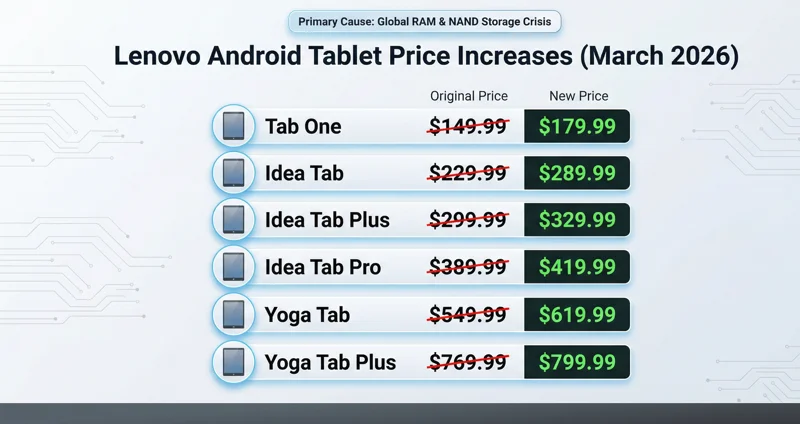
In the entry-level tier, which has traditionally been Lenovo’s strongest market segment for families and students, the price hikes are immediately noticeable. The Lenovo Tab One, previously hailed as the ultimate budget device at $149.99, has now been adjusted to $179.99. While a thirty-dollar increase might seem relatively small in the grand scheme of electronics, it represents a substantial 20% price hike for a budget-conscious buyer. Moving slightly up the ladder, the standard Lenovo Idea Tab has jumped from an affordable $229.99 to a much steeper $289.99.
The mid-range sector is experiencing similar inflation. The highly popular Idea Tab Plus, which strikes a balance between media consumption and light productivity, was originally priced at $299.99. Today, that same tablet will cost you $329.99. These increases completely alter the value proposition of Lenovo’s mid-range lineup, pushing them dangerously close to the pricing territory traditionally dominated by Apple’s base model iPads and Samsung’s Galaxy Tab S FE series.
Premium Tier and Pro Model Increases
The financial sting becomes even more pronounced when examining Lenovo’s premium tablet offerings. The Idea Tab Pro, a device aimed at professionals and digital artists, was originally slated to launch at a highly competitive $349. However, by the time it hit the market and underwent these recent adjustments, its price ballooned to $419.99—a massive leap from its initial conceptual pricing.
The flagship Yoga series, renowned for its unique built-in kickstand design and superior audio capabilities, has also been heavily impacted. The standard Lenovo Yoga Tab has climbed from $549.99 to $619.99. Meanwhile, the top-tier Yoga Tab Plus, which is designed to replace a traditional laptop for many users, has seen a relatively modest but still frustrating increase from $769.99 to $799.99. While Lenovo devices frequently go on sale during major retail holidays, this baseline increase ensures that even future “discounted” prices will likely be higher than the original MSRPs from last year.
The Quiet Death of the Legion Tab Gen 3
Beyond the frustrating price hikes, the most shocking development in Lenovo’s recent strategy shift is the abrupt end of sales for the Lenovo Legion Tab (Gen 3). If you navigate to the company’s website today, you will find that this dedicated gaming tablet has been pulled from active sale and replaced with an ambiguous “Available Soon” placeholder. In the tech e-commerce world, this specific phrasing is a notorious placeholder utilized when a product has been permanently discontinued to make way for new inventory.
The discontinuation of the Gen 3 model is a massive blow to the mobile gaming community. The Legion Tab Gen 3 was highly regarded for providing flagship-level gaming performance, excellent cooling thermals, and a high-refresh-rate display at a price point that did not alienate everyday gamers. Because Lenovo opted to sell this specific model exclusively through its own direct-to-consumer website rather than partnering with third-party retailers like Best Buy or Amazon, finding leftover stock is now virtually impossible. Once Lenovo pulled the plug on their main site, the device effectively vanished from the retail market entirely.
Preparing for the Shocking Legion Tab Gen 5 Release
The strategic removal of the Gen 3 tablet is a direct preparation maneuver for the highly anticipated launch of the Lenovo Legion Tab (Gen 5), which was officially announced earlier this year at the Mobile World Congress (MWC) 2026. While tech enthusiasts are incredibly eager to see the benchmark performance of the new Gen 5 hardware, the excitement is heavily overshadowed by the impending price tag.
Market analysts and early press materials suggest that the Legion Tab Gen 5 will launch with a staggering minimum price of $849. This is a monumental price increase compared to the outgoing Gen 3 model. Assuming the price does not climb even higher before the official release date due to the aforementioned RAM crisis, consumers are looking at a device that competes directly with ultra-premium tablets and full-fledged gaming laptops. While the Gen 5 will undoubtedly feature a cutting-edge processor, superior vapor chamber cooling, and top-tier display technology, forcing consumers to jump straight to an $849 device without offering a more affordable mid-tier gaming option feels like a misstep. Having the Gen 3 remain in the lineup at a reduced price would have provided a much-needed safety net for buyers.
What This Means for the Future of Android Tablets
Lenovo’s pricing strategy in 2026 serves as a harsh indicator of where the broader consumer electronics market is heading. The days of aggressively undercutting competitors with incredibly cheap, high-quality Android tablets may be temporarily over until the global supply chain stabilizes. Consumers looking to upgrade their devices this year must recalibrate their budgets and expectations. If you are in the market for a tablet, it is highly recommended to monitor retail events closely, consider refurbished units, or act quickly before other manufacturers like Samsung and Xiaomi inevitably follow Lenovo’s lead and adjust their own pricing structures to compensate for the ongoing component crisis.
Frequently Asked Questions
Why did Lenovo raise the prices on all its Android tablets?
The primary reason is the ongoing 2026 RAM and NAND flash storage crisis in the tech industry, which has drastically increased the cost of manufacturing raw components.
Which Lenovo tablets are affected by the price hike?
According to data from the US store, every single one of the dozen Android tablets Lenovo currently sells has seen a price increase, ranging from the budget Tab One to the premium Yoga Tab Plus.
Is the Lenovo Legion Tab Gen 3 still available for purchase?
No, Lenovo has ended sales of the Legion Tab Gen 3 on its official website, listing it as “Available Soon” to prepare for the launch of the next generation.
Can I buy the Legion Tab Gen 3 from other retailers like Amazon or Best Buy?
It is highly unlikely. Lenovo kept the distribution of the Legion Tab strictly to its own website and did not bring the tablet to third-party retailers in the US.
When is the Lenovo Legion Tab Gen 5 releasing, and how much will it cost?
The Legion Tab Gen 5 was announced at MWC 2026 and is expected to launch soon with a significantly higher price tag, currently rumored to start at $849.
Did the Lenovo Idea Tab Pro price increase?
Yes, the Idea Tab Pro was originally planned to retail at $349, but it has since been raised to $419.99 following the latest round of price hikes.
Will tablet prices go back down eventually?
Prices may stabilize or see temporary discounts during holiday sales events, but base MSRPs are unlikely to drop permanently until the global supply of RAM and storage returns to a massive surplus.
إخلاء مسؤولية: هذا المقال للأغراض المعلوماتية فقط، ونحن لسنا جهة تابعة لأي مؤسسة مالية أو حكومية مذكورة.