To truly understand the iphone apple ipod product history, one must look back at a time when the tech giant was terrified of its own success. As we reflect from the vantage point of 2026, marking Apple’s 50th anniversary, the narrative of the first iPhone remains a masterclass in corporate courage. It was a $500 gamble that required Apple to essentially render its most profitable product—the iPod—obsolete. This is the untold story of the sleepless nights, the failed prototypes, and the sheer shock experienced by the very engineers who built the device that reshaped human culture.
The Dilemma: When Your Biggest Success Becomes Your Biggest Threat
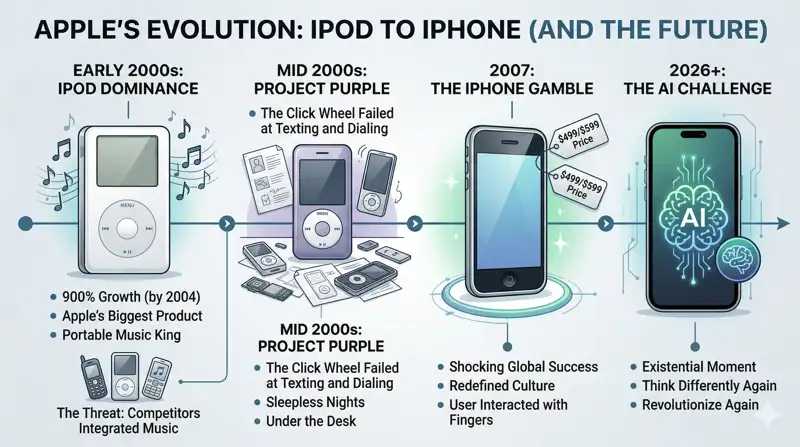
In the early 2000s, Apple was primarily known for desktop and laptop computers. But the launch of the iPod changed everything. By April 2004, the portable music player was experiencing an astronomical growth rate of over 900% year-over-year, vastly outselling the Mac. The iPod was not just a product; it was a cultural phenomenon that dictated the music industry’s future and established Apple as a powerhouse in portable consumer electronics.
However, Apple’s leadership, including co-creator of the iPod Tony Fadell, noticed a brewing storm. Competitors like Motorola, Samsung, and Nokia were beginning to integrate rudimentary MP3 players into their mobile phones. The realization hit the team in Cupertino: the days of consumers carrying multiple devices were severely numbered. If Apple did not cannibalize the iPod, someone else would.
“We were like, people are only going to carry one device. They’re going to have a cell phone with music, or they’re going to have an Apple product with music and communications. And it was like, ‘Okay, what are we going to make?'”
The Push for an “iPod Phone”
The initial instinct was conservative. Why risk the entire company on an unproven concept when you can simply iterate on what already works? The first iteration of Apple’s entry into the mobile phone market literally looked like an iPod that could make phone calls. According to former Apple executives Tony Fadell, Rubén Caballero, and Andy Grignon, the earliest prototypes even featured the iconic iPod click wheel.
The engineering team attempted to build an “iPod plus phone,” but the concept was a functional disaster. The click wheel, perfect for scrolling through song lists, was impossibly clunky for dialing phone numbers and practically useless for text messaging. It became clear that resting on the laurels of the iPod’s design language would not suffice for the smartphone era. A radical new approach was required.
| Device Paradigm | Primary Input Method | Core Functionality | Market Perception (Mid-2000s) |
|---|---|---|---|
| Traditional iPod | Click Wheel | Music playback, basic media | Dominant, essential for music |
| Early Smartphones (BlackBerry, Treo) | Physical QWERTY Keyboard | Email, calls, basic web | Strictly for business professionals |
| The “iPod Phone” Prototype | Click Wheel | Music + telephony | Failed internal concept |
| The Final Original iPhone | Multi-touch Capacitive Screen | Internet communicator, iPod, phone | Risky, unprecedented, expensive |
Project Purple: The Relentless Grind and Sleepless Nights
Once the decision was made to abandon the click wheel in favor of a full touchscreen, the complexity of the project—codenamed Project Purple—skyrocketed. Apple had never built anything so intricate. The transition required the company to start entirely from scratch, forging relationships with new suppliers, building new internal teams, and pioneering technologies that barely existed in consumer formats.
Refining the Touchscreen
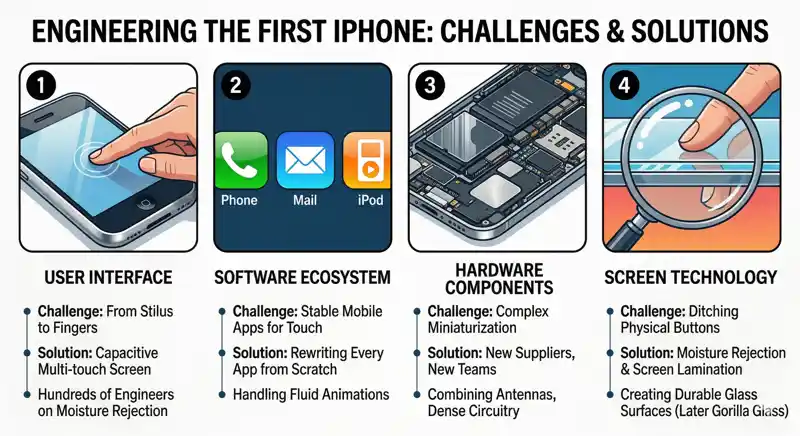
While touchscreens existed prior to the iPhone, they were predominantly resistive screens that required a stylus and felt cumbersome. Apple’s ambition was to use capacitive touch technology that responded to the gentle tap of a bare finger. This required hundreds of engineers laboring over excruciating technical details. They had to solve problems involving screen lamination, moisture rejection (to prevent sweat from registering as a touch), and gesture recognition.
Rubén Caballero, who served as Apple’s vice president of engineering from 2005 until 2019, recalls the grueling two and a half years leading up to the 2007 launch. It was a period defined by intense pressure, high stakes, and physical exhaustion.
“I slept, many times, under my desk.”
Software Built from the Ground Up
The hardware was only half the battle. Andy Grignon, a former Apple senior manager, noted that the software ecosystem presented unprecedented challenges. Because the input method had changed from a mouse and keyboard (or a click wheel) to human fingers, every single application had to be rewritten from scratch.
The operating system had to handle fluid animations, physics-based scrolling, and complex multi-touch gestures like pinch-to-zoom. During development, the software was incredibly unstable. Engineers constantly fought bugs and crashes, trying to figure out how to make this entirely new paradigm function reliably enough for consumer use. The “relentless grind” of the annual iPod release cycle had prepared them for hard work, but the iPhone was a different beast entirely.
| Engineering Challenge | Previous Apple Standard | The iPhone Solution |
|---|---|---|
| User Interface | Mouse/Keyboard or Click Wheel | Capacitive Multi-touch Display |
| Operating System | Mac OS X (Desktop focus) | iPhone OS (Rewritten for mobile/touch) |
| Component Density | Spacious laptop/desktop chassis | Extreme miniaturization, combined antennas |
| Durability | Standard plastics | Glass displays (eventually Gorilla Glass) |
The Shocking Success of a “Luxury Tier” Product
When Steve Jobs finally unveiled the iPhone in 2007, the industry’s reaction was mixed. Entering the mobile phone business was seen as a fool’s errand. Giants like Nokia and Motorola ruled the global landscape with an iron fist, and cellular carriers held tight, monopolistic control over marketing, distribution, and even the software that went on the phones.
Furthermore, the original iPhone was priced at $499 and $599 on contract. In an era where most consumers received their flip phones for free with a two-year carrier agreement, Apple’s device was considered exorbitantly expensive. Many analysts predicted it would fail, relegated to a niche status for wealthy tech enthusiasts.
Interestingly, this skepticism wasn’t limited to outside observers. Inside Apple, many of the very engineers who bled to create the device expected it to remain a high-end curiosity. They viewed it as a premium product, not a ubiquitous global utility.
“If you talk to pretty much anybody, you’ll find that there’s a common theme of: ‘Did you know the phone was going to be as big of a deal as it is?’ And the answer is none of us did. We expected it to be a higher-tier luxury product.”
The market’s reaction shattered all expectations. Consumers didn’t just want a phone; they wanted to take their entire digital lives with them. The iPhone wasn’t just a communication device; it was a status symbol, an entertainment hub, and a window to the internet that actually worked. The engineers were utterly surprised by the rapid adoption and the sweeping cultural shift their invention triggered. It reshaped how humanity communicates, works, and navigates the world. For further historical insights and official company milestones, tech historians often refer to the Official Apple Newsroom archives.
The 2026 Perspective: Legacy and the Next Existential Threat
Fast forward to Apple’s 50th anniversary in 2026, and the iPhone is indisputably the most important product in the company’s history. With billions of active Apple devices in use globally, the iPhone serves as the sun in Apple’s solar system. It spawned an entire, highly lucrative ecosystem of complementary products, including the Apple Watch, AirPods, and a massive services division.
Andy Grignon notes the sheer ubiquity of the device, observing that younger generations literally cannot function or get through their morning routines without it. Tony Fadell points out that the fundamental form factor of the iPhone hasn’t drastically changed over its nearly two-decade existence, which is the ultimate proof of the original design’s profound success.
The AI Revolution: Revolutionizing Again
However, the technology landscape never rests. Just as the iPod faced obsolescence from the smartphone, the traditional smartphone now faces a paradigm shift driven by Artificial Intelligence (AI). Apple finds itself in another “existential moment.”
In recent years, Apple has been perceived as lagging behind aggressively moving AI giants like Google and OpenAI. While Apple has struck strategic partnerships to bolster its AI capabilities, the pressure is on to redefine the user experience once again. The future of Apple depends not just on iterative hardware improvements, but on how intelligently and seamlessly AI can be integrated into the privacy-focused ecosystem they have built.
| Apple’s Existential Moments | The Threat | Apple’s Radical Pivot | The Result |
|---|---|---|---|
| Early 2000s | Irrelevance in mobile computing | Launching the iPod | Dominated portable music |
| Mid 2000s | Cell phones absorbing MP3 players | Cannibalizing iPod for iPhone | Triggered the smartphone revolution |
| Mid 2020s (2026) | The Generative AI Revolution | Deep OS AI integration & partnerships | The current battleground |
Fadell summarizes the current 2026 landscape perfectly: Apple must channel the same fearlessness it had when it killed the iPod. The company must think differently than it has over the last 15 years. To survive the next 50 years, Apple has to think about revolutionizing all over again.
Frequently Asked Questions
What was Apple’s most successful product before the iPhone?
Before the iPhone, the iPod was Apple’s biggest product. By 2004, it was growing at a staggering rate of over 900% and drastically outselling the Mac computer line.
Why did Apple decide to create the iPhone?
Apple executives realized that cell phone manufacturers like Samsung and Motorola were starting to build MP3 players into their phones. They knew consumers would eventually only want to carry one device, so Apple had to create a phone to prevent the iPod from becoming obsolete.
Did the first iPhone prototypes look like the final product?
No. The initial iterations looked exactly like an iPod that could make phone calls, complete with the famous physical click wheel. However, the click wheel proved terrible for texting and dialing, leading to the pivot to a full touchscreen.
Did the Apple engineers expect the iPhone to be a massive global hit?
Surprisingly, no. Many senior engineers and managers working on the first iPhone expected it to be a niche, “higher-tier luxury product” due to its high price tag ($500) and the tight control carriers had over the market at the time.
How did the iPhone change Apple’s business model?
The iPhone shifted Apple from being primarily a computer manufacturer to the world’s leading portable consumer electronics and services company, eventually spawning an ecosystem that includes the App Store, Apple Watch, and AirPods.
What was “Project Purple”?
Project Purple was the highly secretive internal code name for the development of the original iPhone at Apple during the mid-2000s.
What is the biggest challenge facing Apple in 2026?
According to former executives, the industry is in another existential moment due to the rapid advancement of Artificial Intelligence (AI). Apple’s future legacy depends heavily on how it adapts to AI and competes with or partners with companies like Google and OpenAI.
Disclaimer: This article is for informational purposes only and represents an analytical retrospective based on historical statements, executive interviews, and market data regarding Apple’s product history.