
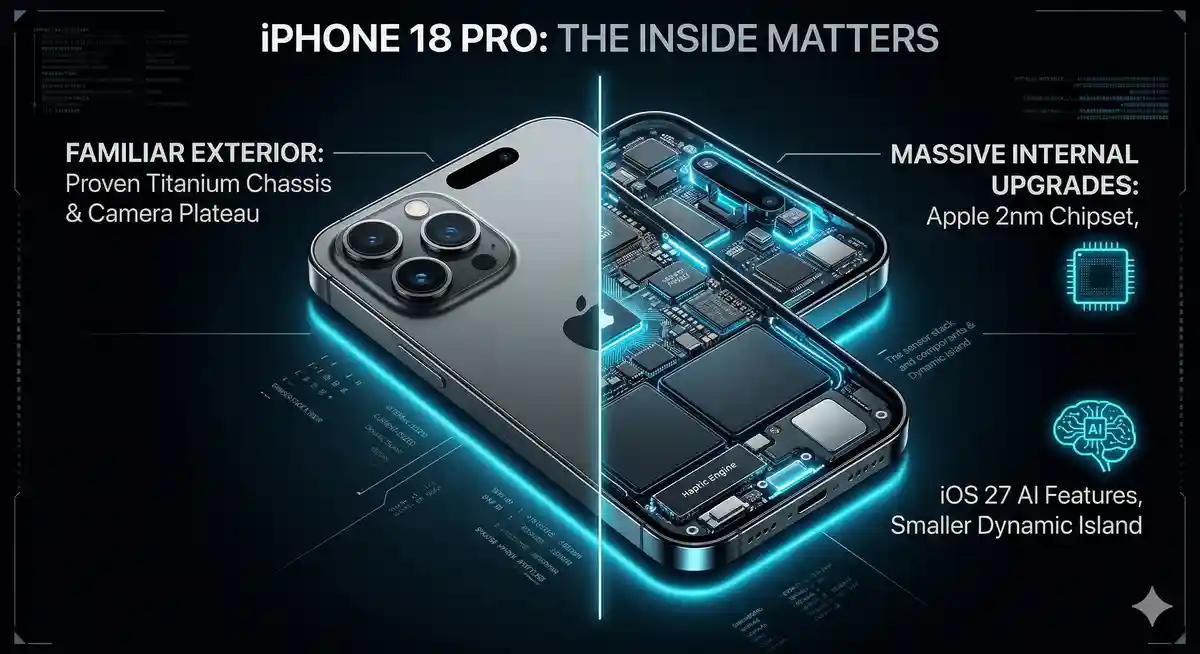
iPhone 18 Pro discussions in 2026 are dominating the tech landscape, but a surprising new trend has emerged on Google Discover and across tech forums: nobody actually cares that it looks identical to last year’s model. As we approach the highly anticipated fall launch, the entities dominating the conversation aren’t radical new chassis materials or bizarre camera placements, but rather the groundbreaking Apple 2nm chipset, the software revolution of iOS 27 AI features, and the stabilization of iPhone 18 Pro pricing. In an era where smartphone upgrade cycles have stretched to three or even four years, Apple is proving that a “boring” exterior is the ultimate trojan horse for massive internal innovation.
The iPhone 18 Pro Design Rumors: The Survey That Changes Everything
For years, tech enthusiasts have clamored for a revolutionary redesign with every annual smartphone release. However, a recent and highly revealing consumer survey indicates a massive paradigm shift in user expectations. According to the data, a staggering majority of smartphone users no longer believe the iPhone 18 Pro must come with a visual overhaul to be considered a worthy purchase. The reality is that the modern smartphone form factor has reached a state of maturity. The glass-and-metal slab we interact with daily is functionally optimized, and consumers are waking up to the fact that change for the sake of change is often detrimental to usability.
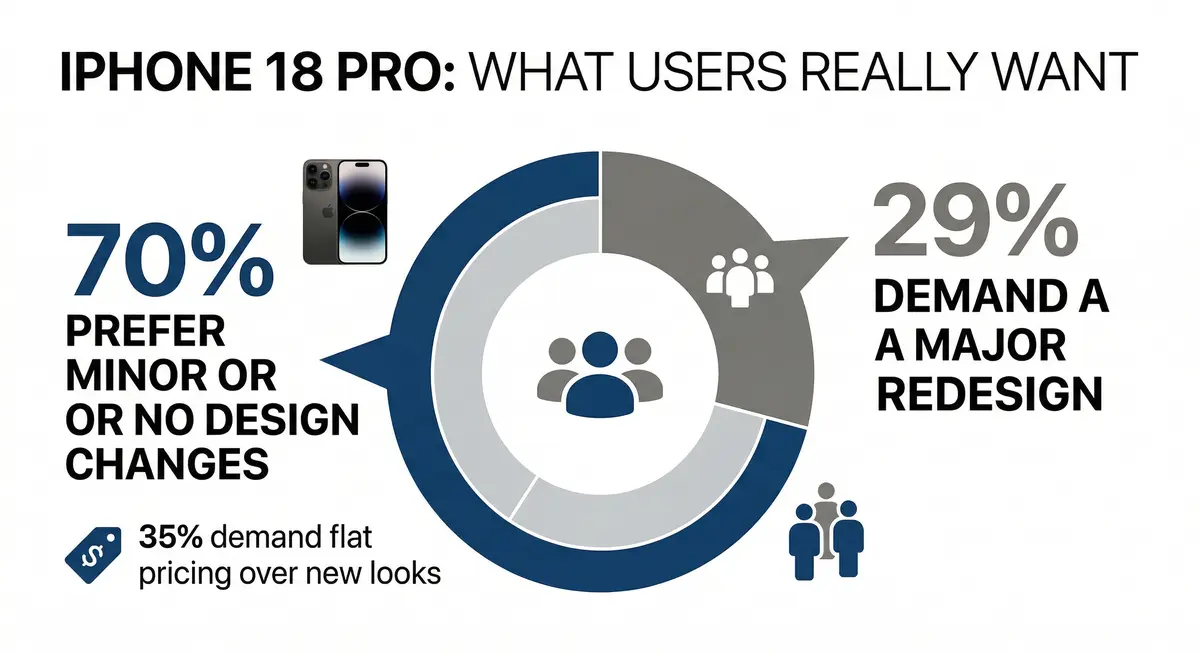
When analyzing the survey results, the numbers speak volumes. Over 70% of respondents cast their votes in support of minor or completely non-existent design changes for the upcoming flagship. Conversely, just under 30% of the voting pool indicated that a major redesign was necessary. For that vocal minority, a visual refresh is the primary metric that could justify a higher price tag. However, the true story lies in the nuances of the majority’s opinion. Close to 35% of all voters explicitly stated they support an iPhone 18 Pro with minor design tweaks—provided there are absolutely zero changes in pricing. Another 12% noted that simply offering a fresh palette of new colors would be more than enough to satisfy their aesthetic desires. Interestingly, nearly 24% of respondents admitted they simply do not care about the physical appearance of the iPhone 18 Pro because their current smartphone upgrade cycles dictate they aren’t upgrading this year anyway.
| Consumer Sentiment on iPhone 18 Pro Design | Percentage of Survey Votes | Primary Reasoning |
|---|---|---|
| Support minor/no design changes (keeping price flat) | 35% | Prefer stable pricing over cosmetic updates. |
| Not upgrading this year (indifferent) | 24% | Longer smartphone upgrade cycles (holding older models). |
| Satisfied with just new color options | 12% | Aesthetic novelty without architectural chassis changes. |
| Demand a major redesign | 29% | Need visual justification for premium flagship pricing. |
“We have undoubtedly reached peak smartphone design; resources are now vastly better spent on refining internal architecture rather than rethinking a form factor that already resonates perfectly with the global consumer.”
Why Redesigns Don’t Matter Like They Used To
To understand why the iPhone 18 Pro design rumors point toward a carbon copy of the previous generation, we must look at the historical context of Apple’s design language. The mere fact that the iPhone 17 Pro was heralded as a “major redesign” simply because it transitioned from a traditional camera island to a so-called “camera plateau” is proof positive that smartphone design has become somewhat stagnant. In reality, Apple is still fundamentally sticking to the same basic, flat-edged geometric elements that were reintroduced way back with the iPhone 12 series.
This is not a sign of laziness on Apple’s part; it is a sign of industrial design perfection. When a company finds a shape that maximizes battery volume, ensures structural rigidity, allows for optimal thermal dissipation, and fits comfortably in the human hand, deviating from it carries immense risk. Consumers have heavily invested in MagSafe accessories, specific car mounts, and ergonomic habits that are entirely dependent on this established form factor. By keeping the exterior “boring,” Apple ensures ecosystem continuity.
Improvements on the Inside: The Apple 2nm Chipset
If the outside is staying the same, where is Apple spending its billions in research and development? The answer lies beneath the glass. The upcoming iPhone 18 Pro is heavily rumored to be the first consumer device to feature the highly anticipated Apple 2nm chipset, manufactured by TSMC. This is a monumental leap in semiconductor technology. Moving from a 3nm node to a 2nm node allows for exponentially more transistors to be packed into the exact same silicon footprint.
What does this mean for the average user who doesn’t care about nanometer counts? It translates directly into massive leaps in battery efficiency and raw computational power. A 2nm chipset generates less heat under heavy loads, meaning the iPhone 18 Pro will sustain peak performance longer when gaming or rendering 4K spatial video. Furthermore, this extra space on the logic board allows Apple to focus on an incremental but highly requested hardware update: a notably smaller Dynamic Island, freeing up precious screen real estate without sacrificing the complex Face ID sensor array.
| Hardware Component | iPhone 17 Pro (2025) | iPhone 18 Pro (2026 Expected) |
|---|---|---|
| Processor Node | A19 Pro (3nm process) | A20 Pro (2nm process) |
| Display Cutout | Standard Dynamic Island | Smaller, refined Dynamic Island |
| Thermal Management | Graphene thermal system | Advanced vapor chamber & 2nm efficiency |
| Camera Design | Camera Plateau | Refined Camera Plateau (Identical footprint) |
iOS 27 AI Features: The Real Selling Point
Hardware is only half of the 2026 equation. The true differentiator for the iPhone 18 Pro will be its software, specifically the heavily rumored iOS 27 AI features. As generative AI becomes an expected, non-negotiable feature in mobile operating systems, Apple is shifting its marketing focus from “look at this new phone” to “look at what this phone can do for you.”
With the immense neural engine capabilities unlocked by the Apple 2nm chipset, iOS 27 is expected to process complex, multi-modal AI tasks entirely on-device, bypassing the need for cloud computing. This means instant, privacy-secure text generation, advanced real-time photo manipulation, and a drastically overhauled Siri that can navigate complex in-app actions with conversational ease. By maintaining a familiar physical design, Apple removes the learning curve of a new device, allowing the user to focus entirely on adapting to these powerful new software capabilities.
The Not-So-New Normal: Industry-Wide Stagnation
It is crucial to understand that Apple is not operating in a vacuum. The decision to maintain a consistent design language is indicative of a broader, industry-wide trend. That might be a tough pill to swallow for tech enthusiasts dreaming of wild, folding, or sliding redesigns every twelve months, but the reality is clear across the board. If we look at Apple’s fiercest competitors in 2026, the strategy is identical.
The upcoming Samsung Galaxy S27 series is widely reported to look almost indistinguishable from the Galaxy S26, maintaining the individual camera ring aesthetic that Samsung has relied on for years. Similarly, Google’s Pixel 11 is expected to be a carbon copy of the Pixel 10, retaining the iconic camera visor while focusing entirely on their custom Tensor silicon and Gemini AI integrations. This is the new normal. For anyone curious about how Apple officially presents its current lineup and design philosophy, you can review Apple’s official iPhone lineup to see how iterative design has long been part of their DNA.
“When the entire mobile industry aligns on iterative physical design, it signals a collective maturity; the true battleground for the next decade of smartphones is silicon efficiency and artificial intelligence, not the shape of the metal.”
| 2026 Flagship Device | Design Strategy | Primary Upgrade Focus |
|---|---|---|
| Apple iPhone 18 Pro | Iterative (Identical to 17 Pro) | 2nm Silicon, iOS 27 AI, Battery Life |
| Samsung Galaxy S27 Ultra | Iterative (Identical to S26 Ultra) | Snapdragon 8 Gen 5, Galaxy AI updates |
| Google Pixel 11 Pro | Iterative (Identical to Pixel 10) | Tensor G6, Advanced Camera Processing |
iPhone 18 Pro Pricing: The Financial Benefit of “Boring”
Perhaps the most compelling argument for the “boring” iPhone 18 Pro design rumors is how it impacts the consumer’s wallet. Developing a brand-new chassis, retooling manufacturing lines, sourcing new materials, and redesigning internal layouts costs billions of dollars. In an economy where inflation and supply chain complexities are constantly driving tech prices up, manufacturers must find ways to offset costs. The 2nm fabrication process is incredibly expensive. By saving money on the physical design R&D, Apple is heavily expected to keep the iPhone 18 Pro pricing completely unchanged from the previous generation.
This is a massive win for the consumer. When paired with the longer smartphone upgrade cycles—where users hold onto their devices for 3 to 4 years—a redesign every few generations is more than enough to feel fresh when someone finally decides to upgrade. If a stagnant design is the trade-off required to get industry-leading 2nm performance and advanced iOS 27 AI features without a $100 price hike, the vast majority of consumers will take that deal every single time.
Conclusion: Embracing the Future of Iteration
The tech community may occasionally lament the loss of the “wild west” days of smartphone design, where every year brought a drastically different shape or concept. However, the data proves that Apple is absolutely on the right path with the iPhone 18 Pro. By embracing a mature, universally accepted form factor, Apple ensures high manufacturing yields, broad accessory compatibility, and stable pricing. The real magic of the 2026 iPhone won’t be seen from across the room; it will be felt in the palm of your hand as the 2nm chipset and iOS 27 redefine what a pocket computer is capable of. Boring has never been so powerful.
Frequently Asked Questions (FAQs)
Will the iPhone 18 Pro look different from the iPhone 17 Pro?
Based on current iPhone 18 Pro design rumors and supply chain leaks, the device will look almost identical to the iPhone 17 Pro, retaining the same “camera plateau” and flat-edged titanium aesthetic.
What is the main upgrade for the iPhone 18 Pro if the design is the same?
The most significant upgrades are internal, specifically the transition to the groundbreaking Apple 2nm chipset, which offers massive improvements in power efficiency and performance, alongside a potentially smaller Dynamic Island.
Will the iPhone 18 Pro pricing increase in 2026?
Analysts predict that by saving on the R&D and manufacturing retooling costs associated with a major redesign, Apple will likely keep the starting price of the iPhone 18 Pro identical to the previous generation.
How will iOS 27 AI features change the iPhone 18 Pro experience?
iOS 27 is expected to heavily leverage the new 2nm chip’s neural engine to run advanced, multi-modal generative AI tasks entirely on-device, offering faster, more private, and deeply integrated smart features across all native apps.
Why are smartphone upgrade cycles getting longer?
Smartphones have reached a point of diminishing returns regarding daily performance. Current devices are fast, have great battery life, and receive software support for over five years, reducing the urgent need for consumers to upgrade annually.
Are other companies also reusing their phone designs?
Yes, the entire industry is shifting toward iteration. Major competitors like Samsung with the Galaxy S27 and Google with the Pixel 11 are also expected to use nearly identical designs to their previous models to focus on software and silicon upgrades.
Is Apple going to shrink the Dynamic Island on the iPhone 18 Pro?
Rumors strongly suggest that the internal space saved by more efficient logic board designs will allow Apple to slightly reduce the footprint of the Dynamic Island, giving users a bit more usable screen space.
Disclaimer: This article is for informational purposes only. The specifications, pricing, and design details discussed regarding the iPhone 18 Pro, iOS 27, and competitor devices are based on industry rumors, consumer surveys, and supply chain analyses available as of 2026, and are subject to change prior to Apple’s official announcements.