The hisense ur9s tv displayport mini led hdmi alternative is arguably the most exciting hardware revelation of 2026, aggressively bridging the gap between premium living room televisions and elite PC gaming monitors. For years, the television industry has treated HDMI as the undisputed king of connectivity. From the reliable HDMI 2.0 to the emerging HDMI 2.2 standard, consumers have been locked into a single lane of display technology. However, Hisense has decided to buck conventional wisdom, introducing a flagship display that offers a massive leap forward for enthusiasts who demand zero compromises.
The DisplayPort Game-Changer: Breaking Traditional Molds
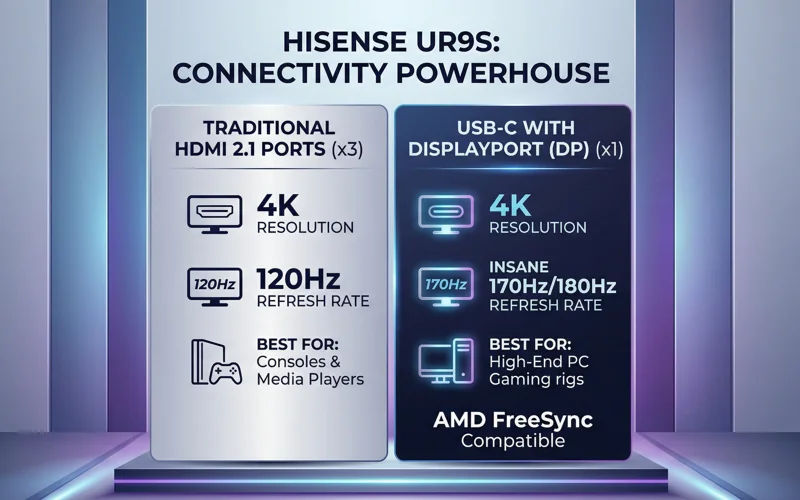
When you look at the back of a modern television, you expect a row of HDMI ports. The Hisense UR9S features three HDMI 2.1 ports, which successfully cater to standard consoles and media players, capping out at a respectable 4K resolution at 120Hz. But the true innovation lies in the inclusion of a USB-C port that delivers full DisplayPort (DP) functionality. This feature is heavily labeled and marketed for a reason: it completely bypasses the bandwidth limitations of traditional television HDMI connections.
For hardcore PC gamers equipped with top-tier graphics cards, this DisplayPort alternative is a dream come true. By connecting a gaming rig directly to the UR9S via DP, users can unlock staggering refresh rates of 4K at 170Hz or even 4K at 180Hz, depending on the screen size. This fundamentally transforms the television into a massive, hyper-responsive gaming monitor, entirely eliminating screen tearing and input lag when paired with its native AMD FreeSync compatibility.
“By integrating DisplayPort functionality via USB-C, Hisense is blurring the line between a traditional living room television and a high-end PC gaming monitor.”
| Connection Type | Max Resolution | Max Refresh Rate | Best Suited For |
|---|---|---|---|
| HDMI 2.1 | 4K | 120Hz | Standard Game Consoles |
| USB-C (DisplayPort) | 4K | 180Hz | High-End PC Gaming |
Next-Gen Visuals: RGB Mini LED and Market Disruption
Beyond the connectivity revolution, the visual fidelity of the UR9S is engineered to dominate the 2026 market. The TV utilizes an advanced RGB Mini LED backlight system. Unlike standard Mini LED panels that rely on white LEDs with color filters, RGB Mini LEDs provide pure red, green, and blue light directly. This results in unprecedented color accuracy, blinding peak brightness, and deep, inky blacks that rival OLED displays without the risk of permanent burn-in.
As showcased at CES 2026, other tech giants like Samsung, Sony, and LG are also experimenting with RGB Mini LED technology. However, Hisense is carving out a highly specific niche by combining this visual horsepower with DisplayPort functionality. To sweeten the deal, the manufacturer has promised future firmware updates that will introduce Dolby Vision 2 HDR, further cementing the UR9S as a future-proof investment. For those tracking the company’s announcements, keeping an eye on Hisense’s official updates will reveal exact firmware rollout dates.
“With RGB Mini LED panels capable of pushing 180Hz at stunning 4K resolutions, the UR9S isn’t just competing with standard TVs; it is creating an entirely new tier of display.”
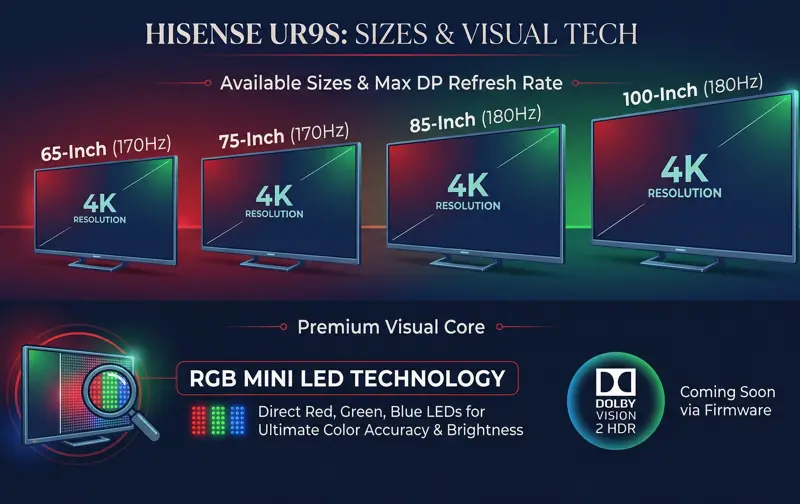
The UR9S lineup is designed to fit a variety of massive entertainment spaces, launching in four distinct sizes. Interestingly, the maximum refresh rate via DisplayPort scales with the size of the panel, rewarding buyers who opt for the most cinematic dimensions.
| Screen Size | Panel Technology | Max DP Refresh Rate |
|---|---|---|
| 65-Inch | RGB Mini LED | 170Hz |
| 75-Inch | RGB Mini LED | 170Hz |
| 85-Inch | RGB Mini LED | 180Hz |
| 100-Inch | RGB Mini LED | 180Hz |
Frequently Asked Questions
What makes the Hisense UR9S different from other 2026 smart TVs?
It features a USB-C port that acts as a DisplayPort, allowing PC gamers to achieve up to 180Hz at 4K resolution, bypassing traditional HDMI limitations.
Does the Hisense UR9S still include HDMI ports?
Yes, it includes three HDMI 2.1 ports for standard connections, supporting up to 4K at 120Hz for modern gaming consoles.
What is RGB Mini LED technology?
It is an advanced backlighting system that uses individual red, green, and blue LEDs rather than white LEDs with filters, resulting in superior color accuracy and brightness.
What refresh rates does the UR9S support via DisplayPort?
The 65 and 75-inch models support up to 4K at 170Hz, while the 85 and 100-inch models support a massive 4K at 180Hz.
Is the UR9S compatible with AMD FreeSync?
Yes, the television is fully compatible with AMD FreeSync, ensuring smooth, tear-free gameplay when connected to compatible PC graphics cards.
Will the Hisense UR9S support Dolby Vision?
Yes, Hisense has announced plans to add Dolby Vision 2 HDR support in a future firmware update.
Who is the primary target audience for this TV?
While great for general home theater use, its core audience consists of hardcore PC gamers who want massive screen sizes without sacrificing the high refresh rates typically found only on desktop monitors.
Disclaimer: This article is for informational purposes only. Product specifications, firmware updates, and connectivity features for the Hisense UR9S are based on manufacturer announcements and are subject to change.