Have you heard about the GTA 6 and the Mystery of the Missing Ferris Wheel Reflection? In 2026, the gaming community is buzzing after a new promotional video clip surfaced.
Rockstar Games recently updated its official website with new details, including the game’s official cover art. Alongside an 80s-inflected music track, an embedded video clip of the Vice City skyline at night was revealed.
The frame is packed with incredible detail, from foreground tennis courts to distant skyscrapers. However, observant fans quickly spotted a major visual inconsistency in the wide central bay.
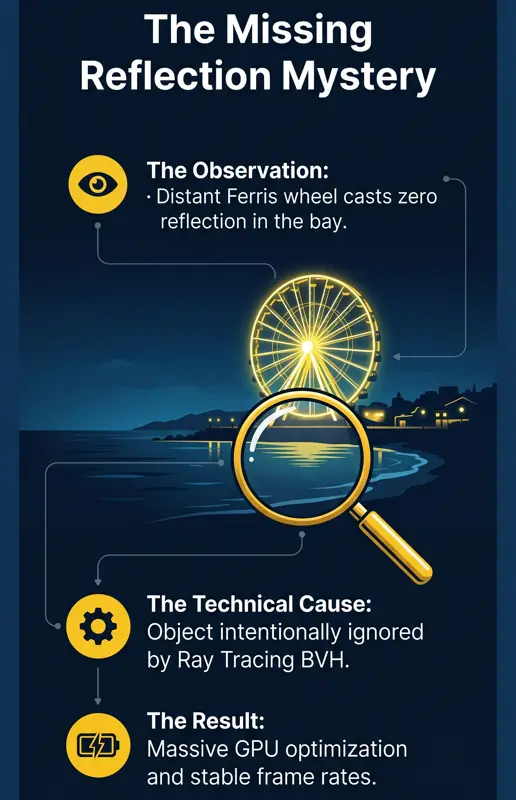
While discussing GTA 6 and the Mystery of the Missing Ferris Wheel Reflection, many players noticed that the massive amusement ride casts absolutely zero reflection in the water below.
Unpacking GTA 6 and the Mystery of the Missing Ferris Wheel Reflection
To understand why this happens, we must look at how modern game engines render complex environments. It is crucial to determine if this is a glaring bug or a calculated optimization technique.
Based on previous, much lengthier trailers, we know that the game features ray traced water reflections. However, this new night shot indicates a hybrid rendering approach.
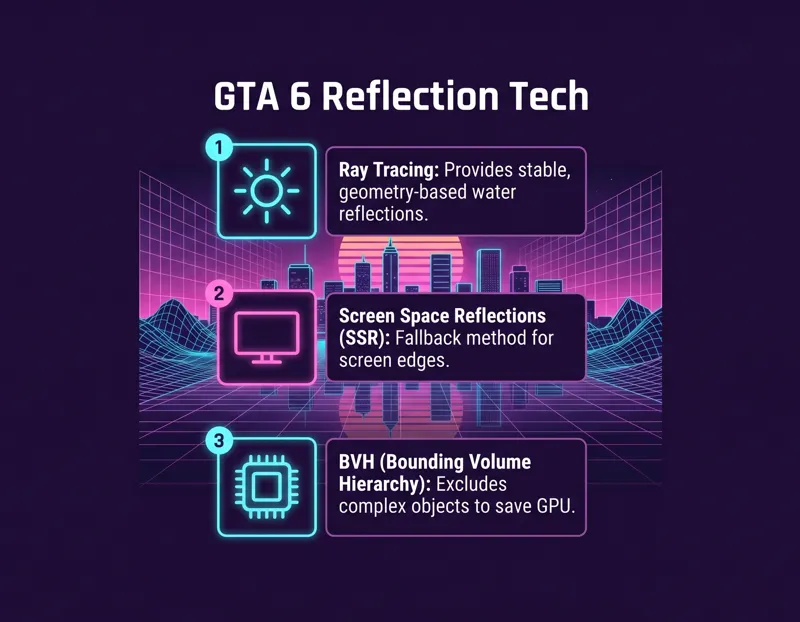
The RAGE engine appears to utilize both hardware-accelerated ray tracing and traditional Screen Space Reflections (SSR) to render the bustling Vice City environment.
| Visual Element | Trailer Observation |
|---|---|
| Vice City Skyscrapers | Reflected via ray tracing, though noticeably brighter than the source. |
| Water Surface | Stable, lacking SSR occlusion artefacts from flying helicopters. |
| Distant Ferris Wheel | Casts absolutely no reflection on the water. |
The Tech Behind GTA 6 and the Mystery of the Missing Ferris Wheel Reflection
Ray tracing allows the game to mirror the geometric mesh of nearby buildings. Interestingly, the reflections in the trailer do not factor in ambient occlusion or detailed shadows.
This results in the reflected image looking visibly brighter than the physical buildings above it. Ray tracing is highly demanding on GPU hardware, so developers must make compromises.
“Ray tracing can be configured in multiple ways to save on GPU performance, especially in dense open-world environments.”
To maximize RAGE engine graphics performance, the developers likely configured the ray tracing pipeline to discriminate between specific objects. This brings us to a concept known as the Bounding Volume Hierarchy.
How BVH Explains GTA 6 and the Mystery of the Missing Ferris Wheel Reflection
The Bounding Volume Hierarchy (BVH) allows the engine to exclude certain objects from the ray tracing pass entirely. This alone perfectly explains the missing amusement ride reflection.
Even though the wheel is within a similar range to the surrounding buildings, it simply is not flagged to reflect in the water. Dropping complex, distant geometry from RT calculations is a massive GPU saving trick.
This approach has major upsides, too. Because the scene relies heavily on ray tracing rather than pure SSR, there are no occlusion artefacts when skyscrapers or helicopters encroach on the screen space.
| Rendering Method | Role in Vice City Trailer |
|---|---|
| Ray Tracing (RT) | Provides stable, geometry-based reflections for main buildings. |
| Screen Space Reflections (SSR) | Acts as a fallback method, filling in blanks at the screen edges. |
| Bounding Volume Hierarchy (BVH) | Excludes complex objects like the Ferris wheel to save GPU power. |
Will Rockstar Fix GTA 6 and the Mystery of the Missing Ferris Wheel Reflection?
It remains to be seen if this ray tracing quirk will be tweaked in the final retail release. Variables like camera distance play a massive role in what gets rendered.
In this brief 10-second clip, neither ray tracing nor SSR is configured to reflect that specific piece of geometry. SSR is clearly present as a fallback, evidenced by subtle cut-offs at the screen edges.
As we get closer to launch, Rockstar Games might adjust the BVH parameters to include the ride in reflection passes.
“For now, the missing reflection stands as a fascinating glimpse into how modern game engines balance breathtaking fidelity with hardware limits.”
Until we have our hands on the final build, the GTA 6 and the Mystery of the Missing Ferris Wheel Reflection will remain a hot topic among graphics enthusiasts and loyal fans.
Frequently Asked Questions
What is the GTA 6 and the Mystery of the Missing Ferris Wheel Reflection?
It refers to a recent Vice City trailer clip where a large Ferris wheel in the background casts no reflection on the bay’s water, unlike the surrounding buildings.
Does the game use ray tracing or SSR?
The trailer indicates a hybrid approach, using ray traced water reflections for primary geometry and Screen Space Reflections (SSR) as a fallback method.
Why would developers exclude the Ferris wheel from reflections?
To save crucial GPU performance. Rendering complex, moving geometry in a ray tracing pass is expensive, so developers exclude certain items to maintain smooth frame rates.
What is Bounding Volume Hierarchy (BVH)?
BVH is a technical method used in ray tracing to organize objects. Developers can use it to flag specific items, like the Ferris wheel, to be ignored by the reflection pass.
Why are the reflections in the trailer brighter than the actual buildings?
To further optimize RAGE engine graphics performance, the reflections do not factor in ambient occlusion or complex shadows, resulting in a brighter, less shaded mirror image.
Are there occlusion artefacts in the water reflections?
No. Thanks to the ray tracing implementation, flying helicopters and screen-edge skyscrapers do not cause the messy occlusion artefacts typically seen with pure SSR.
Is this a final representation of the game’s graphics?
Not necessarily. The game is still in development, and developers often tweak rendering variables and BVH flags right up until the final release date.
Disclaimer: This article is for informational purposes only. Game features, graphics performance, and rendering techniques are subject to change prior to the official release.