Google and Xreal’s ‘Project Aura’ XR Smart Glasses Are Legit, offering a lightweight alternative to clunky spatial computing headsets.
Unveiled at Google I/O 2026, this highly anticipated collaboration bridges the gap between basic audio frames and heavy virtual reality gear. Instead of isolating users from the real world, it delivers an accessible, compact spatial experience directly onto a standard eyewear frame.
As tech enthusiasts look for more practical everyday solutions, this hardware provides a fresh direction. Let us dive deep into the design, software ecosystem, and features that make this new wearable a genuine contender in the industry.
Hardware Architecture: Why Google and Xreal’s ‘Project Aura’ XR Smart Glasses Are Legit
The immediate standout feature of Project Aura is how incredibly natural it feels on your face. Weighing practically the same as standard Xreal hardware, it completely bypasses the bulkiness commonly associated with premium spatial hardware platforms.
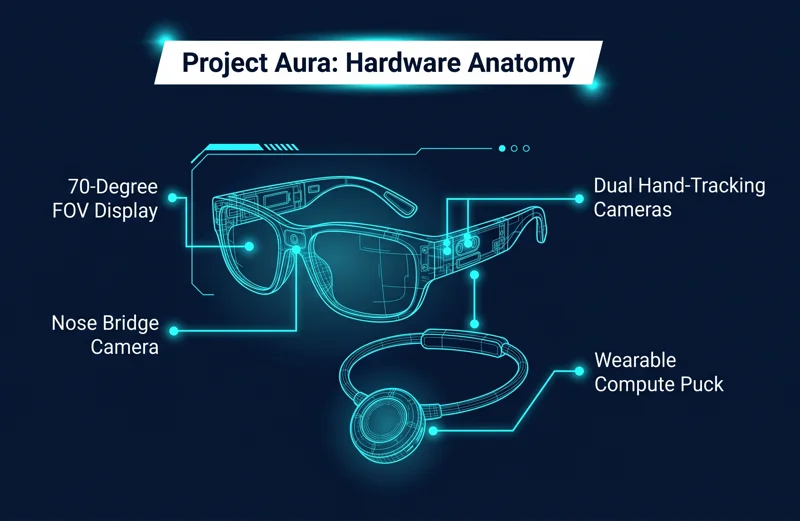
The glasses integrate three specialized cameras hidden discreetly within the lightweight frame. A central camera located on the nose bridge handles quick photo and video capture, while dual side-mounted cameras manage real-time hand movements.
To keep the frames ultra-light, the processing power is offloaded entirely to a separate wearable puck. This compute unit connects via a sleek cable on the left arm and can be worn comfortably around the neck with an attached lanyard.
| Hardware Component | Specifications & Placement | Primary Function |
|---|---|---|
| Nose Bridge Camera | Single Center Sensor | Photos and Video Capture |
| Peripheral Cameras | Dual Side Sensors | Spatial Hand Tracking |
| Compute Puck | External Neckwear Unit | System Processing & Power |
Visual Fields and Display Capabilities
When it comes to visual immersion, testimonies confirm that Google and Xreal’s ‘Project Aura’ XR Smart Glasses Are Legit. The hardware sports an impressive 70-degree field of view, which is remarkably wide for a pair of compact smart glasses.
This wide field of view allows you to anchor multiple virtual applications side-by-side in your actual living environment. Users can easily view three distinct active application windows simultaneously without crowding their natural eyesight.
The micro-OLED panel technology delivers incredibly sharp graphics, ensuring that fine text is readable. The system handles text presentation gracefully, making web browsing and multi-tasking highly efficient without noticeable pixelation.
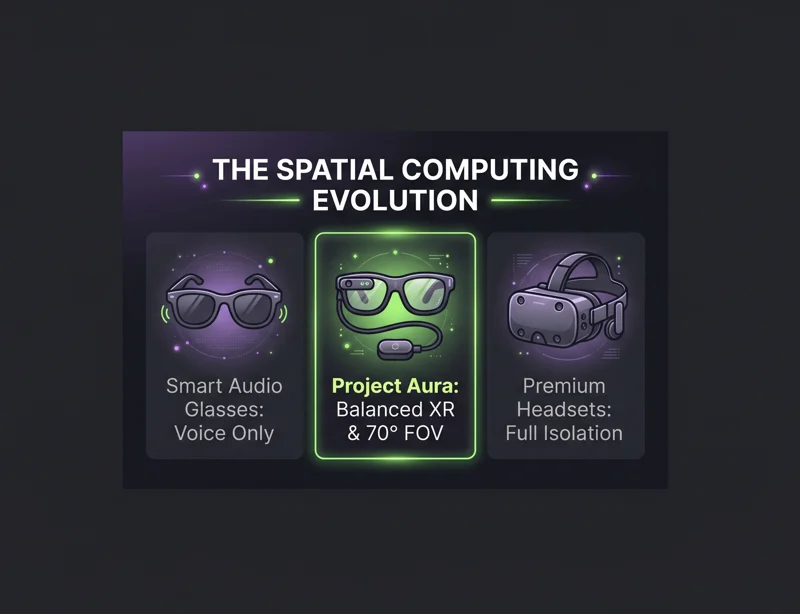
By blending a wide 70-degree field of view with an external compute puck, Project Aura creates a balanced spatial computing environment without isolating the user.
Software and Spatial Performance: Google and Xreal’s ‘Project Aura’ XR Smart Glasses Are Legit
The device operates on Google’s specialized Android XR spatial platform, bringing deep ecosystem integration directly into your field of vision.
Navigation relies on physical hand tracking gestures rather than external hardware controllers. Users simply reach forward, pinching their fingers to select digital objects or holding a pinch gesture to drag app windows around their space.
Because there is no internal eye-tracking technology, you navigate by turning your head toward the object you want to interact with. To learn more about software developments, check out the official Android Developers portal.
| Software Feature | Supported Functionality | Current Limitation |
|---|---|---|
| Hand Tracking | Pinch to select, hold to drag windows | Occasional gesture drops |
| Gemini Intelligence | Real-time physical object identification | Requires stable internet connection |
| Laptop Extension | Mirrors laptop screen over USB-C | Window dragging needs polish |
Gaming and Gemini AI Integration
The interactive software environment proves that Google and Xreal’s ‘Project Aura’ XR Smart Glasses Are Legit when running spatial games like Demeo. Players can use natural dual-hand gestures to grab, rotate, scale, and manipulate whole map levels smoothly.
Opening your right palm acts as a contextual macro command, instantly displaying your available digital playing cards. This gesture-driven interface feels far more natural and engaging than utilizing a standard plastic gamepad controller.
Furthermore, built-in Gemini Intelligence provides incredible contextual awareness of the physical room around you. The AI can look at a shelf, accurately identify real-world objects, and provide details about them instantly.
Gemini AI integration transforms these glasses from a passive display into an active, intelligent assistant that understands your physical environment.
The Verdict on Project Aura Ahead of Global Launch
While the operating system still requires a final layer of software polish, the underlying hardware proof-of-concept remains incredibly strong.
The device offers an intermediate solution between basic audio eyewear and massive, thousands-of-dollars headwear. For a breakdown of the current market placement, look at the comparison matrix below.
| Device Category | Form Factor | Spatial Computing Capacity |
|---|---|---|
| Smart Audio Glasses | Standard Eyewear | None (Audio & Voice Only) |
| Project Aura | Compact Glasses + Puck | Moderate (70-degree FOV) |
| Premium XR Headsets | Bulky Headset | Full Immersive Isolation |
Ultimately, Google and Xreal’s ‘Project Aura’ XR Smart Glasses Are Legit because they prioritize daily comfort, visual balance, and everyday utility over isolation.
7 FAQs About Project Aura XR Glasses
What operating system runs on Project Aura?
The smart glasses run natively on Google’s new Android XR spatial computing platform.
Does the device feature built-in eye-tracking technology?
No, Project Aura relies on head-turning positioning paired with physical hand tracking gestures instead of eye-tracking.
How wide is the field of view on these smart glasses?
The device features an impressive 70-degree field of view, capable of hosting multiple app windows simultaneously.
Where is the main processor located on Project Aura?
The processing components are located inside an external compute puck worn around the neck to keep the eyewear lightweight.
Can these glasses interact with real-world objects?
Yes, integrated Gemini Intelligence allows the glasses to scan, analyze, and talk about physical objects in your environment.
Can I use Project Aura as an external laptop monitor?
Yes, you can connect your laptop directly to the compute puck via a USB-C cable to extend your desktop display.
When will these smart glasses be officially released?
The companies have announced a global launch scheduled for later in 2026, though exact regional dates are pending.
Disclaimer: This article is for informational purposes only. Specifications, software capabilities, and release timelines reflect pre-launch demo models and are subject to change by Google and Xreal before the final retail release.