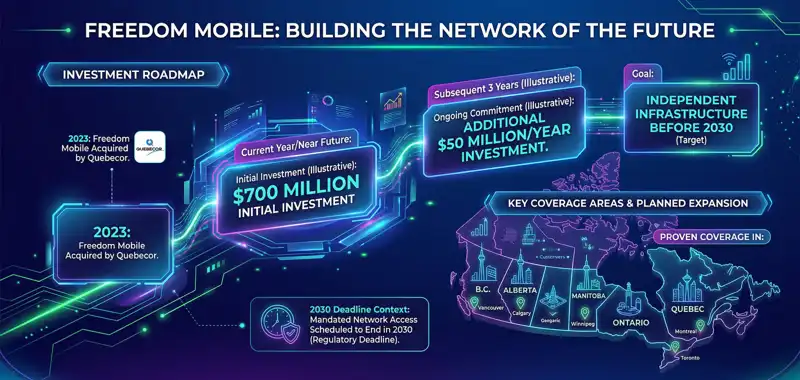
With the latest telecommunications news confirming plans for Freedom Mobile to ramp up spending on its network infrastructure, the Canadian wireless landscape is bracing for a massive shift. Quebecor, the parent company of Freedom Mobile, has announced an aggressive strategy to invest a staggering $700 million in capital expenditures this year alone. This bold financial maneuver is not merely about expanding 5G coverage; it is a calculated survival strategy ahead of the critical 2030 deadline when the mandated network access framework is scheduled to end. For millions of Canadians who have long suffered under some of the highest mobile data prices in the developed world, this Quebecor network infrastructure investment could be the permanent lifeline they have been waiting for.

Breaking Down Quebecor’s Ambitious Network Strategy
To understand why Freedom Mobile is injecting such massive capital into its infrastructure, we must look at the regulatory environment governing the Big Three telecom competitors Canada currently relies on. Following its acquisition by Quebecor in 2023, Freedom Mobile was granted mandated network access by federal regulators. This policy forced legacy carriers to allow Freedom to piggyback on their existing towers where it lacked its own, effectively accelerating competition. However, this safety net was never meant to be permanent. With the Canadian Radio-television and Telecommunications Commission signaling that this mandated access will likely expire in 2030, Freedom Mobile is racing against the clock.
According to CEO Pierre Karl Péladeau, the initial $700 million injection this year will be followed by sustained investments of $50 million annually for the subsequent three years. This front-loaded spending spree is designed to rapidly build physical towers, lay fiber-optic cables, and acquire essential spectrum to ensure Freedom Mobile coverage expansion reaches critical mass before the regulatory training wheels are removed. Even if arbitration for roaming agreements remains a possibility post-2030, owning the underlying infrastructure gives Quebecor ultimate leverage in any future negotiations.
“The $700 million infrastructure investment is not just about expanding coverage; it is a declaration of independence that will fundamentally disrupt the traditional Canadian telecom monopoly.”
This strategy is heavily scrutinized by industry analysts who note that building a national network from scratch is a monumental task. The geography of Canada makes rural deployment notoriously expensive. However, by focusing heavily on dense urban corridors and strategic suburban expansions in Ontario, B.C., Alberta, Manitoba, and Quebec, Freedom is reinforcing its strongholds where its 4.4 million wireless customers predominantly reside.
| Investment Phase | Allocated Budget | Strategic Objective |
|---|---|---|
| Year 1 (Current) | $700 Million | Rapid tower deployment, 5G spectrum activation, reducing reliance on mandated roaming. |
| Year 2 | $50 Million | Network optimization, filling coverage gaps, edge computing integration. |
| Year 3 | $50 Million | Rural expansion, enhancing network redundancy, and finalizing independent infrastructure. |
| Year 4 (Approaching 2030) | $50 Million | Final preparations for the expiration of the CRTC mandated network access. |
What This Means for Canadian Wireless Plan Pricing
The most immediate and tangible benefit of Freedom Mobile’s aggressive expansion is the downward pressure it exerts on Canadian wireless plan pricing. Historically, the Big Three telecom companies have maintained a tight grip on market pricing, leading to frequent and frustrating price hikes for consumers. Freedom Mobile has positioned itself as the definitive market disruptor. By operating an increasingly robust independent network, Freedom is empowered to offer promotional rates that force competitors into a price war.
A prime example of this market disruption was witnessed recently when Freedom repeatedly rolled out an aggressive $40/250GB CAN/US/MEX plan, heavily loaded with global roaming features. This bold pricing strategy immediately triggered reactionary discounts from subsidiary brands owned by the major telecom giants. Consumers directly benefit from this intense competition. Furthermore, Freedom Mobile actively promotes its highly popular “Price Freeze Promise.” This guarantee ensures that a customer’s base wireless plan price will never increase as long as they maintain their account, serving as a powerful counter-narrative to the standard industry practice of creeping fees.
“By offering massive data buckets at unprecedented prices combined with a strict Price Freeze Promise, Freedom Mobile is proving that affordable, high-quality connectivity is entirely possible in Canada.”
This consumer-centric approach is yielding massive dividends for Quebecor. Since the official acquisition of Freedom Mobile in 2023, Quebecor’s share price has surged by an impressive 85 percent. This financial success story validates the business model: invest heavily in consumer trust and network reliability, and the market share will follow. To better understand the regulatory framework allowing this competition to thrive, you can review the policies detailed by the Canadian Radio-television and Telecommunications Commission.
The End of Mandated Access: The 2030 Cliff
While the current regulatory landscape favors competition, the looming 2030 deadline for the CRTC mandated network access 2030 expiration is a critical juncture. Currently, the threat of regulatory arbitration forces major networks to lease out space to Freedom at reasonable rates. If the government decides to firmly cut this cord in 2030 without extensions, Freedom Mobile will have to rely on commercial roaming agreements in areas where its $700 million investment could not reach. Negotiating these agreements without the backing of federal arbitration could lead to higher wholesale costs.
However, analysts are deeply divided on whether the federal government will actually allow the mandate to expire cleanly. Given the undeniable success the policy has had in lowering wireless costs—a major political talking point during elections—there is strong speculation that some form of safety net may be extended. Regardless of the political outcome, Quebecor’s proactive infrastructure spending ensures that Freedom Mobile will be negotiating from a position of strength rather than desperation. The more towers they own, the less they need to rent.
| Telecom Provider | Pricing Strategy | Price Guarantee |
|---|---|---|
| Freedom Mobile | Aggressive value pricing, cross-border roaming bundles, high data limits (e.g., $40/250GB). | Price Freeze Promise (Base rate never increases). |
| Big Three (Premium Brands) | Premium pricing focusing on peak speeds, 5G+ access, and bundled home services. | Historically subject to routine base-rate increases. |
| Big Three (Flanker Brands) | Reactionary pricing matching Freedom’s plans temporarily to reduce customer churn. | Rarely offer lifetime price lock guarantees. |
Long-term Outlook for Canadian Connectivity
The transformation of Freedom Mobile from a regional alternative into a legitimate national competitor is the most significant telecom development of the decade. The decision by Quebecor to allocate upwards of $850 million over the next four years shows a deep commitment to the Canadian consumer. As the network matures, we can expect to see enhanced 5G capabilities, better building penetration for signals, and wider availability in suburban and rural corridors. For the average Canadian, this translates directly to more choices, better services, and most importantly, retention of a larger portion of their monthly budget.
Furthermore, Freedom Mobile’s success proves that a fourth national carrier is not only viable but essential for a healthy telecommunications market. It puts the onus on the legacy carriers to innovate and improve customer service rather than relying on an entrenched monopoly to guarantee profits. As 2030 approaches, all eyes will be on Ottawa and the CRTC to see how they manage the transition, but one thing is certain: Freedom Mobile is building its own road, and it is paved with a $700 million investment.
Frequently Asked Questions
Why is Freedom Mobile investing $700 million this year?
Freedom Mobile is ramping up spending to rapidly build its own independent network infrastructure before the federal mandate that allows them to use competitors’ networks expires in 2030.
What is the mandated network access policy?
It is a federal CRTC policy requiring Canada’s major telecom companies to allow competitors like Freedom Mobile to use their network towers at regulated rates to foster market competition.
Will my Freedom Mobile plan get more expensive to pay for this?
No. Freedom Mobile actively promotes its “Price Freeze Promise,” which guarantees that the base price of your current wireless plan will never increase as long as you keep it.
How does this infrastructure investment benefit regular consumers?
By building its own network, Freedom reduces its operating costs and reliance on rivals. This allows them to continue offering highly competitive, low-cost data plans that force the entire industry to lower their prices.
Who owns Freedom Mobile?
Freedom Mobile is owned by Quebecor, a major Canadian telecommunications and media company, which acquired the wireless provider in 2023.
Will Freedom Mobile still work if I travel outside their new network zones?
Yes. Freedom Mobile will continue to rely on commercial roaming agreements with other providers to ensure customers have connectivity even outside of their primary infrastructure zones.
How are the Big Three telecoms reacting to Freedom’s expansion?
The major competitors are being forced to offer reactionary discounts and better data packages through their subsidiary brands in an effort to prevent customers from switching to Freedom Mobile.
Disclaimer: This article is for informational purposes only. Financial figures, corporate strategies, and regulatory policies such as the CRTC network access mandate are subject to change based on government decisions and corporate announcements. Always verify current telecom pricing and terms directly with the service providers.