The recent announcement that the Framework CEO warns AI boom may lead to a scenario where personal computing as we know it is dead has sent shockwaves through the hardware enthusiast community in 2026. Nirav Patel, the visionary founder behind Framework, has issued a stark manifesto regarding the future of user ownership, repairability, and the creeping dominance of cloud-leased devices. As artificial intelligence continues its aggressive expansion, the very foundation of how we build, buy, and interact with computers is under severe threat.
The Threat to User Ownership: A Winner-Takes-All Economy
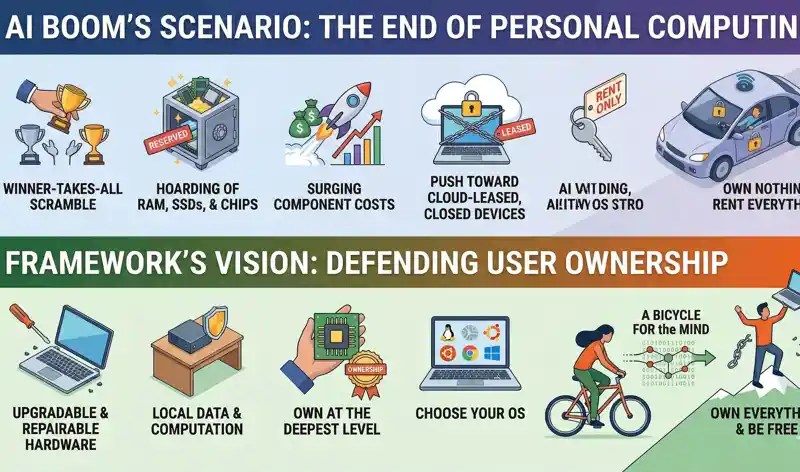
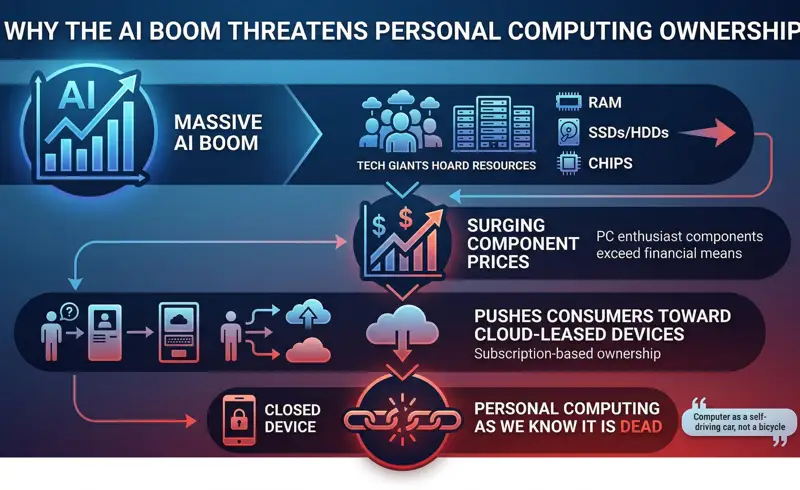
For the past several years, the tech landscape has been heavily skewed by an unprecedented surge in AI development. What started as a software revolution has rapidly morphed into a hardware crisis. Tech giants and massive AI data centers are acquiring resources at an alarming rate, hoarding RAM, solid-state drives (SSDs), hard disk drives (HDDs), and high-performance processors. This monopolization of silicon has turned the computing hardware market into a “winner-takes-all” race, fundamentally altering the accessibility of technology for the average consumer.
As AI data centers absorb the lion’s share of available hardware, PC component prices have surged beyond the financial reach of everyday PC enthusiasts and builders. This economic squeeze is not accidental; it is a systemic shift pushing consumers away from traditional hardware ownership toward subscription-based, cloud-leased devices. Patel points out that this shift fundamentally strips users of their agency, turning open ecosystems into walled gardens where the user has zero control over their hardware or data.
| Resource | Traditional Market Access | 2026 AI Boom Impact |
|---|---|---|
| Advanced Processors (GPUs/CPUs) | Accessible to consumers & gamers | Hoarded by enterprise AI data centers |
| High-Speed Storage (SSDs/NVMe) | Affordable upgrades for users | Bulk-purchased for AI memory caching |
| Device Ownership | Perpetual ownership of local hardware | Shift toward leased, cloud-dependent terminals |
Patel has highlighted that the overarching goal of modern tech conglomerates seems to be minimizing user autonomy. The idea of computing as a tool for independent creation is eroding.
“The industry is asking you to own nothing and be happy. Computers are no longer a bicycle for the mind. They are becoming the self-driving car that takes you directly to the destination.”
Framework’s Manifesto: Fighting for Local Control and Upgradable Hardware
Despite this pessimistic outlook, Framework is not backing down. Over the last six years, the company has successfully proven that building high-performance, thin, and light laptops that respect consumer rights through repairability and customization is entirely viable. Even massive corporations have slowly started adopting repair-friendly policies, yet the structural threat of the AI hardware boom remains the ultimate enemy of consumer-grade personal computing.
Looking ahead to the highly anticipated Next Gen Event scheduled for April 21, 2026, in San Francisco, Framework aims to reaffirm its commitment to the average PC customer. Their strategy involves doubling down on upgradable hardware and ensuring that users maintain local control over their data and computational power. If you wish to learn more about their mission, you can visit the official Framework website for updates on their ecosystem.
| Computing Paradigm | Local Hardware (Framework Vision) | Cloud-Leased Devices (Industry Trend) |
|---|---|---|
| Hardware Control | Fully modular, upgradable, and repairable | Locked, disposable, and opaque |
| Data Privacy | Locally stored and processed | Hosted on third-party AI servers |
| Long-Term Cost | One-time purchase with targeted upgrades | Endless monthly subscription fees |
The mission goes beyond just selling repairable laptops; it is a philosophical stand against a dystopian tech future. By providing hardware that users can deeply own, modify, and repair, Framework is providing an alternative to the AI-takes-all paradigm.
“Whether that is choosing your OS, modifying your hardware, or even just keeping your data and computation local rather than leased from the cloud… we will always be fighting for a future where you can own everything and be free.”
The Path Forward in 2026 and Beyond
As we navigate 2026, the tech community faces a critical junction. Will consumers accept a reality where they merely rent access to computational power hosted thousands of miles away, or will they demand true ownership? The success of Framework’s upcoming product lines will serve as a crucial barometer for consumer sentiment.
| Core Pillar | Framework’s Approach to Solving the Crisis |
|---|---|
| Sustainability | Reducing e-waste by allowing module replacements instead of whole-device discarding. |
| Empowerment | Providing accessible tools and schematics for users to fix their own machines. |
| Independence | Encouraging local computation to bypass reliance on AI cloud conglomerates. |
Patel’s warning is not meant to incite panic but to inspire action. The death of personal computing is only a guaranteed scenario if consumers willingly surrender their rights to physical hardware and local data processing. By choosing devices built on the principles of longevity and customization, the computing public can push back against the “own nothing” agenda.
Frequently Asked Questions
What does Nirav Patel mean when he says personal computing is dead?
He refers to the shift away from users buying and owning local, upgradable hardware, moving instead toward a market dominated by closed, cloud-dependent devices controlled by major tech companies.
How is the AI boom affecting PC component prices?
Massive AI data centers are bulk-buying essential components like RAM, SSDs, and processors at record speeds, creating scarcity and driving up prices for the average consumer.
What are cloud-leased devices?
These are hardware terminals that rely almost entirely on cloud servers for storage and processing power, requiring users to pay subscription fees rather than owning the computing power locally.
Why does Framework prioritize repairable laptops?
Framework believes in giving users ultimate control over their hardware, reducing electronic waste, and saving consumers money by allowing individual part upgrades rather than forcing entire system replacements.
What is the significance of the Framework Next Gen Event in April 2026?
The event in San Francisco is expected to unveil new hardware and serve as a renewed pledge to defend user ownership against the monopolistic trends of the AI hardware boom.
Can local computing compete with AI cloud processing?
While massive AI models require cloud infrastructure, Framework argues that everyday personal computing, data storage, and standard tasks should remain local to protect user privacy and autonomy.
What does the phrase “computers are no longer a bicycle for the mind” mean?
Originally a Steve Jobs quote implying computers amplify human potential, Patel uses it to argue that modern, AI-driven devices are taking away user agency, acting more like autonomous machines than tools for human creativity.
Disclaimer: This article is for informational purposes only. The views and opinions expressed regarding the future of personal computing, AI data centers, and hardware market trends are based on industry commentary and projections as of 2026.