Living in Las Vegas means knowing that not everything that glitters is gold—and that is especially true when it comes to Internet Service Provider (ISP) marketing. If you are a local who is sick and tired of paying for “up to” 1 Gigabit speeds only to experience constant buffering during your Friday night Netflix binge or lagging out in the middle of a high-stakes competitive match, you are not alone. The truth about finding the fastest internet in Las Vegas is that performance varies wildly, not just from neighborhood to neighborhood, but literally block-by-block. A shiny new fiber connection in Summerlin might deliver blazing-fast perfection, while an older cable drop in Downtown or Sunrise Manor leaves you struggling to load a basic web page.
Here at the Mobile Services Center, we are done with generic corporate promises. You do not need another glossy brochure; you need real-world, address-level data, transparency about hidden fees, and the absolute best network options for gaming, working from home, and 4K streaming. Let’s cut through the desert mirage and look at the real-world winners for 2026.
Quick Answer – Who Has the Fastest Internet in Las Vegas Right Now?
If you want to skip the technical deep dive and just want to know who to call to upgrade your home network today, here is the current leaderboard for the Las Vegas Valley.
Fastest overall (citywide median speeds)
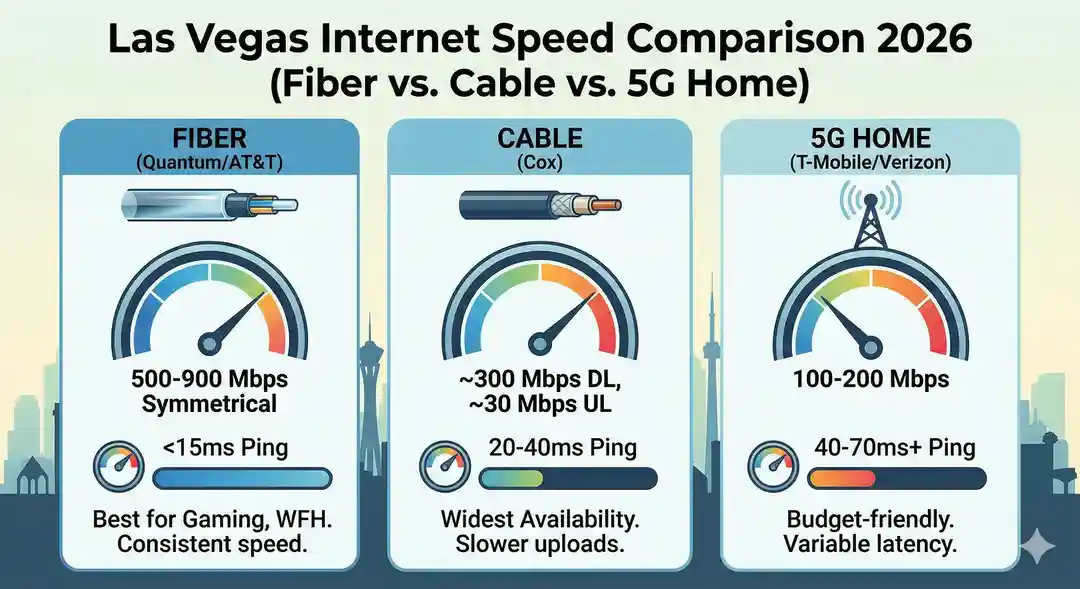
Cox Communications remains the heavyweight champion when it comes to pure availability combined with high-end download speeds. Thanks to their widespread DOCSIS 3.1 and expanding fiber-to-the-home (FTTH) networks, Cox consistently delivers top-tier download speeds to the largest percentage of Clark County residents. If you need massive download bandwidth and live in an area where their 2 Gig service is active, they are statistically the safest bet for pushing high numbers across the board.
Fastest for true fiber‑level performance
Quantum Fiber (by CenturyLink) takes the crown for true, unadulterated fiber performance. While their footprint isn’t as universal as Cox, if your address qualifies for Quantum Fiber, you hit the jackpot. Offering multi-gigabit symmetrical speeds (meaning your upload is just as fast as your download), Quantum Fiber avoids the peak-hour neighborhood slowdowns notorious with traditional cable. For hardcore streamers, content creators, and those running home servers, this is the gold standard in Vegas.
Fastest budget‑friendly fast internet
T-Mobile & Verizon 5G Home Internet share the title for the fastest budget-friendly option. For a flat rate (often around $50-$60 per month with no hidden hardware rental fees), you can tap into Las Vegas’s incredibly dense 5G cellular network. While speeds can fluctuate based on tower congestion, many locals easily pull 300+ Mbps downloads. It completely bypasses the messy local wiring to your house, making it a stellar, affordable alternative if you just want fast, reliable service without an annual contract.
How We Define “Fastest” Internet in Las Vegas
To truly understand network performance in 2026, we have to throw the old marketing playbooks in the trash. ISPs love to advertise theoretical maximums, but those numbers rarely reflect what you experience in your living room.
First, we have to look past the advertised “up to” speeds and focus heavily on real-world Speedtest results. An ISP might boast “Up to 1,000 Mbps,” but if their infrastructure in your specific neighborhood is aging, you might only see a fraction of that during the 7:00 PM to 10:00 PM internet rush hour. When we evaluate the true Las Vegas median internet speed, we are looking at the middle ground of what thousands of actual residents are pulling on their everyday devices, giving us a much more accurate picture of what you can actually expect when you plug in your router.
Furthermore, raw download speed is only a third of the equation. To truly have a “fast” connection, you need to account for three major factors:
- Upload Speeds: If you work from home, upload speed dictates how crisp your Zoom video looks and how fast you can send large files to a client. Symmetrical fiber connections excel here, whereas traditional cable often throttles upload bandwidth severely.
- Latency (Ping): This is the time it takes for a signal to travel from your computer to the server and back. If you are hunting for low latency internet for gaming, this is your most critical metric. Even with a 2 Gig download speed, a high latency connection will result in unbearable lag in games like Call of Duty or Valorant.
- Jitter: This measures the variance in your latency. High jitter means your connection is unstable, leading to rubber-banding in video games and robotic, choppy audio during important VoIP remote work meetings.
By measuring all these variables together, we find the true network champions of the Vegas Valley—not just the ones with the biggest billboards on the I-15.
Would you like me to draft Part 2, detailing the specific neighborhood-by-neighborhood breakdowns and the ultimate recommendations for WFH and gaming setups?
Fastest Internet Providers in Las Vegas (Ranked)
To find the best internet providers in Las Vegas, we have to look past the flashy billboards on the I-15 and dig into how these networks actually perform under load. Whether you are transferring massive files for work or trying to maintain a stable ping in competitive gaming, the technology delivering your connection matters more than the marketing claims. Here is the unfiltered, real-world breakdown of the top contenders in the Vegas Valley for 2026.
1. Quantum Fiber (by CenturyLink)
If you have access to fiber internet las vegas residents constantly rave about, it is likely Quantum Fiber. Operating as CenturyLink’s premium fiber-to-the-home (FTTH) service, Quantum is the undisputed king of performance in the Valley, offering multi-gigabit tiers up to a staggering 8 Gbps.
- Real-World Median Speeds: 500 to 900 Mbps symmetrically (on their 1 Gig plan).
- Availability: Patchy. Covers roughly 25-30% of the city, heavily concentrated in newer developments in Summerlin, Centennial Hills, and parts of Henderson.
- Pros: Symmetrical speeds (massive upload bandwidth), incredibly low latency for gaming, and absolutely no data caps.
- Cons: If your home is not already wired for it, you are out of luck. Customer support can also be hit-or-miss during installation.
2. Cox Communications
Cox is the default provider for the vast majority of Clark County. While they heavily advertise gigabit internet las vegas wide, the reality is that their network is predominantly coaxial cable (DOCSIS 3.1/4.0), not true fiber. This means you get fast downloads, but significantly bottlenecked uploads.
- Real-World Median Speeds: 250 to 500 Mbps download / 20 to 35 Mbps upload.
- Availability: Near monopoly. Available to roughly 99% of Las Vegas, North Las Vegas, and Henderson.
- Pros: You can get it almost anywhere, and the download speeds are generally reliable enough for heavy 4K streaming.
- Cons: A strict 1.25 TB data cap that gamers and remote workers will easily blow past (costing an extra $50/month to remove). Upload speeds are a major pain point for content creators.
3. AT&T Fiber (via Gigapower)
For years, AT&T was virtually non-existent in the Vegas residential broadband market, but their massive fiber expansion (partnering with the Gigapower joint venture) has completely changed the landscape in 2026. They are aggressively trenching new lines and bringing serious competition to Cox.
- Real-World Median Speeds: 500 to 900 Mbps symmetrically.
- Availability: Rapidly expanding but still limited. Currently focusing on select neighborhoods in Summerlin, Henderson, and newer subdivisions.
- Pros: World-class reliability, symmetrical gigabit speeds, transparent pricing, and zero data caps. Plus, great bundle discounts if you use AT&T for your mobile phone.
- Cons: The construction phase means your neighborhood might be waiting a while for the rollout to reach your specific street.
4. T-Mobile & Verizon 5G Home Internet
Fixed wireless is the biggest disruptor in the local telecom market. By tapping into the dense cellular networks covering the Strip and the suburbs, 5g home internet las vegas options bypass the local cable monopolies entirely. It is a plug-and-play solution that has freed thousands of locals from annual contracts.
- Real-World Median Speeds: 100 to 200 Mbps download / 10 to 20 Mbps upload.
- Availability: Widespread. If you get a strong 5G cell signal at your house, you can likely get this service.
- Pros: Extremely budget-friendly (often $35-$50 a month locked in), zero installation hassle, and no data caps.
- Cons: Subject to network deprioritization during peak hours (like major events or conventions). The higher jitter and latency make it a poor choice for hardcore competitive gamers.
5. LV.Net (now operating under ISP.net)
A true Las Vegas original, LV.Net uses fixed microwave wireless technology to beam internet from high-altitude towers directly to a receiver on your roof. While they cannot compete with fiber on raw speed, they are an essential lifeline for off-grid properties or areas where Cox refuses to run cable.
- Real-World Median Speeds: 50 to 100 Mbps download.
- Availability: Unmatched line-of-sight coverage. If you can see their towers from your roof, you can get service, extending far into rural outskirts like Pahrump or the edges of Mount Charleston.
- Pros: Locally owned, hyper-responsive customer support, and no data caps.
- Cons: Expensive. You are paying a premium for lower maximum speeds, and adverse weather can occasionally impact the microwave signal.
Ultimate Las Vegas Internet Speed Comparison Table
To help you make the best decision for your home, we have compiled the ultimate cheat sheet comparing the reality of these providers. Pay close attention to the typical latency and hidden fees, as those dictate your daily experience far more than the advertised max speeds.
| Provider | Tech Type | Advertised Max Speed | Real-World Median Speed | Typical Latency | Intro Price | Hidden Fees / Data Caps |
|---|---|---|---|---|---|---|
| Quantum Fiber | Fiber | Up to 8 Gbps | 500 – 900 Mbps | 5 – 15ms | $50/mo | None (Unlimited Data) |
| AT&T Fiber | Fiber | Up to 5 Gbps | 500 – 900 Mbps | 5 – 15ms | $55/mo | None (Unlimited Data) |
| Cox Communications | Cable / Fiber | Up to 2 Gbps | 250 – 500 Mbps | 20 – 40ms | $50/mo | 1.25 TB Data Cap, High Equipment Fees |
| T-Mobile / Verizon 5G | Fixed Wireless 5G | Up to 300 – 1000 Mbps | 100 – 200 Mbps | 40 – 70ms+ | $35 – $50/mo | None (Subject to congestion slowdowns) |
| LV.Net (ISP.net) | Fixed Wireless | Up to 500 Mbps | 50 – 100 Mbps | 20 – 40ms | $50/mo | Potential upfront setup/hardware fees, No Caps |
Best Fast Internet by Neighborhood and Home Type
Las Vegas is a city of distinct neighborhoods, each with its own infrastructure quirks. What is blazing fast in a brand-new subdivision might be a crawling, buffered mess in a historic downtown district. Here is how the network map truly looks across the Valley.
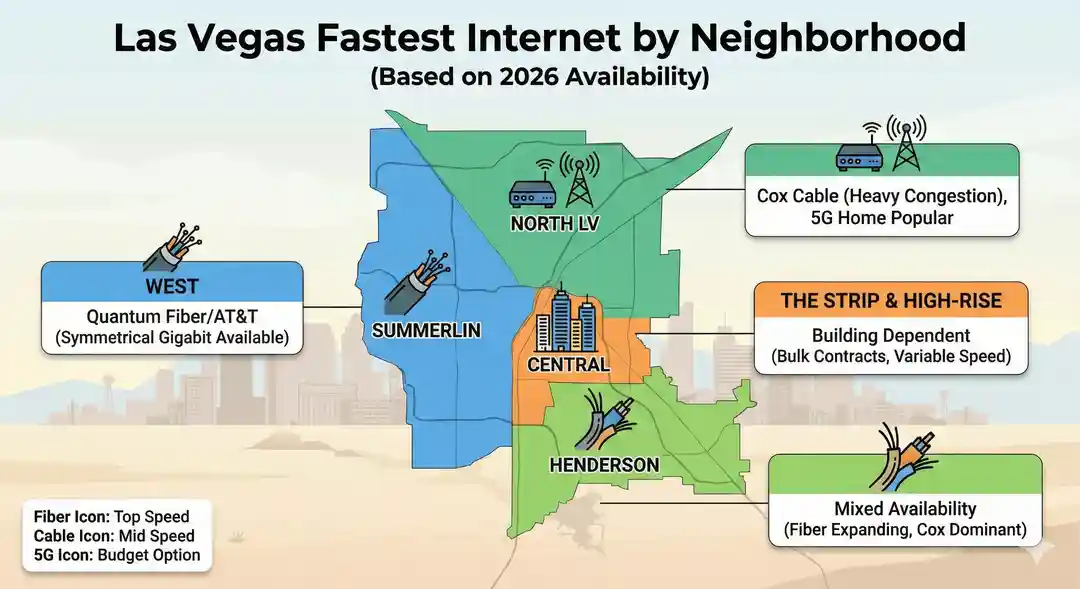
Summerlin & The West Side
Summerlin is a tale of two eras. The newer developments (Summerlin South, The Ridges, and Red Rock Country Club areas) are heavily wired with true fiber from both Quantum Fiber and AT&T, making gigabit symmetrical speeds easily accessible. However, if you live in the older, original Summerlin villages built in the 90s, you are likely stuck in a Cox Communications monopoly with older coaxial infrastructure.
Henderson & Green Valley
Henderson is massive, and its internet landscape reflects that sprawl. Historic Green Valley has reliable, albeit sometimes congested, Cox service. Moving south toward Inspirada, Cadence, and Anthem, fiber availability shoots way up. Quantum Fiber has a strong foothold here, making it a haven for remote workers who need heavy upload bandwidth.
North Las Vegas
Historically, North Las Vegas has been notoriously underserved by fiber-optic networks. While providers are slowly trenching new lines, Cox remains the dominant heavyweight here. Because of the heavy reliance on Cox’s shared cable nodes, North Vegas residents frequently report the most aggressive 8:00 PM network slowdowns. 5G Home Internet from T-Mobile and Verizon has become incredibly popular here as a workaround to bypass the localized cable congestion.
The Strip & High-Rise Apartments
Living in a luxury high-rise like Panorama Towers, Turnberry, or The Martin comes with a massive caveat: you rarely get to choose your provider. High-rises are usually pre-wired with bulk community internet contracts (often through Cox or a specialized commercial ISP). While download speeds are usually perfectly adequate for streaming, you are completely at the mercy of the building’s internal wiring (Ethernet vs. older VDSL) and the HOA’s negotiated data caps.
Vegas Locals Say… (What Real Users Report)
If you spend five minutes on Las Vegas local Reddit or Facebook community groups, you will see the exact same sentiments echoed over and over again. We synthesized the thousands of comments to give you the real word on the street:
- On Cox: “The speeds are actually really good, but the pricing is exhausting. Once your promo period ends, the bill jumps, and hitting that 1.25 TB data cap with three kids and a couple of Xboxes is basically guaranteed. Expect to pay that extra $50 a month for unlimited.”
- On Quantum / CenturyLink Fiber: “It is the holy grail if you can actually get it. I pay $75 a month flat, never have outages, and my ping in Valorant is 12ms. But when I moved two miles down the road, they told me it wasn’t available there. Heartbreaking.”
- On 5G Home Internet: “I switched from Cox to T-Mobile to save money. It’s $50 flat and I get about 250 Mbps. It’s totally fine for Netflix and working from home, but I do notice it buffers a bit when big conventions are in town or during F1 weekend.”
- On LV.Net: “I live out near Mount Charleston where nobody else will run a wire. LV.Net is expensive for the speed you get, but their customer service is local and incredible. They literally sent a tech to my roof on a Sunday.”
How to Actually Get the Speeds You Pay For
You can buy the fastest internet in Las Vegas, but if your home setup is flawed, you are throwing money into the Bellagio fountains. Las Vegas homes have specific architectural challenges. Here are three actionable ways to fix your home network:
- Beware the Stucco and Chicken Wire: Most Las Vegas homes are built with stucco over a metal wire mesh exterior. This essentially turns your house into a Faraday cage. If you place your Wi-Fi router against an exterior wall hoping to get a signal in your backyard or pool area, the wire mesh will kill the signal instantly. Keep your router centralized or invest in an outdoor mesh access point.
- Keep Your Router Out of the Vegas Heat: Do not put your modem or router in a non-climate-controlled garage or right next to a south-facing window. Networking equipment easily overheats and thermal-throttles (slows down) to protect itself. If your internet mysteriously drops every day in July at 3:00 PM, heat is likely the culprit.
- Hardwire for Latency: If you game or take crucial Zoom calls, do not rely on Wi-Fi. Run a Cat6 Ethernet cable directly from your router to your PC or console. This completely eliminates Wi-Fi jitter and guarantees you are getting the true latency your ISP provides.
Frequently Asked Questions About Fast Internet in Las Vegas
What is the fastest internet provider in Las Vegas for gaming?
For gaming, speed isn’t just about downloads; it is about low latency (ping) and zero packet loss. Quantum Fiber and AT&T Fiber are objectively the best for Vegas gamers. Their fiber-to-the-home networks provide ultra-low latency (often under 10ms to West Coast servers) and stable connections that cable and 5G simply cannot match.
Why is my internet so slow in Las Vegas during the evening?
If you are on Cox Communications (cable internet) or a 5G Home Internet plan, your neighborhood shares a localized node or cell tower. Between 7:00 PM and 10:00 PM, everyone in your subdivision is logging onto Netflix, downloading games, and scrolling social media. This heavy localized traffic creates a bottleneck, causing your speeds to drop and latency to spike.
Is 5G home internet a good replacement for Cox in Las Vegas?
Yes, but it depends on your use case. If you are a casual internet user who streams TV, browses the web, and works from home handling emails and basic video calls, 5G internet is a fantastic, budget-friendly way to ditch the Cox data caps. However, if you are a competitive gamer, a Twitch streamer, or run a Plex server, the fluctuating latency and slower upload speeds of 5G will frustrate you.
Summary – How to Choose the Fastest Internet in Las Vegas for You
Stop paying for “up to” speeds you never see. Here is your quick decision matrix for finding the best internet in the Vegas Valley for 2026:
- If it is available at your address: (verify using the official FCC National Broadband Map) Get Quantum Fiber or AT&T Fiber. It is the best technology, period. Low latency, symmetrical speeds, and no data caps.
- If you need raw download speed but fiber isn’t an option: Go with Cox Communications. It is everywhere, the downloads are fast, but be prepared to pay extra to remove the data cap if you are a heavy user.
- If you want a cheap, reliable connection with no hidden fees: Check out T-Mobile or Verizon 5G Home Internet. It is a great alternative to cable if you get a strong cell signal inside your house.
- If you live on the rural outskirts or off the grid: Call LV.Net. They will beam the internet straight to your roof when the big telecoms refuse to run wires.