Empirical Research Assistance (ERA) is fundamentally transforming the landscape of computational science in 2026.
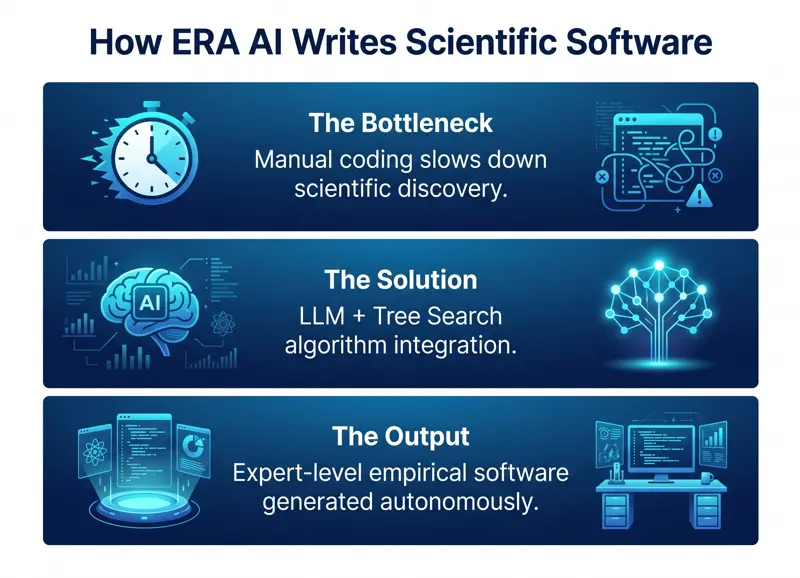
For decades, the rigorous cycle of scientific discovery has been severely bottlenecked by the slow, manual creation of custom software. Researchers often spend months writing code to test a single hypothesis.
Today, the introduction of Empirical Research Assistance (ERA) eliminates this barrier by autonomously creating expert-level scientific software tailored to maximize precise quality metrics.
By embracing Empirical Research Assistance (ERA), laboratories and academic institutions can completely bypass the traditional coding hurdles that slow down innovation.
The system takes a prompt or a scientific goal and outputs highly optimized, functional software. This breakthrough in computational experiments automation means that scientists can dedicate their time to analyzing results and formulating new theories, rather than debugging complex code structures.
The Algorithmic Power of Empirical Research Assistance (ERA)
At the core of Empirical Research Assistance (ERA) lies a highly sophisticated architecture that merges a Large Language Model (LLM) with Tree Search (TS) algorithms.
While standard LLMs are excellent at generating boilerplate code, they often fail when tasked with creating novel, highly specialized scientific software. Empirical Research Assistance (ERA) solves this by using Tree Search to systematically evaluate, iterate, and improve the generated code against a predefined quality metric.
This intelligent navigation through the vast space of possible programmatic solutions allows Empirical Research Assistance (ERA) to consistently achieve expert-level results.
It actively explores and integrates complex research ideas from external literature, synthesizing new methods that human engineers might overlook.
| Feature | Traditional Coding | Empirical Research Assistance (ERA) |
|---|---|---|
| Development Speed | Months of manual iteration | Rapid generation via AI processing |
| Error Resolution | Manual debugging | Automated via Tree Search optimization |
| Knowledge Integration | Requires human research | Directly parses external scientific sources |
“By fusing Large Language Models with iterative Tree Search, AI systems now possess the capability to engineer scientific software that rivals, and often surpasses, human expertise.”
Groundbreaking Discoveries via Empirical Research Assistance (ERA)
The true value of Empirical Research Assistance (ERA) becomes undeniable when reviewing its performance in high-stakes fields.
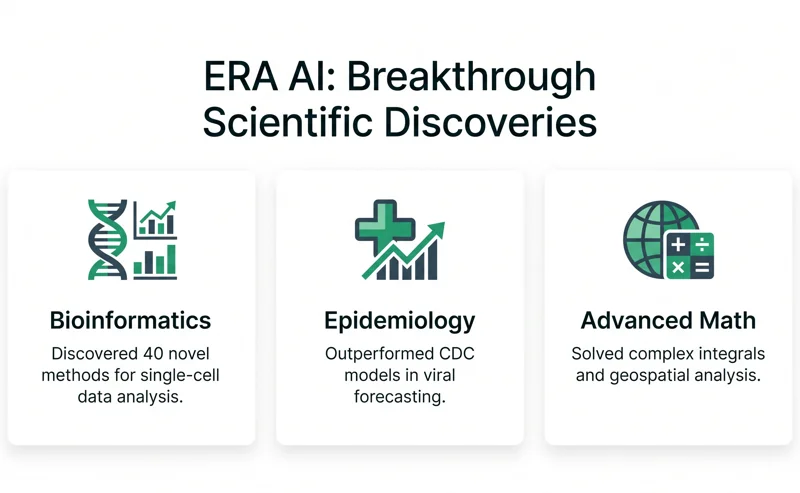
In the realm of AI-driven bioinformatics and forecasting, the results have been historically significant. When tasked with bioinformatics challenges, Empirical Research Assistance (ERA) discovered 40 novel methods for single-cell data analysis.
What makes this achievement remarkable is that the methods produced by Empirical Research Assistance (ERA) decisively outperformed the top human-developed methods on a highly competitive public leaderboard.
Single-cell data analysis is notoriously complex, requiring deep statistical knowledge and optimized software to process massive datasets. Empirical Research Assistance (ERA) handled this with unprecedented efficiency.
Epidemiological Forecasting and Empirical Research Assistance (ERA)
Perhaps the most critical demonstration of this AI for scientific discovery occurred in the field of epidemiology.
Forecasting viral spread and hospitalization rates requires parsing millions of data points with zero margin for error. In this domain, Empirical Research Assistance (ERA) generated 14 unique forecasting models for COVID-19 hospitalizations.
Astoundingly, the models constructed by Empirical Research Assistance (ERA) outperformed the official CDC ensemble, as well as all other individual models submitted by leading human data scientists.
This level of precision in computational experiments automation proves that AI-generated software is ready to handle mission-critical public health tasks.
| Scientific Field | Task Description | ERA Performance Metric |
|---|---|---|
| Bioinformatics | Single-cell data analysis | Discovered 40 novel methods beating top human models |
| Epidemiology | COVID-19 hospitalization forecasting | 14 models generated, outperforming the CDC ensemble |
Expanding Horizons with Empirical Research Assistance (ERA)
The versatility of Empirical Research Assistance (ERA) is a testament to its robust underlying architecture.
Beyond biology and viral forecasting, this AI system has successfully produced expert-level software for advanced geospatial analysis.
It has also contributed to neuroscience by writing software for neural activity prediction in zebrafish, a critical model organism for understanding brain function.
Furthermore, Empirical Research Assistance (ERA) has demonstrated profound mathematical capabilities, including the numerical solution of complex integrals.
It has even devised a completely novel rule-based construction for time series forecasting, showcasing its ability to innovate rather than merely replicate existing algorithms.
“The future of scientific discovery is no longer constrained by human coding speed; it is now propelled by the limitless exploratory capacity of AI research assistants.”
As Empirical Research Assistance (ERA) continues to evolve, it represents a monumental step toward accelerating human progress across all scientific disciplines.
By continuously devising and implementing novel solutions to complex tasks, this technology ensures that the next great scientific breakthrough is always within reach.
For deeper technical insights into the development of such AI systems, you can review the publications at the Google DeepMind Official Site.
Frequently Asked Questions
What is Empirical Research Assistance (ERA)?
It is an advanced AI system developed to help scientists autonomously write expert-level empirical software, accelerating the pace of computational experiments.
How does Empirical Research Assistance (ERA) generate code?
The system utilizes a combination of Large Language Models (LLMs) and advanced Tree Search algorithms to intelligently explore possible software solutions and maximize a specific quality metric.
What role does Tree Search play in this AI?
Tree Search allows the AI to systematically navigate different coding pathways, evaluating, testing, and refining the software until it achieves expert-level performance.
Has Empirical Research Assistance (ERA) been tested in real-world scenarios?
Yes, it has successfully generated functional code for single-cell data analysis in bioinformatics and created highly accurate COVID-19 hospitalization forecasting models.
How did the AI perform against human developers?
In multiple rigorous tests, including bioinformatics leaderboards and CDC epidemiological forecasting challenges, the software written by the AI directly outperformed top human-developed methods.
Can Empirical Research Assistance (ERA) handle non-medical data?
Absolutely. The system has successfully produced expert-level software for geospatial analysis, the numerical solution of integrals, and innovative time series forecasting.
Why is computational experiments automation important?
Automating the software creation process removes a massive, time-consuming bottleneck, allowing researchers to focus purely on scientific discovery and data analysis rather than manual coding tasks.
Disclaimer: This article is for informational purposes only. The AI systems, algorithms, and capabilities discussed reflect the state of technology and scientific research as of 2026 and are subject to ongoing development.