Chrome V8 Zero Day Exploited in the Wild is the latest urgent cybersecurity threat demanding immediate attention from billions of internet users in 2026.
Google has just released a massive security update to patch 230 vulnerabilities, but one specific flaw stands out due to its severe nature and active exploitation.
Users must act quickly to secure their devices against this high-stakes browser vulnerability before cybercriminals can leverage it against their personal networks.
This article breaks down exactly what you need to know about this critical flaw and how to apply the necessary Google Chrome security update immediately.
Understanding the Chrome V8 Zero Day Exploited in the Wild
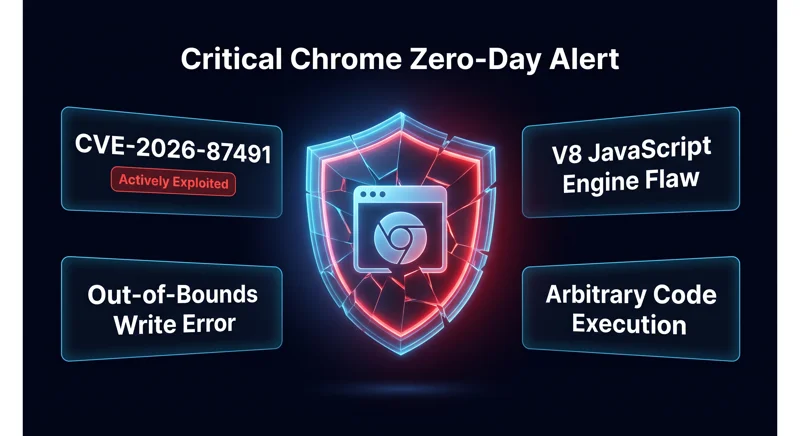
The tech community was put on high alert when researchers discovered the Chrome V8 Zero Day Exploited in the Wild, officially tracked as CVE-2026-87491.
This medium-severity vulnerability is classified as an out-of-bounds write bug located within V8, which is Chrome’s core JavaScript and WebAssembly engine.
According to security experts, this flaw allows a remote attacker to execute arbitrary code inside the sandbox environment simply by tricking a user into visiting a crafted HTML page.
Security researcher Jihyeon Jeong of Compsec Lab at Seoul National University discovered and reported the flaw, receiving a $2,500 bug bounty reward.
“Access to bug details and links may be kept restricted until a majority of users are updated with a fix.”
Google has officially acknowledged that hackers are currently using this exploit, but the company is withholding specific attack details to protect users.
By restricting information, Google ensures that other malicious actors cannot easily copy the attack methods before the global user base has time to update.
How the Chrome V8 Zero Day Exploited in the Wild Works
To understand the danger of the Chrome V8 Zero Day Exploited in the Wild, one must understand how modern web browsers protect user operating systems.
Browsers use a “sandbox” to keep web code isolated from the rest of your computer, preventing malicious sites from installing malware directly.
However, an arbitrary code execution sandbox escape means the attacker has found a way to bypass these restrictions using the V8 JavaScript engine vulnerability.
You can read more about vulnerability classifications on the NIST National Vulnerability Database.
| Vulnerability ID | Component | Flaw Type | Status |
|---|---|---|---|
| CVE-2026-87491 | V8 Engine | Out-of-bounds write | Actively Exploited |
| CVE-2026-87639 | WebPackaging | Use-after-free | Patched |
Other Flaws Alongside the Chrome V8 Zero Day Exploited in the Wild
While the Chrome V8 Zero Day Exploited in the Wild is the most pressing issue, this massive patch addresses 229 other security gaps.
This includes five critical security flaws primarily found in the WebGL and Cast components of the browser, which could also lead to severe compromises.
With this latest development, Google has now addressed a total of seven actively exploited Chrome zero-days since the beginning of 2026.
This high number of zero-day discoveries highlights the ongoing, aggressive nature of browser-based cyberattacks in the current digital landscape.
“Many of our security bugs are detected using AddressSanitizer, MemorySanitizer, UndefinedBehaviorSanitizer, Control Flow Integrity, libFuzzer, or AFL.”
Google relies on a robust suite of automated tools and a strong bug bounty program to catch these issues before they cause widespread internet chaos.
However, when a zero-day slips through, the responsibility falls on the end-user to apply the provided Chromium browser patch as fast as possible.
| Critical CVE ID | Affected Component | Vulnerability Type |
|---|---|---|
| CVE-2026-87464 | WebGL | Use-after-free |
| CVE-2026-87527 | WebGL | Buffer overflow |
| CVE-2026-87628 | Cast | Use-after-free |
Fixing the Chrome V8 Zero Day Exploited in the Wild
To protect yourself from the Chrome V8 Zero Day Exploited in the Wild, you must update your browser immediately.
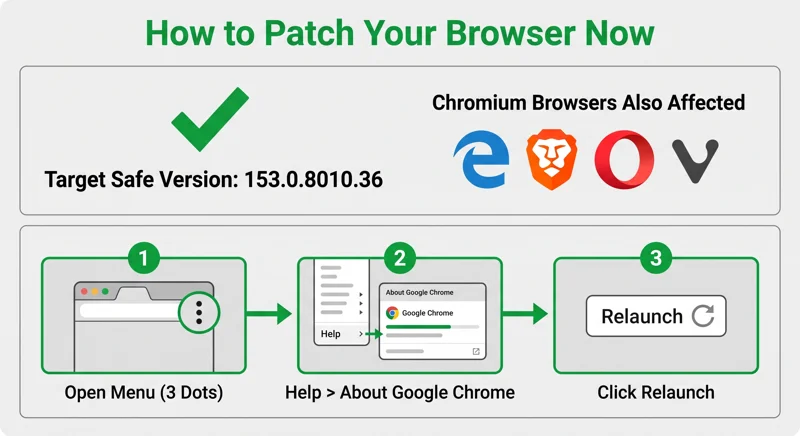
For optimal protection, Windows and macOS users should ensure their Chrome browser is updated to version 153.0.8010.36 or 153.0.8010.37.
Linux users need to verify they are running version 153.0.8010.36 to be safe from this specific V8 engine vulnerability.
To install the update, navigate to More (the three dots), select Help, click About Google Chrome, and then allow the browser to Relaunch.
Frequently Asked Questions
What exactly is the Chrome V8 Zero Day Exploited in the Wild?
It is a critical security vulnerability (CVE-2026-87491) in Chrome’s JavaScript engine that hackers are currently using to attack users.
How does this vulnerability affect my computer?
If you visit a maliciously crafted HTML page, an attacker can use this out-of-bounds write flaw to execute arbitrary code inside the browser’s sandbox.
Who discovered the Chrome V8 Zero Day Exploited in the Wild?
The flaw was discovered by security researcher Jihyeon Jeong from Compsec Lab at Seoul National University.
What version of Chrome do I need to be safe?
You need to update to Chrome version 153.0.8010.36 or .37 on Windows and Mac, or 153.0.8010.36 on Linux.
How do I update my Google Chrome browser?
Click the three vertical dots in the top right corner, go to “Help,” select “About Google Chrome,” and let the update install before clicking “Relaunch.”
Are other browsers affected by this flaw?
Yes, other Chromium-based browsers like Microsoft Edge, Brave, Opera, and Vivaldi share the same V8 engine and will require patching.
Why isn’t Google sharing how the attack works?
Google is restricting bug details to prevent other hackers from learning how to exploit the vulnerability before most users have updated their browsers.
Disclaimer: This article is for informational purposes only. Cybersecurity threats evolve rapidly, and users are strongly advised to keep all software automatically updated to the latest vendor-approved versions.