
When looking back at automotive history, finding buick turbocharged production cars on the dealership lots in 1978 is a detail that surprises many modern enthusiasts. While some auto-industry innovations come and go, turbocharging tech has proven its worth and is absolutely here to stay. Today, turbochargers are favored for their ability to produce more efficient engines that do not consume as much fuel as their older, naturally aspirated counterparts. However, the industry owes a massive debt of gratitude to the early heroes of this technology. While models like the Saab 99 and Porsche 911 Turbo are well-celebrated, two American models joined them in 1978, yet they seem to be almost entirely forgotten today.
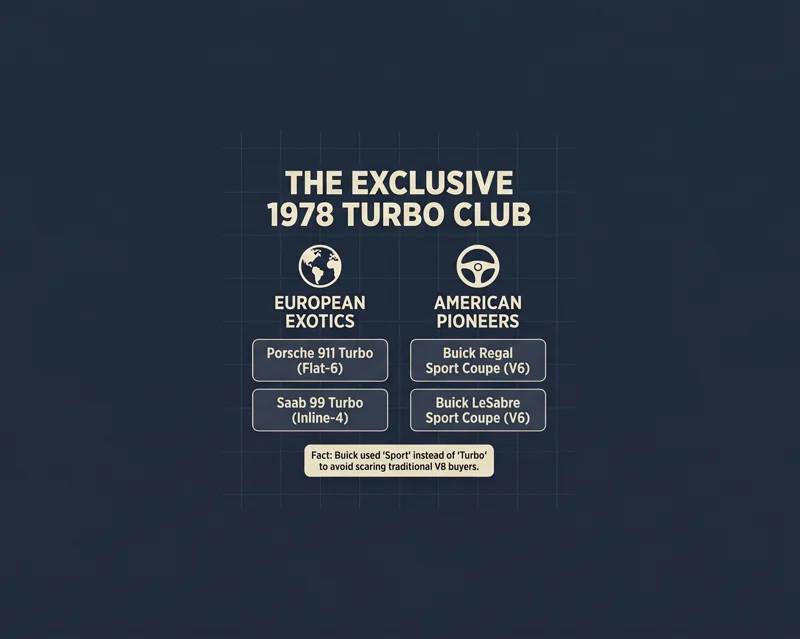
The Exclusive 1978 Turbo Market
In 1978, the global automotive landscape was vastly different. Outside of Buick dealers, your only other options for a turbocharged vehicle were those two rather exotic, highly expensive European imports. The American models in question that joined this elite club were the Buick Regal Sport Coupe and the LeSabre Sport Coupe. Interestingly, the manufacturer was not shouting from the rooftops about the new forced-induction technology under the hood.
“Wizardry, science, and magic—all are terms the automaker used to advertise the new boosted models in 1970s advertisements.”
While both Saab and Porsche proudly boasted “Turbo” in their actual model names, the American counterparts instead received the “Sport” designation. Historians speculate that executives were anxious about how the American public, accustomed to large-displacement V8s, would respond to early turbo engine history. Despite the cautious naming convention, these classic boosted V6 engines represented a massive leap forward in domestic engineering.
| Make & Model | Origin | Engine Type |
|---|---|---|
| Porsche 911 Turbo | Germany | Flat-6 |
| Saab 99 Turbo | Sweden | Inline-4 |
| Buick Regal / LeSabre Sport Coupe | United States | V6 |
Under the Hood: The Boosted 231 V6
As the marketing material proudly stated in the late-1970s, this was “America’s only turbocharged production automobile engine” at the time. Its development history dates back to 1975, with initial experimentation beginning as part of the prestigious Indy Pace Car program. The production powerplant was based on the 231-cubic-inch even-fire V6. To handle the increased pressure, engineers implemented numerous changes to make the engine boost-ready, including new pistons, an entirely new camshaft profile, strengthened internal components, and the integration of an AiResearch TB03 turbocharger.
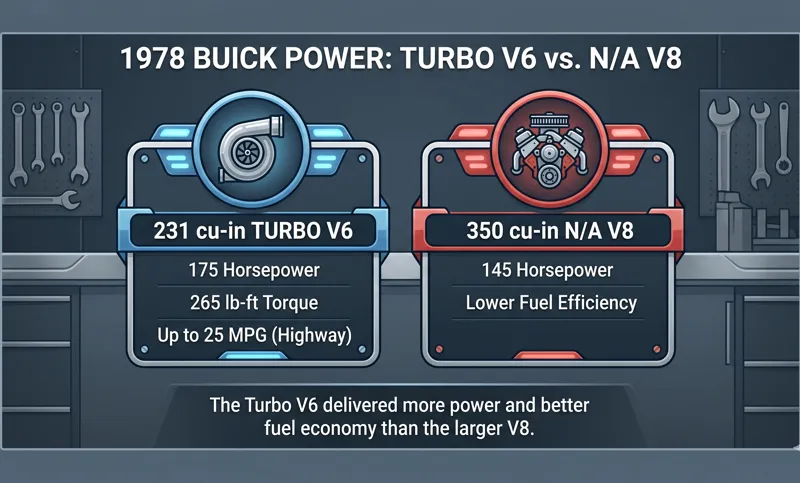
The performance results were genuinely impressive for the era. The V6 kicked out 150 or 175 horsepower, depending on whether the buyer chose a two- or four-barrel carbureted engine. For reference, the brand’s naturally aspirated 350-cubic-inch V8 at the time mustered up only 145 horses. Furthermore, the V8 was no match for the V6 in terms of fuel efficiency. With the two-barrel setup, the Regal returned 25 mpg on the highway and 18 mpg around town, proving that forced induction could blend economy with power.
| Engine Variant (1978) | Horsepower | Torque (lb-ft) |
|---|---|---|
| Naturally Aspirated 231 V6 | 105 hp | 185 lb-ft |
| Turbocharged 231 V6 (4-barrel) | 175 hp | 265 lb-ft |
| Naturally Aspirated 350 V8 | 145 hp | N/A |
Rallye Ride and Handling
To complement the engine, the suspension was also built for performance. The setup, dubbed “Rallye ride and handling,” consisted of firmer springs and shocks, paired with uprated front and rear stabilizer bars. Equipped with grippy Firestone tires and a TH350 Turbo Hydra-Matic automatic transmission, the car achieved a 0-60 mph time of 11.2 seconds. For a 3,500-pound, six-cylinder family coupe in the late 1970s, this was a highly respectable figure.
The Earlier American Turbo Pioneers
While the 1978 models were the only American forced-induction cars on the market that year, they were not the absolute first. To find the true pioneers of 1970s turbocharged American cars and their predecessors, you have to look further back into the archives of the General Motors Corporate Website.
“You would have to wind the clock back 16 years more to find America’s first turbocharged production models, the 1962 Oldsmobile F-85 Jetfire and Corvair Monza Spyder.”
The Oldsmobile Jetfire featured a 215-cubic-inch V8 that produced an incredible one horsepower per cubic inch. Meanwhile, the Chevy Corvair Corsa introduced a turbocharged, air-cooled flat-6. Though these early efforts were short-lived due to reliability issues and complex maintenance, they paved the way for the reliable V6s of 1978, securing a fascinating chapter in 1978 auto industry innovations.
| Pioneer Model | Year Introduced | Engine Specs |
|---|---|---|
| Oldsmobile F-85 Jetfire | 1962 | 215ci Turbo V8 |
| Chevrolet Corvair Monza Spyder | 1962 | 150ci Turbo Flat-6 |
Frequently Asked Questions
What were the four turbocharged production cars available in 1978?
The four cars were the Porsche 911 Turbo, the Saab 99 Turbo, the Buick Regal Sport Coupe, and the Buick LeSabre Sport Coupe.
Why didn’t the American 1978 models use the word “Turbo” in their names?
Automakers used the term “Sport” instead, likely because they were anxious about how the American public, who were used to traditional V8s, would react to new, unfamiliar engine technology.
Was the 1978 turbocharged V6 more powerful than the V8 offered at the time?
Yes, the turbocharged 231 V6 produced between 150 and 175 horsepower, which outperformed the naturally aspirated 350 cubic-inch V8 that only produced 145 horsepower.
What kind of fuel economy did the Regal Sport Coupe get?
With the two-barrel carburetor setup, the Regal could achieve an impressive 25 mpg on the highway and 18 mpg in the city.
What was the “Rallye ride and handling” package?
It was a suspension upgrade that included firmer springs and shock absorbers, along with uprated front and rear stabilizer bars for better cornering performance.
Were the 1978 Regals and LeSabres the first American cars with turbos?
No. The first American production cars with turbos were introduced in 1962: the Oldsmobile F-85 Jetfire and the Chevrolet Corvair Monza Spyder.
What transmission came standard with the 1978 Sport Coupes?
All models were equipped with the reliable TH350 Turbo Hydra-Matic automatic transmission.
Disclaimer: This article is for informational purposes only. Automotive specifications and historical data are based on classic automotive records and may vary slightly depending on the exact trim and production run of the vehicles mentioned.