Having the att customers updated ussd code list at your fingertips is one of the most efficient ways to manage your wireless account, check your data limits, and configure your mobile device without ever needing to wait on hold for a customer service representative. In today’s fast-paced digital era, consumers demand instant access to their account metrics. While mobile applications and online portals are excellent tools, they require an active internet connection and login credentials. USSD (Unstructured Supplementary Service Data) codes, on the other hand, communicate directly with the carrier’s network towers over the voice channel, providing instantaneous feedback on your device’s screen.
Whether you are looking for specific at&t ussd codes to pay your monthly bill, or you want to explore advanced att mmi codes to troubleshoot a network connectivity issue, understanding how these numerical sequences function is highly beneficial. This comprehensive guide will break down the essential at&t codes, explaining their specific functions, how to use them, and why they remain a crucial part of mobile telecommunications infrastructure.
Understanding Unstructured Supplementary Service Data (USSD)
Before diving into the extensive directories, it is important to understand what these codes actually are. Often referred to as “Quick Codes” or “Feature Codes,” USSD is a protocol used by GSM cellular telephones to communicate with the service provider’s computers. Unlike SMS messages, which follow a store-and-forward logic, USSD creates a real-time connection during the session. The connection remains open, allowing a two-way exchange of a sequence of data.
Many users informally refer to these as at&t secret codes or att # codes because they are typed directly into the phone’s native dialer pad and usually begin with an asterisk (*) and end with a hashtag (#). When you hit the call button, the phone does not place a voice call; instead, it sends a data packet to the AT&T servers, which instantly replies with a pop-up message on your screen containing the requested information.
USSD codes provide a direct, internet-free pathway to your AT&T account database, ensuring you can access critical billing and usage data even when your mobile data is turned off or depleted.
The Essential AT&T Short Codes for Account Management
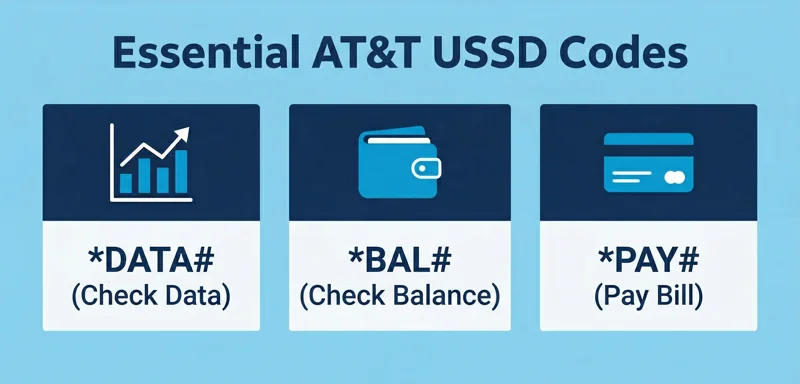
Managing your finances and understanding your current billing cycle is arguably the most common use case for utilizing an att dial codes directory. For postpaid wireless consumers, tracking minute usage (if applicable), messaging limits, and current account balances is crucial to avoiding overage charges. The following at&t short codes list provides the foundational commands every subscriber should know.
To use any of these att codes for phone management, simply open your smartphone’s default phone application (the dialer), type the sequence exactly as shown, and press the green “Call” or “Send” button. Within seconds, the network will return a message with your requested data.
| USSD / Short Code | Function / Description | Target Audience |
|---|---|---|
| *BAL# (*225#) | Retrieves your current account balance and the date of your last payment. | Postpaid & Prepaid |
| *PAY# (*729#) | Initiates the process to pay your bill using a registered payment method. | Postpaid Accounts |
| *MIN# (*646#) | Checks your current voice minute usage for the billing cycle. | Limited Minute Plans |
| *TXT# (*898#) | Checks your SMS and MMS text messaging usage. | Limited Text Plans |
Monitoring Data Usage with AT&T Phone Codes
In an era where streaming high-definition video, playing online multiplayer games, and utilizing cloud storage are daily activities, managing mobile data is paramount. Exceeding your data cap can result in severe throttling (reduced speeds) or unexpected overage fees depending on your specific wireless tier. Utilizing at&t phone codes to actively monitor your gigabyte consumption is a smart financial habit.
By utilizing the at&t ussd codes list dedicated to data, you bypass the need to log into the myAT&T app. This is particularly useful if your data is already throttled, making app navigation painfully slow. When you input these specific at and t codes, the network pulls your exact byte count directly from the billing mainframe.
| Data USSD Code | Specific Function | Expected Output |
|---|---|---|
| *DATA# (*3282#) | Checks total data usage for the current billing cycle. | Text message detailing GB used and remaining allowance. |
| *#3282*2# | Check data usage for a specific device on a shared family plan. | Device-specific gigabyte breakdown. |
| *NEW# (*639#) | Check your eligibility for a smartphone hardware upgrade. | Status of your installment plan and upgrade date. |
Advanced AT&T Phone Features Codes and MMI Commands
Beyond simple billing inquiries, there exists a deeper layer of at&t phone features codes. These are often classified under the umbrella of Man-Machine Interface (MMI) codes. These specific att mmi codes interact not just with the network, but with the hardware of your specific smartphone device (whether it is an iPhone, Samsung Galaxy, or Google Pixel).
Many tech enthusiasts seek out an all sim ussd code list to find universal commands that work across carriers, but AT&T utilizes specific routing for certain features like call forwarding, caller ID blocking, and voicemail configuration. Furthermore, some users look for an at&t service update code to force their device to reconnect to the nearest cell tower or refresh their OTA (Over-The-Air) provisioning.
It is crucial to note that while some websites claim to have extensive lists of at&t secret codes, many older codes have been deprecated as networks evolved from 3G to 4G LTE and now 5G architectures. However, several universal hardware and carrier-specific codes remain highly functional and essential for troubleshooting.
| MMI / Feature Code | Technical Function | Use Case |
|---|---|---|
| *#06# | Displays the International Mobile Equipment Identity (IMEI) number. | Required for unlocking phones, insurance claims, or selling the device. |
| *67 [Phone Number] | Blocks your Caller ID for a single outgoing call. | Maintaining privacy when calling businesses or unknown numbers. |
| *72 [Phone Number] | Activates unconditional call forwarding to a specified number. | Routing calls to a landline or alternative device when traveling. |
| *73 | Deactivates unconditional call forwarding. | Restoring normal incoming call routing to your mobile device. |
Differentiating Between USSD, MMI, and Text Short Codes
To fully leverage the AT&T network capabilities, consumers must understand the subtle differences in the terminology used within the telecommunications industry. While they are often used interchangeably by the public, at&t short codes, att text codes, and USSD commands function differently on the backend.
USSD Codes: As previously discussed, these begin with a star (*) and end with a hash (#). They establish a real-time, two-way connection. They do not leave a record in your SMS inbox (though AT&T’s system will often trigger an automated SMS containing the requested info immediately after the USSD session ends).
MMI Codes: Man-Machine Interface codes are specifically designed to change settings on the device itself or manage supplementary services like Call Waiting or Call Forwarding. The at&t carrier code configuration dictates how the network responds to these MMI inputs. If you ever see an “Invalid MMI Code” error, it usually means your phone temporarily lost connection to the AT&T voice network, or the code is not supported by your specific device model.
Text Short Codes: These are 5 or 6-digit numbers (like 74666) that you type into the “To” field of your messaging app, rather than the dialer. For example, sending the word “STOP” to a marketing text uses an att short codes framework. While not USSD, they are a vital part of the att text codes ecosystem used for interacting with the carrier and third-party services.
Troubleshooting Common USSD Errors
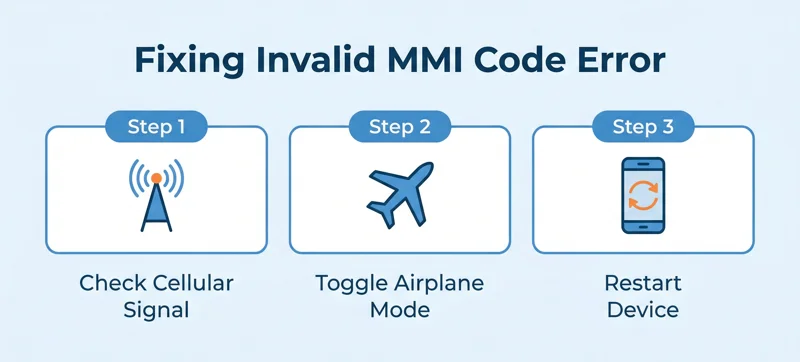
Occasionally, when utilizing the att phone codes, you might encounter an error message on your screen. The most frequent error reads: “Connection problem or invalid MMI code.” This can be frustrating when you simply want to check your balance. This error typically occurs due to a momentary disruption in your cellular signal, as USSD requires a stable voice connection to transmit the data packets.
To resolve this, ensure you have at least two bars of cellular signal. If you are using Wi-Fi Calling, you may need to temporarily disable it, as some older USSD gateways struggle to route through internet-based voice protocols. Restarting your smartphone or toggling Airplane Mode on and off can force the device to re-register with the nearest AT&T cell tower, which usually clears the MMI error and allows the at&t codes to process successfully.
For further reading on how carriers handle billing transparency and the tools available to consumers, you can reference the official AT&T star services guide.
Conclusion
Navigating your wireless service does not have to be a complicated endeavor requiring long wait times or complex app navigation. By mastering the commands within the AT&T customers updated USSD code list, you empower yourself to manage your digital life efficiently. From securing your privacy with caller ID blocking to tracking every megabyte of data usage, these numerical shortcuts are indispensable tools for any modern smartphone user.
Frequently Asked Questions
What are AT&T USSD codes?
USSD (Unstructured Supplementary Service Data) codes are short numerical sequences, usually starting with an asterisk (*) and ending with a hash (#), entered into your phone’s dialer to instantly request account information, data usage, or change network settings directly from the carrier.
Why do I receive an “Invalid MMI code” error when dialing?
This error typically happens if you have poor cellular reception, if the specific code is no longer supported on the modern network, or if there is a conflict with Wi-Fi Calling. Toggling Airplane Mode or restarting your phone usually resolves a temporary network connection issue.
Are these AT&T short codes free to use?
Yes. Dialing official AT&T USSD codes (like *DATA# or *BAL#) to check your account status, balance, or data usage is completely free and will not deduct from your plan’s minute or messaging allowances.
Do these codes work on AT&T Prepaid (formerly GoPhone) accounts?
Yes, most essential codes work on prepaid accounts. However, prepaid users have specific codes designed for their billing structure, such as *777# to check the remaining prepaid account balance and expiration date.
Can I use these codes while roaming internationally?
Generally, yes. USSD codes are designed to work across global GSM networks. You can use them to check your balance or data usage while abroad, though you should verify your international roaming plan details to avoid unexpected network charges.
What is the specific code to check my AT&T data usage?
You can dial *DATA# (which corresponds to *3282# on the keypad) and press call. AT&T will instantly send you a free text message detailing your current data consumption for the billing cycle.
How do I find my phone’s IMEI number using a dial code?
Open your phone’s dialer app and type *#06#. You do not even need to press the call button; the 15-digit International Mobile Equipment Identity (IMEI) number will automatically populate on your screen.
Disclaimer: The information provided in this article is for educational and reference purposes only. Telecommunications networks frequently update their systems, and some USSD or MMI codes may be changed, deprecated, or restricted based on your specific device, geographical location, or rate plan. We are an independent informational resource and are not affiliated with, endorsed by, or sponsored by AT&T Inc. Always verify current service codes through official AT&T support channels.