Finding the correct area code zamboanga utilizes is the first critical step to establishing seamless communication with businesses, government offices, and residents in the vibrant Region IX of the Philippines. As telecommunications networks continue to expand and modernize in 2026, understanding regional dialing rules is more important than ever.
The Zamboanga Peninsula is a vast and economically significant region in Mindanao. Because of its large geographical footprint, the telecommunications infrastructure is divided into distinct zones. A simple dialing mistake can lead to dropped calls, connection errors, or reaching the wrong province entirely.
Whether you are a logistics manager coordinating shipments through the local seaports, an international tourist planning a visit, or an overseas Filipino worker (OFW) calling home, this comprehensive guide will equip you with everything you need to know about navigating the local telephone grid.
In this authoritative 2026 guide, we will break down the specific regional codes, provide step-by-step dialing instructions for domestic and international callers, and explore the modern telecommunications landscape of the Zamboanga Peninsula.
Understanding the Regional Telecommunications Framework
The Philippines operates under a closed dialing plan for local calls and an open dialing plan for long-distance and international communication. The National Telecommunications Commission (NTC) assigns specific numerical prefixes to different geographic regions to organize traffic efficiently.
For the Zamboanga Peninsula, the prefix numbers are primarily in the 60s block. However, contrary to popular belief, not the entire peninsula shares a single number. The region is carefully segmented to handle the growing volume of landline and digital voice traffic.
Before you dial, you must identify the exact province or independent city you are trying to reach. The dialing rules vary slightly depending on whether you are calling from a local landline, a mobile phone, or an international network.
The Specifics of area code zamboanga city
Zamboanga City, often hailed as the “City of Flowers” or “Asia’s Latin City,” is a highly urbanized, independent city. It serves as the commercial and industrial powerhouse of the peninsula.
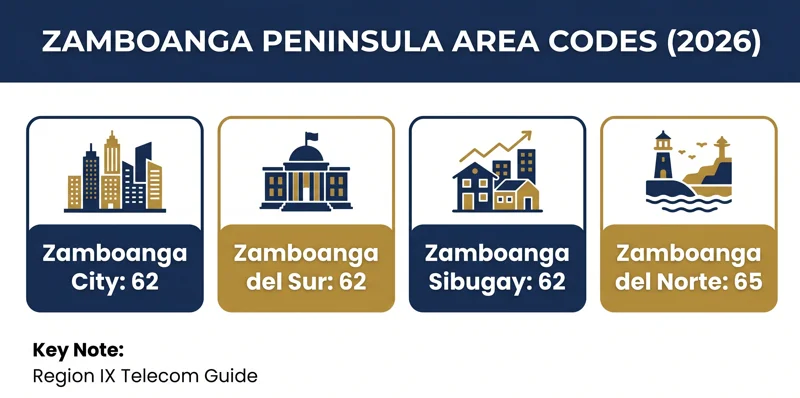
If you are trying to reach a landline within this bustling metropolis, the area code zamboanga city relies on is 62. This code has been the standard for decades and remains unchanged going into 2026.
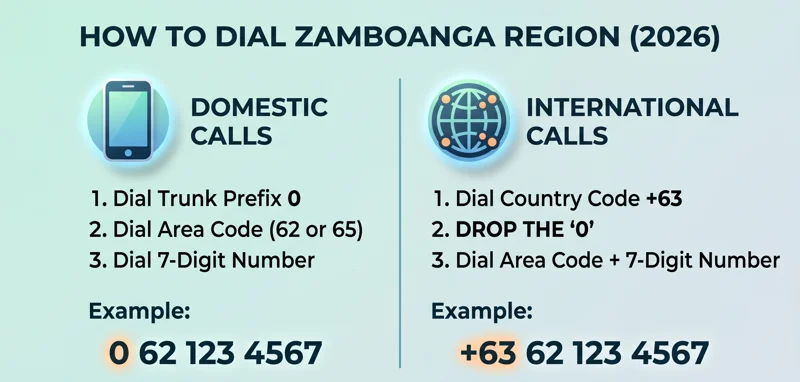
When dialing a local Zamboanga City landline from a mobile phone anywhere in the Philippines, you must input the trunk prefix “0”, followed by “62”, and then the seven-digit local subscriber number. For example: 0 + 62 + XXX XXXX.
Moving east from the independent city, we enter Zamboanga del Sur, a province known for its rolling hills and the vibrant capital city of Pagadian. Pagadian City is the regional administrative center for Region IX.
Interestingly, the area code zamboanga del sur utilizes is also 62. It shares this prefix with Zamboanga City, reflecting the historical telecommunications mapping of the region before massive population booms necessitated further network splitting.
Therefore, calling a government office in Pagadian City requires the same dialing format. You will use the 62 prefix. However, local subscriber numbers are allocated differently by local carriers like PLDT and Globe to ensure there is no overlap between the two distinct geographical areas.
Identifying the area code zamboanga del norte
Zamboanga del Norte occupies the northern coast of the peninsula, facing the Sulu Sea. It is famous for the historic city of Dapitan, where national hero Dr. Jose Rizal was exiled, and its bustling capital, Dipolog City.
Unlike its southern neighbors, the telecommunications grid here is different. The official area code zamboanga del norte uses is 65. This distinction is crucial for callers.
If you attempt to use the 62 prefix when calling Dipolog or Dapitan, your call will either fail entirely or connect to a completely different subscriber in the southern part of the peninsula. Always double-check that you are using 65 for the northern province.
Details on the area code zamboanga sibugay
Zamboanga Sibugay is the newest province in the region, having been carved out of Zamboanga del Sur in the early 2000s. Its capital is the municipality of Ipil, a rapidly growing commercial hub intersecting major regional highways.
Because it was formerly part of Zamboanga del Sur, the area code zamboanga sibugay inherited the existing telecommunications infrastructure. Thus, the area code remains 62.
While the province has gained political independence, its landline network remains integrated with the 62 regional block. Callers trying to reach businesses in Ipil or other Sibugay municipalities will follow the standard 62 dialing protocols.
Accurate telecommunications routing is the invisible backbone of regional commerce; knowing the exact provincial prefix ensures your business operations in Mindanao remain uninterrupted.
Summary of Zamboanga Peninsula Area Codes
To make it easier for logistics operators, virtual assistants, and remote workers to quickly identify the correct routing numbers, we have compiled a centralized reference table.
This table reflects the official assignments verified by the National Telecommunications Commission for the year 2026.
| Province / Independent City | Capital / Major Hub | Assigned Area Code |
|---|---|---|
| Zamboanga City | Highly Urbanized City | 62 |
| Zamboanga del Sur | Pagadian City | 62 |
| Zamboanga Sibugay | Ipil | 62 |
| Zamboanga del Norte | Dipolog City / Dapitan City | 65 |
How to Dial Correctly in 2026
Knowing the regional number is only half the battle. You must also format the sequence correctly based on the device you are using and your geographical location. Formatting errors are the leading cause of international call failures.
The Philippines uses the international country code +63. This is essential for anyone calling from overseas or using internet-based calling applications like Skype or Viber to reach a traditional landline.
Let’s break down the exact dialing sequences for domestic and international communication to ensure your calls connect on the first attempt.
Domestic Long-Distance Dialing (Within the Philippines)
If you are inside the Philippines but outside the Zamboanga Peninsula (for example, calling from Manila or Cebu), you are making a domestic long-distance call. You must use the National Direct Dialing (NDD) prefix, which is “0”.
The sequence is: 0 + Area Code + 7-digit Local Number.
If you are calling a business in Dipolog from Manila, you would dial: 0 + 65 + XXX XXXX. If you are calling Zamboanga City from a smart phone registered in Davao, you dial: 0 + 62 + XXX XXXX.
International Dialing (Calling from Abroad)
When calling from outside the Philippines, you must drop the domestic trunk prefix “0”. This is a common mistake that OFWs and international investors make. Including the zero will confuse the international routing switches.
The sequence is: International Access Code + 63 + Area Code + 7-digit Local Number.
For example, if you are calling Pagadian from the United States, you would dial the US exit code (011), followed by the Philippines country code (63), followed by the regional code (62), and then the local number: 011 + 63 + 62 + XXX XXXX.
If you are using a modern smartphone overseas, simply hold the zero key to generate the plus sign (+), which automatically replaces the International Access Code. You would dial: +63 62 XXX XXXX.
The Shift to Digital: VoIP and Business Lines
In 2026, the business landscape in Region IX is rapidly digitizing. Traditional copper-wire landlines are being steadily replaced by Voice over Internet Protocol (VoIP) and fiber-optic telephone systems, spearheaded by major providers like PLDT and Globe Telecom.
Despite this technological upgrade, the National Telecommunications Commission mandates that the traditional numbering formats remain intact. This ensures a seamless transition for consumers and maintains the geographic identity of local businesses.
Therefore, even if a hotel in Zamboanga City upgrades to a cloud-based PBX system, their primary contact number will still proudly feature the 62 prefix. This legacy numbering plan maintains trust and local authority for regional enterprises.
For official regulations regarding numbering plans and telecommunications policies, you can refer directly to the National Telecommunications Commission (NTC) website.
In the era of digital enterprise, maintaining a localized geographic phone number establishes immediate trust and signifies a genuine physical presence within the local community.
Dialing Format Cheat Sheet
To avoid any confusion, here is a practical cheat sheet demonstrating the exact dialing formats. We will use a hypothetical local number (123-4567) located in Zamboanga City to illustrate the sequences.
| Origin of Call | Target Location | Exact Dialing Sequence |
|---|---|---|
| Local Landline (Within Zamboanga City) | Zamboanga City Landline | 123-4567 (7 digits only) |
| Mobile Phone (Anywhere in PH) | Zamboanga City Landline | 062 123 4567 |
| Landline in Manila | Zamboanga City Landline | 062 123 4567 |
| International Caller (e.g., USA) | Zamboanga City Landline | 011 63 62 123 4567 |
| Global Smartphone (using +) | Zamboanga City Landline | +63 62 123 4567 |
Economic Impact of Reliable Communications in Region IX
The Zamboanga Peninsula is a critical economic gateway to the BIMP-EAGA (Brunei Darussalam-Indonesia-Malaysia-Philippines East ASEAN Growth Area). Reliable telecommunications are the lifeblood of this cross-border trade.
Seafood processing, specifically the canning of sardines in Zamboanga City, requires constant coordination with international shipping vessels, local fishing fleets, and global distributors. A dropped call or misrouted fax can delay a multi-million peso shipment.
By ensuring that international investors and trading partners know the precise dialing protocols, local enterprises reduce friction in business transactions. Clear communication guidelines are an often-overlooked aspect of local search engine optimization and corporate professionalism.
Furthermore, the booming eco-tourism sectors in Dapitan and the pristine beaches of Zamboanga del Sur heavily rely on advance bookings. Hotels and tour operators must prominently display their properly formatted international contact numbers to secure foreign visitors.
Troubleshooting Common Connection Issues
Even when armed with the correct information, callers occasionally experience connection issues. Understanding the root causes can save time and frustration.
If you receive a “number cannot be reached” automated message when dialing internationally, verify that you have dropped the leading “0” from the area code. This is the most prevalent error.
If you are dialing a 62 or 65 number and the call connects to a fax machine tone, you have likely dialed a corporate data line rather than a voice line. Verify the local 7-digit number with the business through their official website or social media channels.
Occasionally, heavy monsoon rains or typhoons can temporarily disrupt landline infrastructure in the peninsula. If a landline is continuously dead, try reaching the business via their mobile numbers, which are routed through cellular towers that often have backup power systems.
Mobile Numbers vs. Landlines in the Philippines
It is vital to distinguish between fixed landlines and mobile numbers. In the Philippines, mobile phone numbers do not use geographic area codes at all.
Regardless of whether a person lives in Zamboanga Sibugay or Metro Manila, their mobile number will follow a non-geographic network prefix assigned to telecom providers like Globe, Smart, or DITO (e.g., 0917, 0918, 0991).
When dialing a Philippine mobile number from abroad, you also drop the leading “0”. The format is simply +63 followed by the 10-digit mobile number (e.g., +63 917 XXX XXXX). Never inject the 62 or 65 geographic code into a mobile number sequence.
Future of Telecommunications in Region IX
Looking beyond 2026, the telecommunications infrastructure in the Zamboanga Peninsula is slated for further enhancements. The rollout of 5G cellular networks and low-earth orbit (LEO) satellite internet is bridging the gap for remote municipalities.
While internet-based communication continues to rise, the legacy fixed-line numbering system remains legally protected and deeply integrated into the banking, government, and emergency service sectors.
Understanding these codes is not just about making a phone call; it is about navigating the structural organization of one of the Philippines’ most culturally and economically rich regions.
Frequently Asked Questions
What is the exact area code for Zamboanga City?
The area code for Zamboanga City is 62. You use this prefix for all landlines located within the independent city limits.
Does Zamboanga del Norte use the 62 prefix?
No. Zamboanga del Norte, which includes Dipolog and Dapitan, uses the area code 65. Using 62 will misroute your call.
How do I call a Pagadian City landline from a smartphone?
Pagadian City is in Zamboanga del Sur, which uses 62. From a local Philippine mobile phone, dial 062 followed by the 7-digit landline number.
Are Zamboanga Sibugay and Zamboanga del Sur on the same telecom grid?
Yes. Because Sibugay was formerly part of Zamboanga del Sur, both provinces share the 62 area code for their fixed-line telecommunications.
Why is my international call to Zamboanga failing?
The most common reason for failure is dialing the trunk prefix “0”. When calling from abroad, dial +63 62 (or 65) and the local number. Do not dial +63 062.
Did the NTC change Zamboanga numbers to 8 digits like in Metro Manila?
As of 2026, the 8-digit landline migration primarily affected Metro Manila and surrounding specific regions. Zamboanga Peninsula landline subscriber numbers generally remain at 7 digits.
Do I use the 62 code when calling a mobile phone in Zamboanga?
No. Philippine mobile phone numbers use carrier-specific network prefixes (like 0917 or 0918) and do not use geographic area codes at all.
Disclaimer: This article is for informational purposes only. Telecommunications networks, dialing codes, and regulatory policies are subject to change by local telecommunications providers and the National Telecommunications Commission (NTC). Always verify official contact numbers directly with the intended recipient or official directories before making important business or personal calls.