As Apples always listening watch features test eavesdropping laws across multiple jurisdictions, smartwatch wearers find themselves navigating unprecedented legal territory. The introduction of ambient artificial intelligence in wearable consumer technology has elevated convenient productivity while simultaneously triggering critical debates over conversational surveillance.
With hardware makers striving to make digital assistants seamlessly proactive, everyday ambient listening has transitioned from science fiction into wearable reality. However, state-level wiretapping statutes established decades ago are clashing sharply with these automated background tools.
Why Apples always listening watch features test eavesdropping laws Today
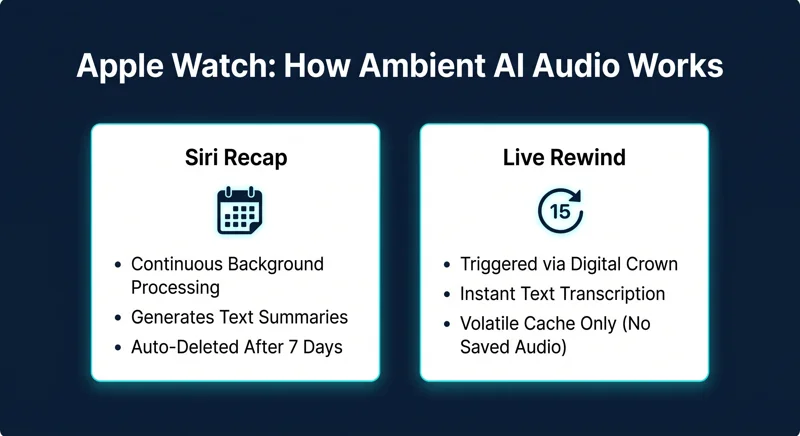
The core tension explaining why Apples always listening watch features test eavesdropping laws centers on two newly deployed utilities: Siri Recap and Live Rewind. Available on newer hardware like Apple Watch Series 12 and Ultra 4, these tools utilize continuous acoustic monitoring to summarize conversations or transcribe recent spoken dialogue.
Siri Recap works quietly throughout your day to compile text digests of meetings, chats, and verbal reminders. Meanwhile, Live Rewind permits users to double-tap the Digital Crown to view a transcript of the preceding 15 seconds of ambient speech.
| Smartwatch AI Feature | Operational Function | Privacy Mechanism |
|---|---|---|
| Siri Recap | Generates daily summaries of spoken interactions | Auto-deleted after 7 days unless saved |
| Live Rewind | Transcribes the prior 15 seconds of audio on demand | On-screen visual indicator & temporary cache |
“When wearable devices continuously interpret ambient human speech, the line between passive assistive technology and unlawful audio interception vanishes.”
Wiretap Statutes and Apples always listening watch features test eavesdropping laws
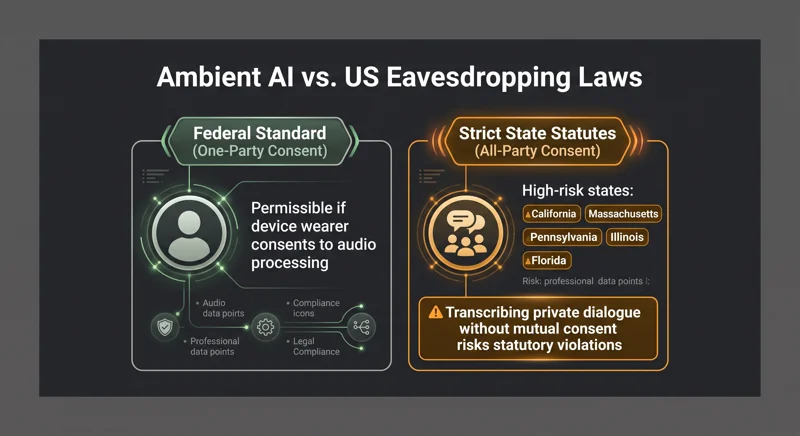
Legal practitioners are raising alarm bells because Apples always listening watch features test eavesdropping laws in several two-party and all-party consent states. Jurisdictions including California, Massachusetts, Pennsylvania, Illinois, and Florida strictly prohibit recording or intercepting confidential communications without express permission from every speaker.
Even though hardware engineers emphasize that raw audio streams are processed locally in volatile memory and never permanently stored as conventional audio files, state statutes frequently define illegal interception by the act of capturing or interpreting sound waves itself.
State Liability: Apples always listening watch features test eavesdropping laws
The distinction between text transcription and traditional analog recording is becoming a major battleground. Because Apples always listening watch features test eavesdropping laws, defense attorneys warn that wearable owners could face legal exposure if non-consenting parties discover their spoken words were automatically transcribed into searchable summaries.
Privacy advocacy organizations such as the Electronic Frontier Foundation have noted that bystander consent remains functionally impossible in public or semi-private spaces where smartwatches passively operate.
| State Jurisdiction | Consent Requirement | Potential Legal Exposure |
|---|---|---|
| California | All-Party Consent | Civil damages and statutory eavesdropping penalties |
| Massachusetts | All-Party Consent | Strict prohibition on secret electronic interception |
| Federal Law (US) | One-Party Consent | Generally compliant if device wearer consents |
“Users must understand their local wiretap environment, because technological capability consistently outpaces statutory reform.”
Best Practices While Apples always listening watch features test eavesdropping laws
To reduce personal liability while Apples always listening watch features test eavesdropping laws, smartwatch owners should exercise proactive caution. Apple includes granular software toggles that allow users to disable background transcription or configure location-based geofences where listening features shut off automatically.
In professional workplaces, medical clinics, and confidential business meetings, turning off ambient recording features represents the safest operational choice until judicial precedent establishes formal compliance guidelines.
Final Assessment: Apples always listening watch features test eavesdropping laws
The ongoing scrutiny surrounding why Apples always listening watch features test eavesdropping laws illustrates the growing friction between ambient smart devices and conversational privacy. While artificial intelligence offers undeniable productivity gains, users must navigate evolving state consent frameworks to avoid unintended legal repercussions.
Frequently Asked Questions
Why do Apples always listening watch features test eavesdropping laws?
They test eavesdropping laws because state wiretap statutes often prohibit intercepting oral communications without consent from all participants, even when audio is instantly converted to text.
Does the Apple Watch permanently store my voice recordings?
No, the system uses on-device local processing in secure hardware, discarding raw audio without writing traditional sound files to storage.
What is the primary function of Siri Recap?
Siri Recap summarizes daily conversations and verbal interactions to assist users with schedule tracking and memory retention.
How does the Live Rewind feature operate?
Live Rewind temporarily caches the preceding 15 seconds of ambient audio, displaying a textual transcript on your watch screen when activated.
Which states have strict all-party consent laws?
States such as California, Massachusetts, Pennsylvania, Illinois, and Florida require all parties in a conversation to consent to interception.
Can users disable these ambient listening functions?
Yes, users can completely turn off Siri Recap and Live Rewind within watch settings or restrict them by time and location.
Could a smartwatch wearer face criminal charges under wiretap statutes?
Some defense attorneys argue that non-consensual electronic interception in all-party consent states could technically trigger statutory violations or civil liability.
Disclaimer: This article is for informational purposes only and does not constitute formal legal advice. Wiretap and privacy statutes vary widely across jurisdictions. Consult a qualified attorney for legal guidance regarding recording consent laws.