Apple Audio Intelligence privacy has become the central talking point among privacy advocates and consumers following Apple’s latest hardware reveal.
When the tech giant unveiled the Apple Watch Series 12 and Apple Watch Ultra 4, its ambient audio capabilities sparked immediate surveillance concerns.
To address growing public skepticism, the company published an extensive white paper clarifying how its on-device architecture isolates sensitive speech data.
The document provides critical technical insight into how hardware boundaries protect users even when smart features are actively monitoring nearby sound.
The Truth Behind Apple Audio Intelligence Privacy and Ambient Listening
Consumers were naturally alarmed to learn that new wearables could passively track and summarize conversations throughout the day.
However, Apple Audio Intelligence privacy guarantees that raw acoustic signals are never converted into persistent audio files.
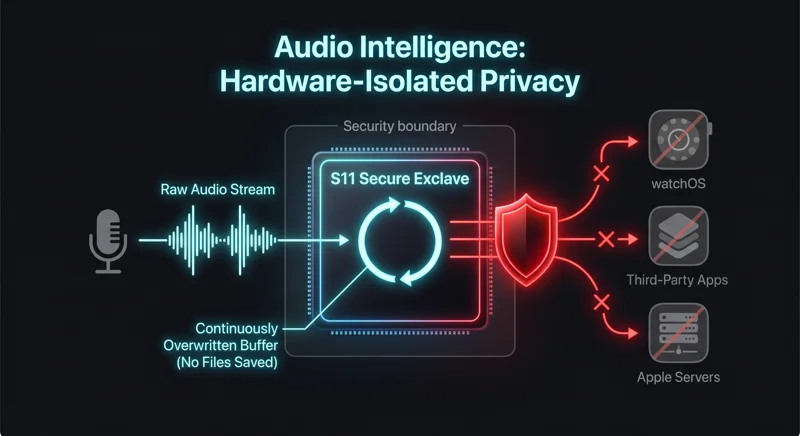
According to Apple’s official documentation, the microphone stream is processed entirely within dedicated silicon and remains isolated from the main system.
This means neither third-party developers, watchOS background tasks, nor Apple technicians can access or reconstruct your personal recordings.
“The raw audio is handled within dedicated hardware, is not saved as a file, and is not accessible to the operating system, apps, or Apple.”
Instead of transmitting voice recordings to remote cloud farms, the system relies on local silicon processing to interpret sound.
This edge-computing architecture ensures that acoustic patterns are analyzed in real time and immediately discarded after processing.
How the Secure Exclave Reinforces Apple Audio Intelligence Privacy
At the center of Apple Audio Intelligence privacy is the newly engineered Secure Exclave housed inside the S11 chip.
The Secure Exclave acts as a hardware-isolated compartment built directly into the silicon to manage sensitive sensor inputs.
When audio passes through the watch microphone, it enters a volatile memory buffer strictly contained inside this secure zone.
This temporary buffer is continuously overwritten, preventing any retrospective extraction of audio data by malicious software.
You can read more about Apple’s overarching hardware security architecture on the Official Apple Privacy Overview.
| Hardware Layer | Primary Function | Privacy Isolation Level |
|---|---|---|
| Microphone Sensor | Captures ambient acoustic signals | Hardware-routed exclusively to Secure Exclave |
| S11 Secure Exclave | Analyzes speech, sound, and music | Inaccessible to watchOS, apps, and Apple servers |
| Overwritten Buffer | Holds transient audio stream | Never converted into permanent audio files |
User Safeguards in Apple Audio Intelligence Privacy Systems
Beyond isolated silicon engineering, Apple Audio Intelligence privacy gives individuals complete authority over when ambient features run.
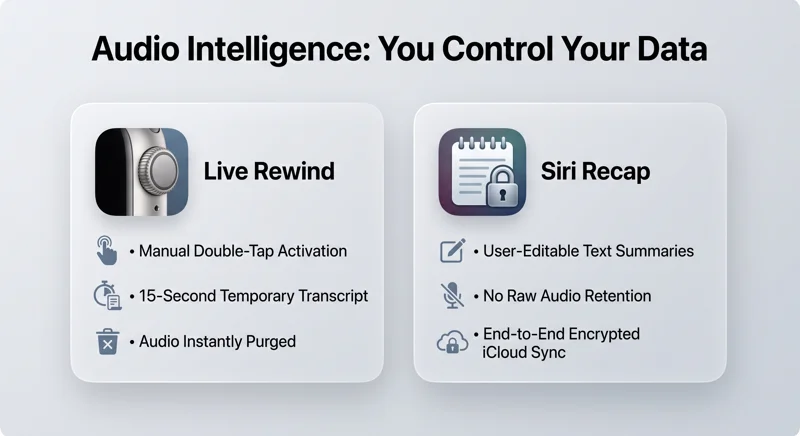
For example, the Live Rewind feature does not operate autonomously; it requires an intentional double-press of the Digital Crown.
Once triggered, the feature generates a text transcript of the last 15 seconds of spoken audio, discarding the sound immediately afterward.
Similarly, users retain granular control over Siri Recap, choosing whether ambient summaries remain permanently active or scheduled for specific hours.
“This buffer is a continuously overwritten stream that exists only within the protected hardware and never creates an audio recording.”
Users can review, edit, or delete text summaries generated by Siri Recap before allowing them to integrate with their personal records.
By keeping transcripts under direct user moderation, the platform prevents sensitive business or personal exchanges from being automatically logged without review.
| AI Audio Feature | Trigger Method | Data Output & Retention |
|---|---|---|
| Live Rewind | Double-press Digital Crown | Temporary 15-second transcript; audio instantly purged |
| Siri Recap | Scheduled or continuous ambient | Text action points; editable and reviewable by user |
| Sound Recognition | Passive background detection | Alert notification only; zero acoustic logs retained |
Data Encryption and Cloud Syncing in Apple Audio Intelligence Privacy
Whenever contextual summaries must transfer from your watch to an iPhone, Apple Audio Intelligence privacy applies end-to-end encryption.
The transmission occurs through hardware-to-hardware handshakes managed directly between the Secure Exclaves of both devices.
If you sync summaries across your personal ecosystem using iCloud, end-to-end cryptographic keys protect the text against interception.
To enable this highest security tier, users simply need an active device passcode and two-factor authentication enabled on their Apple Account.
Frequently Asked Questions
Does Apple Audio Intelligence privacy permit Apple to listen to my conversations?
No. Apple’s privacy architecture ensures that raw acoustic signals are processed exclusively inside isolated hardware and are never accessible to Apple or third parties.
What is the Secure Exclave in the S11 chip?
The Secure Exclave is a hardware-isolated enclave on the S11 processor that analyzes sensor data separately from watchOS and regular apps.
Does Live Rewind store permanent audio recordings?
No. Live Rewind utilizes a continuously overwritten audio stream that only converts the past 15 seconds into text upon a manual double-press of the Digital Crown.
Can third-party apps access the ambient audio stream?
No. Third-party applications cannot access the microphone stream processed inside the Secure Exclave under any circumstances.
How does Siri Recap handle my spoken summaries?
Siri Recap creates editable text summaries of key points, allowing users to choose exactly what text to keep, edit, or delete permanently.
How are Audio Intelligence transcripts protected during iCloud sync?
Transcripts sync using end-to-end encryption between devices, provided the user has configured a device passcode and iCloud two-factor authentication.
Which watch models support these Audio Intelligence privacy protections?
The architecture is built directly into the S11 silicon powering the Apple Watch Series 12 and the Apple Watch Ultra 4.
Disclaimer: This article is for informational purposes only and is based on official technical documentation and hardware specifications released by Apple. System capabilities and privacy configurations may evolve with future software updates.