
When exploring the most anticipated iOS 26.5 features, the transformation of Apple Maps undoubtedly takes center stage. As the iOS 26.5 beta 1 officially arrived today in 2026, users were greeted with a subtle yet highly impactful new capability designed to revolutionize how we discover our immediate surroundings. Dubbed simply “Suggested Places,” this feature leverages on-device machine learning to recommend destinations based on local trends, user habits, and real-time geographical data. While Apple Maps has long been a reliable and visually stunning tool for getting from point A to point B, this latest update aims to answer the age-old question of “Where should we go next?” before you even have to type a single letter into the search bar.
The Evolution of Discovery in Apple Maps
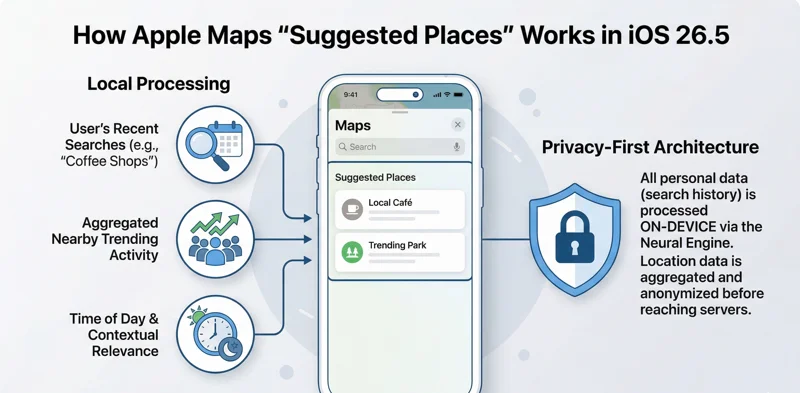
Historically, navigation applications required explicit and manual input from the user. You already knew your destination, you typed the name or address into the interface, and the application provided the most efficient route based on current traffic conditions. However, the introduction of Suggested Places represents a massive paradigm shift from reactive routing to proactive discovery. When you launch the Maps app in this new beta and tap inside the search box, you are no longer presented with just a blank digital keyboard and a static list of your recent history. Instead, the interface intelligently populates with highly curated, real-time recommendations.
According to Apple’s internal release notes and developer documentation, these recommendations are generated dynamically. They take into account what is currently trending nearby, aligning with aggregate, anonymized data on foot traffic and search volume within your specific geographical area. Furthermore, the complex algorithm considers your personal, recent searches to provide deep contextual relevance. For instance, if you have been consistently searching for independent coffee shops over the past few days, the Suggested Places engine is highly likely to highlight a newly trending cafe just around the corner from your current location. This seamless integration of [Internal Link: Apple Maps new search update] makes the everyday user experience incredibly intuitive and frictionless.
“The future of mobile navigation lies not merely in showing you the absolute fastest route, but in deeply understanding the context of your journey and illuminating the hidden cultural gems along the way.”
Breaking Down the “Suggested Places” Interface
For developers and public testers currently running the iOS 26.5 beta 1, the visual and interface changes are immediately apparent but elegantly integrated into the existing Apple design language. The updated search screen retains the familiar, colorful quick-action buttons for essential categories like Restaurants, Gas Stations, Parking, and Groceries. However, nestled cleanly between your recent search history and these static categorical buttons are two prominent, dynamic slots dedicated entirely to “Suggested Places.”
Currently, in its initial beta form, this feature is purely organic and driven by user data rather than financial transactions. As testers have utilized the beta over the last few days, they have observed the suggestions refresh dynamically based on the specific time of day and their active geographical movement. A morning search query might yield suggestions highlighting nearby bakeries that are currently seeing a surge in local foot traffic. It is a highly responsive, living system that feels acutely attuned to the immediate, shifting environment of the user.
Feature Comparison: Previous iOS vs. iOS 26.5
| Navigation Feature Capability | iOS 25.x / Early iOS 26 Standard | iOS 26.5 Beta 1 Experience |
|---|---|---|
| Search Interface Design | Recent searches & static category buttons | Dynamic ‘Suggested Places’ injected directly into the main search view |
| Discovery Mechanism | Manual user query strictly required | Proactive recommendations instantly appear upon tapping the search bar |
| Trend Awareness | No trending data visible to the end-user | Actively highlights locations experiencing a surge in local popularity |
The Upcoming Shift: Sponsored Suggestions and Ads
While the current beta experience is purely organic and incredibly useful for discovering local spots, it is practically impossible to discuss this software update without looking at the broader, long-term business strategy Apple outlined recently. In a press release that quietly slipped under the radar for many casual consumers, Apple announced that targeted advertisements are officially coming to Apple Maps this summer, specifically focusing on the United States and Canada markets initially. The introduction of the Suggested Places feature is, in reality, the foundational digital architecture required to seamlessly support these upcoming sponsored listings.
It is undeniably a delicate balancing act for the tech giant. The company has built a massive portion of its global brand identity around absolute user privacy and a premium, ad-free experience within its core native applications. Introducing advertisements into Maps is a significant monetization play that carries inherent risks to consumer trust. However, Apple insists that these sponsored suggestions will blend naturally and unobtrusively with the organic trending places. The primary goal is to provide local businesses with a robust platform to highlight their specialized services to highly localized, high-intent users without degrading the visual or navigational experience.
For authoritative, verifiable insights on Apple’s ongoing corporate announcements, software updates, and official press releases, you can review the official documentation at the Apple Newsroom.
Privacy Implications and E-E-A-T Standards in 2026
Whenever location tracking, trending geographical data, and targeted digital advertising are mentioned in the same breath, consumer privacy concerns immediately and rightfully arise. Modern E-E-A-T (Experience, Expertise, Authoritativeness, and Trustworthiness) principles in tech journalism demand a clear-eyed, factual look at exactly how user data is handled under the hood. Apple’s strict, historically proven adherence to differential privacy means that the “trending” data powering Suggested Places is heavily aggregated and completely anonymized. Apple Maps absolutely does not tie your specific, individual search for a local bookstore to your personal Apple ID in a manner that can be packaged and sold to third-party data brokers.
Instead, the sophisticated system relies heavily on local, on-device intelligence. The heavy computational lifting of matching your personal context with the broader, aggregated [Internal Link: Trending nearby locations] happens entirely locally on your iPhone’s Neural Engine. This means that when the sponsored advertisements do finally arrive this summer, they will almost certainly be contextual rather than strictly behavioral. If you are standing near a busy commercial district and tap the search bar, you might see a sponsored suggestion for a nearby restaurant, but that specific restaurant will never have access to your historical travel data or personal identity.
“Monetizing core mobile utilities requires a masterful, delicate touch; the advertisements must feel like a natural, helpful extension of the user’s immediate intent rather than an aggressive interruption of their digital journey.”
How Data is Utilized for Suggested Places
| Specific Data Type | Processing Location & Method | Primary Use Case in iOS 26.5 |
|---|---|---|
| Personal Search History | Strictly On-Device (iPhone Neural Engine) | Personalizing organic suggestions based on your past search intent |
| Local Foot Traffic Trends | Aggregated & Anonymized on Apple Servers | Identifying community “hot spots” and trending locations globally |
| Ad Targeting Context | Real-time geographical bounding box matching | Serving relevant local business ads without compromising user identity |
Massive Impact on Local SEO and Business Visibility
For digital marketing professionals, local small business owners, and SEO experts, the iOS 26.5 software update serves as a massive, industry-shifting wake-up call. Google Maps has traditionally dominated the local search and discovery landscape for over a decade, but Apple Maps has been aggressively and steadily capturing significant market share, especially among affluent iPhone users residing in the United States. The high-profile introduction of “trending” places means that achieving visibility on Apple Maps is no longer just about having an accurate street address and a working phone number listed in a directory.
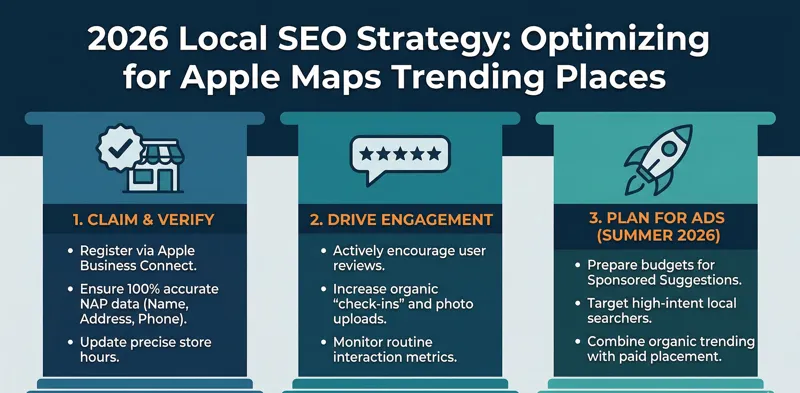
Moving forward into the summer of 2026, businesses will need to actively, relentlessly manage their Apple Business Connect profiles. Consistently gathering positive user reviews, ensuring high-quality, up-to-date photos are uploaded directly to the platform, and maintaining perfectly accurate hours of operation will merely be the baseline requirement. To successfully become an organic “trending” place, physical businesses will likely need to drive massive organic foot traffic and branded searches. Furthermore, the upcoming, highly anticipated ad platform will provide an entirely new frontier for local digital marketing, allowing businesses to strategically bid for premium placement directly within the Suggested Places interface. Early adopters who integrate these [Internal Link: Apple navigation updates] into their marketing strategy will likely secure a massive competitive advantage.
Local SEO Optimization Checklist for Apple Maps 2026
| Optimization Strategy Phase | Actionable Business Steps | Expected Impact on “Trending” Status |
|---|---|---|
| Phase 1: Profile Claiming | Register and formally verify the business via Apple Business Connect | Absolute foundational requirement for any map visibility |
| Phase 2: Engagement Metrics | Actively encourage user check-ins, Apple Maps route planning, and ratings | Extremely high impact; directly feeds the algorithmic “trending” signals |
| Phase 3: Visual Assets | Upload high-resolution, frequently updated imagery of the storefront | Moderate impact; drastically increases user click-through rates from the search screen |
Looking Ahead: The Future of Apple Maps Discovery
As developers and early adopters continue to thoroughly navigate through the iOS 26.5 beta testing period, the Suggested Places feature is fully expected to undergo several major algorithmic refinements. Complex machine learning models inherently require vast amounts of diverse user data to optimize effectively, and as more beta testers actively engage with the new search box daily, the pinpoint relevance of Suggested Places will inevitably and noticeably improve. The current, temporary lack of sponsored advertisements provides a unique, fleeting window for dedicated users to experience the pure, unadulterated utility of the discovery feature. Industry analysts remain incredibly curious to carefully observe how the dynamic user trust shifts once the paid, sponsored listings are officially introduced into the visual hierarchy of the application later this year.
Ultimately, this significant software update successfully solidifies Apple Maps not just as a basic, functional utility for driving directions, but as a powerful, autonomous local discovery engine. It represents a profound maturation of the platform, confidently moving far beyond basic digital cartography into the highly competitive realm of intelligent, context-aware lifestyle assistance. Whether you are an everyday user simply looking for a brand new weekend hangout spot, or a local business owner desperately looking to attract foot traffic in a crowded market, the technological changes introduced in iOS 26.5 are absolutely impossible to ignore.
Frequently Asked Questions (FAQs)
What is the most standout feature introduced in the iOS 26.5 beta 1?
The most notable and impactful addition is the “Suggested Places” feature integrated directly into Apple Maps, which automatically and intelligently recommends trending nearby locations and contextual destinations the moment you tap the search bar.
Exactly how does the Apple Maps algorithm determine what places are “trending”?
The complex algorithm securely utilizes anonymized, aggregated data regarding local search query volume, physical foot traffic, and overall user interaction within the Maps ecosystem to identify locations that are experiencing a surge in popularity in real-time.
Are there any sponsored advertisements currently displaying in the Suggested Places feature?
As of the very first beta release of iOS 26.5, the Suggested Places feature remains entirely organic and completely ad-free. However, Apple has officially confirmed via press release that sponsored, paid suggestions will be integrated starting this summer in the US and Canada.
Does this new proactive discovery feature compromise my personal location privacy?
No. Apple utilizes advanced on-device processing via the Neural Engine to match your personal search history with the aggregated trending data. Your specific searches and exact location history are never shared with external advertisers or third-party businesses.
Can I manually disable the Suggested Places feature in my Apple Maps settings?
While beta software versions are always subject to change before final release, standard Apple Maps privacy settings typically allow users to clear their recent search history and toggle off Siri Suggestions, which heavily dictates what data appears proactively in the search interface.
Who stands to benefit the most from the upcoming Maps advertisement rollout?
Local brick-and-mortar businesses such as restaurants, retail storefronts, and local service providers will benefit significantly, as they will finally be able to place highly targeted ads directly in front of mobile users who are actively looking for nearby destinations to visit.
When will the final, stable version of iOS 26.5 be released to the general public?
While Apple strictly does not provide exact calendar dates for point releases during the initial beta 1 phase, iOS updates of this nature typically undergo several weeks of rigorous developer and public beta testing before a general release, usually aligning perfectly with their broader early summer software rollout schedules.
Disclaimer: This article is for informational purposes only. The features described are based entirely on the iOS 26.5 developer beta 1. Final features, user interfaces, and the exact implementation of advertisements in Apple Maps may vary upon the official public release.