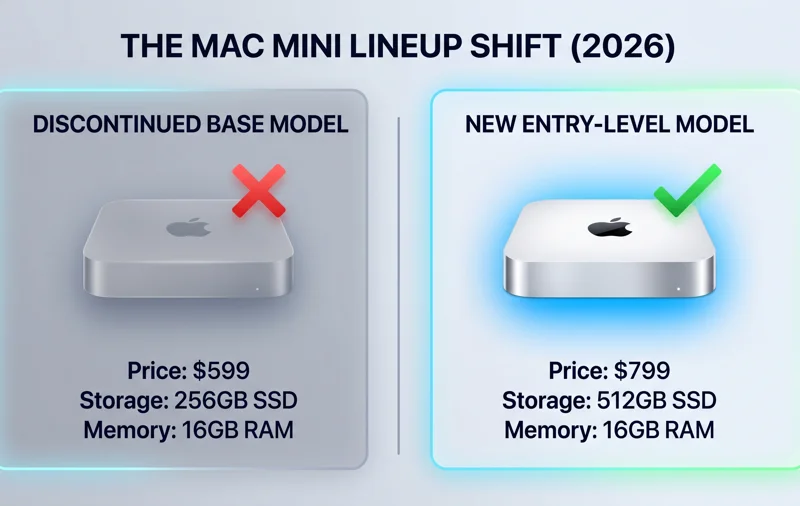
Recent shifts in the technology landscape have confirmed what many budget-conscious consumers feared: apple appears to have discontinued its cheapest mac mini. For years, the $599 entry-level Mac desktop stood as the most accessible gateway into the Apple ecosystem, offering remarkable value. However, changes recently spotted on the official Apple Store page indicate a dramatic pivot. The 256GB base model is completely absent from the lineup, meaning the most affordable configuration now strictly features 512GB of storage. Consequently, the Mac mini effectively starts at $799. This sudden adjustment marks the end of an era for Apple’s most budget-friendly machine, driven primarily by unprecedented hardware demands in the artificial intelligence sector and ongoing global supply chain constraints.
The Price Hike and Discontinuation Explained
When the redesigned Mac mini was initially launched for $599, it was widely praised as one of the best hardware deals available. Outfitted with multiple tiers of the Apple M4 chip, a minimum of 16GB of RAM, 256GB of solid-state storage, and an impressive array of I/O ports, the machine punched far above its weight class. It was the perfect entry-level Mac desktop for students, independent creators, and small business owners. Now, by quietly removing the lowest tier, Apple has forced prospective buyers to rethink their purchasing strategies.
“The AI industry’s insatiable demand for memory, storage, and powerful computing chips has finally caught up with the consumer desktop market.”
The elimination of the 256GB model is not merely a pricing strategy; it reflects a broader industry reality. The base model Mac pricing has historically been a delicate balancing act for the Cupertino giant. By shifting the baseline to 512GB, Apple is standardizing a higher tier of performance, albeit at a steeper cost to the consumer.
| Mac Mini Configuration | Storage / Memory | Price Point | Current Status |
|---|---|---|---|
| Base M4 Model (Previous) | 256GB SSD / 16GB RAM | $599 | Discontinued |
| Base M4 Model (New Minimum) | 512GB SSD / 16GB RAM | $799 | Available |
| Upgraded M4 Pro Model | 1TB SSD / 32GB RAM | $1,299+ | Available |
The AI Connection: Local Agents and Computing Power
The fundamental catalyst behind this sudden supply shift is the massive popularity of the Mac mini among the AI crowd. Apple’s M4 chip capabilities proved to be extraordinary for running complex, local Large Language Models (LLMs). As the technology evolved through 2025 and 2026, these tiny desktops were increasingly repurposed as dedicated hardware hubs for sophisticated local AI agents, such as OpenClaw. Developers quickly realized that stringing together a cluster of $599 Mac minis was significantly more cost-effective than renting expensive cloud compute instances.
“Both of these are amazing platforms for AI and agentic tools, and the customer recognition of that is happening faster than what we had predicted, and so we saw higher than expected demand.” – Tim Cook
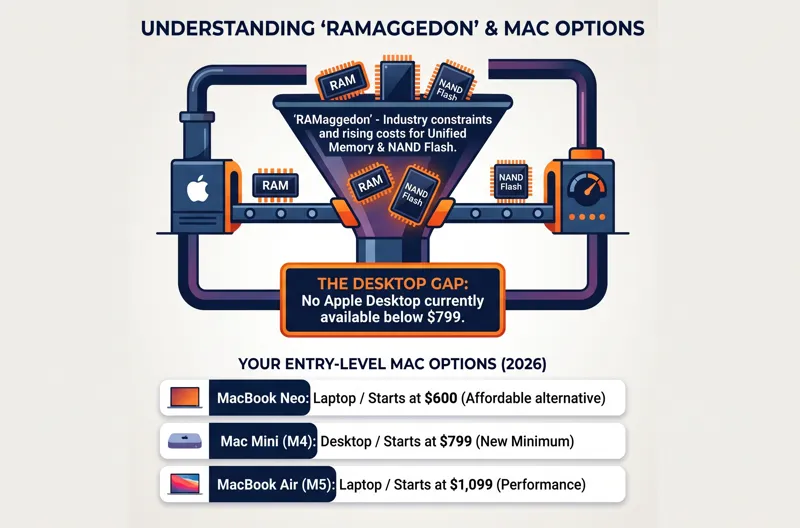
This localized AI boom created a massive drain on Apple’s inventory. The situation was further compounded by what industry analysts are calling “RAMaggedon”—a severe global constraint around sourcing critical components like high-speed memory and NAND storage chips. Apple, usually adept at absorbing supply chain shocks, had to make a tough call.
| Primary Hardware Bottlenecks | Impact on Production | Market Consequence |
|---|---|---|
| NAND Flash Storage | Higher costs per gigabyte | Elimination of 256GB tier |
| Unified Memory Modules | Restricted overall volume | Supply/Demand imbalance |
For detailed corporate insights regarding how Apple manages its hardware production and financial forecasting, readers can refer to the Apple Investor Relations portal. Apple has historically managed RAM and storage supply constraints better than its competitors, often hiding the volatile effects across its vast product lines.
For example, when Apple refreshed the MacBook Air with the M5 chip, the company smoothly transitioned to a 512GB baseline, bumping the starting price to $1,099. In the laptop segment, this price hike was cushioned by the release of the $600 MacBook Neo, an affordable, streamlined alternative. Unfortunately, the Mac mini has no such counterpart. Those looking for an entry-level Mac desktop are currently left without a sub-$600 option, forcing them to either stretch their budget to $799 or explore the refurbished market.
“Without a direct replacement for the $599 Mac mini, Apple risks alienating a crucial demographic of budget-conscious digital creators.”
| Alternative Apple Computers | Form Factor | Starting Price (2026) |
|---|---|---|
| MacBook Neo | Laptop | $600 |
| MacBook Air (M5) | Laptop | $1,099 |
| Mac Studio | Desktop | $1,999+ |
As the year progresses, it remains uncertain if Apple will reintroduce a true budget desktop or if the $799 price point is the new permanent standard. Until supply chain equilibrium is restored—a process CEO Tim Cook warned could take “several months”—buyers should anticipate continued premium pricing for Apple’s compact computing powerhouses.
Frequently Asked Questions
Why did the price of the base Mac mini suddenly increase?
The $599 model featuring 256GB of storage was discontinued due to a combination of high demand from the AI sector and industry-wide shortages in memory and storage components. The cheapest available model now includes 512GB of storage, starting at $799.
Are local AI agents really causing a hardware shortage?
Yes. Because the M4 chip is highly efficient at processing complex AI tasks locally, developers have been purchasing Mac minis in large volumes to build clusters for agentic workflows, straining Apple’s supply chain.
Is there an affordable desktop alternative to the $799 Mac mini?
Currently, Apple does not offer a sub-$600 desktop alternative. The closest budget option in their lineup is the MacBook Neo laptop, which starts around $600.
What is “RAMaggedon”?
It is an industry term used to describe the widespread shortage and rising costs of unified memory and NAND storage chips, which has forced many tech manufacturers to alter their hardware configurations and pricing.
Will the $599 Mac mini ever return?
Apple has not confirmed if the cheaper model will return. CEO Tim Cook noted it may take several months to reach a supply-demand balance, leaving the possibility open but unconfirmed.
Does the $799 Mac mini still have the M4 chip?
Yes, the $799 configuration includes the powerful Apple M4 chip, alongside at least 16GB of RAM and the upgraded 512GB of internal storage.
Where can I still buy the $599 256GB Mac mini?
While officially discontinued on the Apple Store, you may still find remaining stock at third-party retailers or on the refurbished market until supplies are completely exhausted.
Disclaimer: This article is for informational purposes only. Pricing, product availability, and technical specifications are subject to change based on manufacturer updates and regional market variations.