The recent tech news confirming that amazon to end support for older kindle devices 2012 has sent shockwaves through the digital reading community. If you are still holding onto a classic, button-heavy e-reader that you purchased over a decade ago, your time is unfortunately running out. Amazon is preparing to cut off these trusted devices from the broader digital ecosystem, fundamentally changing how long-term users interact with their digital libraries.
The Impending May 2026 Cutoff Date
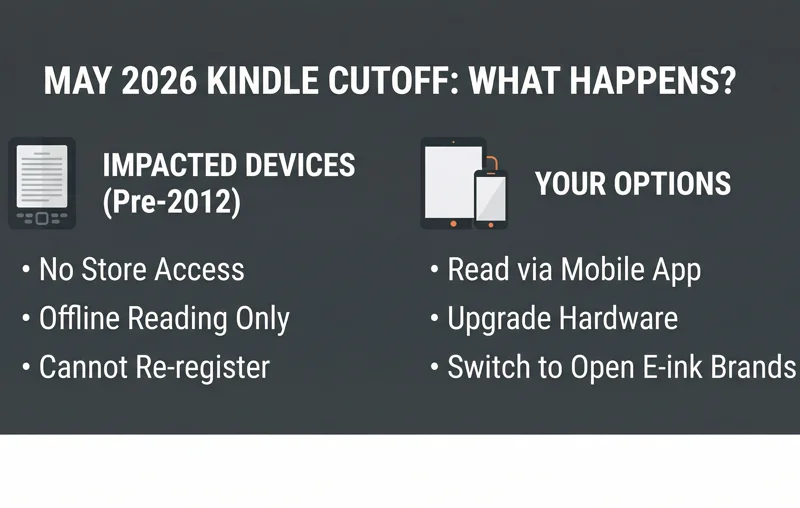
Amazon has officially set a firm deadline for its legacy e-readers. By the May 2026 cutoff date, specifically May 20, 2026, any Kindle released in 2012 or earlier will be severely restricted. The company has begun sending out emails to impacted customers, notifying them that these older units will permanently lose Kindle Store access. But what does this actually mean for your daily reading habits?
Essentially, while the device will still turn on and display text, its primary functionality as an internet-connected store will vanish. You will no longer be able to browse for new titles, purchase books, borrow from lending libraries, or download new content directly to the device. You will only be permitted to read the books that are already physically downloaded onto the e-reader’s hard drive prior to the deadline.
| Impacted Kindle Model | Release Era | Status After May 20, 2026 |
|---|---|---|
| Kindle (1st and 2nd Gen) | Pre-2010 | No Store Access / Offline Reading Only |
| Kindle DX & DX Graphite | 2009-2010 | No Store Access / Offline Reading Only |
| Kindle Keyboard, Touch, 4, 5 & Paperwhite (1st Gen) | 2010-2012 | No Store Access / Cannot Re-register if Reset |
The Backlash: Electronic Waste Concerns and Forced Upgrades
The reaction from longtime users has been overwhelmingly negative. Many consumers view this as a textbook example of planned obsolescence, even if the devices have been supported for 14 to 18 years. The core of the frustration lies in the fact that e-ink displays do not degrade the same way smartphone batteries or laptop processors do. Many of these pre-2012 units are still in pristine, working condition.
I’ve had my Kindle for years, but it still works perfectly and continues to serve me well. How wasteful is it to make a product practically unusable in order to force people to buy a newer model.
This move heavily fuels electronic waste concerns. When massive tech conglomerates discontinue support for perfectly functional hardware, millions of devices are pushed into landfills. According to data from the United Nations Institute for Training and Research (UNITAR), global e-waste is projected to reach an astounding 82 million tonnes by the year 2030. Forcing users to abandon working e-readers only exacerbates this growing environmental crisis, mirroring similar controversial decisions across the tech industry.
Amazon has stated that users will still be able to access their purchased libraries through the mobile app, web browser, or by upgrading to newer hardware. The company is reportedly offering promotional discounts to help users transition. However, this forced migration has prompted many die-hard readers to explore Kindle device alternatives altogether.
| Alternative Brand | Key Feature | Best For… |
|---|---|---|
| Boox Palma | Smartphone form-factor, Android OS | Users wanting app freedom outside Amazon’s ecosystem |
| Vivlio E-reader | Open format support (EPUB) | European users and open-source library fans |
| Kobo Libra Colour | Color E-ink, OverDrive integration | Frequent public library borrowers |
If you choose to abandon the Amazon ecosystem, devices running full Android operating systems with e-ink displays allow you to install various reading apps, granting you sovereignty over where you buy your books. This approach insulates you against the sudden ecosystem closures that plague closed-source hardware.
The future of digital reading demands open ecosystems; locking books inside hardware with an expiration date is no longer acceptable to the modern consumer.
The Gradual Decline of Legacy Support
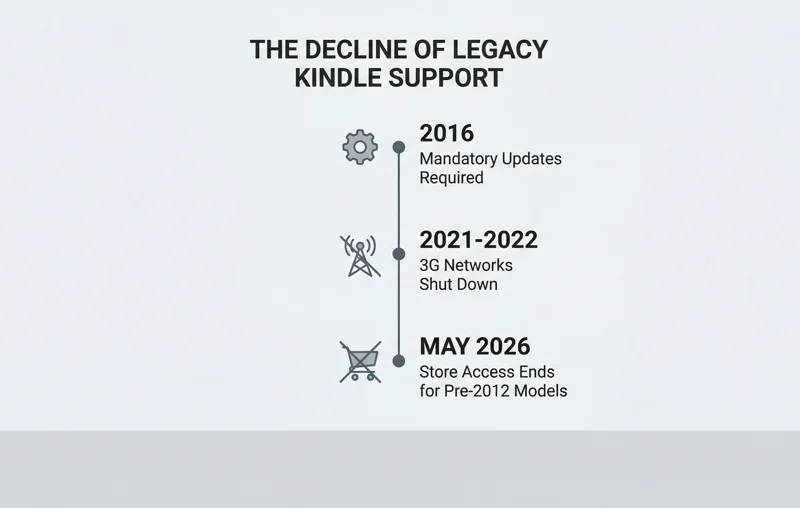
Looking back, the writing has been on the wall for some time. Amazon has systematically reduced functionality for these older models over the years. Understanding this timeline helps put the 2026 cutoff into perspective.
| Year | Amazon Policy Change |
|---|---|
| 2016 | Required mandatory updates just to maintain basic Store access. |
| 2021/2022 | 3G cellular networks shut down, disabling wireless downloads on 3G-only models. |
| 2026 (Upcoming) | Complete removal of Kindle Store functions and registration capabilities. |
Ultimately, while 14 years is an eternity in the tech world, e-readers have historically occupied a different space than smartphones—acting more like digital paper than computing hubs. The decision to sever their connection to the storefront serves as a stark reminder that when you buy a digital ecosystem device, you are only renting access for as long as the manufacturer deems it profitable.
Frequently Asked Questions
What happens to my old Kindle after May 20, 2026?
Your device will remain powered on and can open books already downloaded to it. However, it will lose all access to the Kindle Store, meaning no new purchases or direct downloads.
Can I still read my purchased books on other devices?
Yes. Your digital library remains intact on your Amazon account. You can access your books via the Kindle mobile app, Kindle for Web, or any newer, supported Kindle e-reader.
Which specific Kindle models are losing support?
The cutoff affects devices released in 2012 and earlier, including the 1st/2nd Gen Kindle, Kindle DX, Kindle Keyboard, Kindle 4 and 5, Kindle Touch, and the 1st Gen Paperwhite.
What if I factory reset my old Kindle after the deadline?
If you deregister or factory reset an affected pre-2012 Kindle after May 20, 2026, you will not be able to re-register it to your Amazon account, rendering it largely useless.
Why is Amazon doing this to devices that still work?
Amazon cites that technology has progressed significantly over the last 14-18 years, making it difficult and securely unviable to maintain backward compatibility for these legacy operating systems.
Are there any trade-in promotions available?
Yes, Amazon has stated they are offering promotional discounts and trade-in options to affected users to ease the financial burden of upgrading to modern hardware.
What are the best non-Amazon alternatives?
Brands like Boox, Vivlio, and Kobo offer excellent e-ink alternatives that often support open formats like EPUB and are not tied exclusively to the Amazon storefront.
Disclaimer: This article is for informational purposes only. The information regarding device support cutoffs is based on announcements made by Amazon as of early 2026. Deadlines and promotional offers are subject to change by the manufacturer.