Agentic coding apps have officially transitioned from a niche developer trend to a systemic disruption of the global software ecosystem in 2026. What started as a fascination with “vibe coding”—the ability to describe an app’s “vibe” to an AI and receive a fully functional codebase—has led to an unprecedented surge in App Store submissions. This wave of AI-generated software is currently clashing with Apple’s long-standing commitment to human-led quality control, creating a bottleneck that threatens the agility of the entire iOS platform.
The Rise of Vibe Coding and the 2026 Surge
The landscape of software development changed forever with the release of hyper-intelligent models like Claude 4.5 and its successors. These models empowered a new demographic: the non-coding creator. By utilizing agentic coding apps, individuals who have never written a line of Swift or Objective-C are now capable of shipping sophisticated, feature-rich applications in a matter of hours. This “vibe coding” movement prioritizes intent and aesthetic over manual syntax, allowing the AI to handle the heavy lifting of logic, debugging, and API integration.
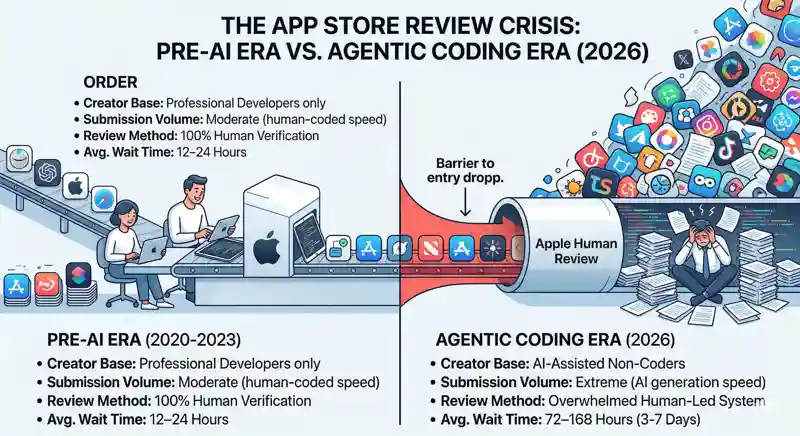
However, this democratized access to app creation has a massive side effect. The sheer volume of unique applications being submitted to the App Store has scaled exponentially, while Apple’s human review team has only scaled linearly. In early 2026, the industry began noticing a shift. Traditional 24-hour review windows have stretched into three, five, and sometimes seven-day waiting periods, even for minor updates.
How Agentic Coding Apps Broke the Human Review Model
For decades, Apple has prided itself on the “Human Touch.” Every app and update is inspected by a real person to ensure safety, privacy, and performance. This was manageable when the barrier to entry was high—learning to code took years. Today, agentic coding apps allow a single user to iterate and submit dozens of experimental apps per month. This has effectively “DDoS-ed” the human review queue.
| Metric | Pre-AI Era (2020-2023) | Agentic Coding Era (2026) |
|---|---|---|
| Avg. Review Time | 12–24 Hours | 72–168 Hours |
| Submission Volume | Moderate (Professional Devs) | Extreme (AI-Assisted Creators) |
| Review Method | 100% Human Verification | Human-Lead (Currently Failing) |
Established tech giants and indie developers alike are feeling the burn. When a critical bug fix for a major social media platform or a banking app is stuck in a queue behind thousands of “vibed” experimental calculators and weather apps, the ecosystem’s reliability begins to crumble.
“The era of manual human review for every single line of code is no longer sustainable in a world where AI can generate a year’s worth of human effort in six seconds.”
The Inevitable Shift: Automated App Review Solutions
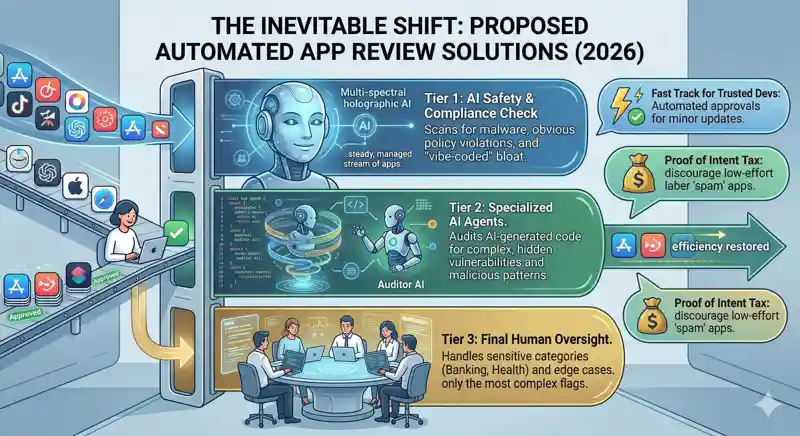
Apple is now at a crossroads. To maintain the integrity of the App Store while clearing the Apple developer queue backlog, the company must pivot toward automated app review solutions. Industry experts suggest a tiered approach where AI models—perhaps a proprietary version of Apple’s own LLMs—perform the initial safety and compliance checks, leaving only the most complex or sensitive apps for human eyes.
Potential New Review Architectures
To address the crisis, several frameworks are being discussed within the developer community:
- Tiered Verification: Established developers with a history of compliance receive “Fast Track” automated approvals for minor updates.
- AI-to-AI Auditing: Apple utilizes specialized AI agents to audit the code produced by agentic coding apps, looking for hidden malicious patterns that a human might miss in a rush.
- The “Proof of Intent” Tax: Increasing the cost of developer accounts or submission fees to discourage low-effort “spam” apps generated by AI.
-
- Priority Queues
| Solution Type | Pros | Cons |
|---|---|---|
| Automated Updates | Instant deployment for trusted devs | Potential for “update-jacking” malware |
| Protects large-scale infrastructure | Fairness concerns for new indie devs | |
| AI Sandboxing | Highly scalable and fast | AI might miss nuanced policy violations |
Why This Matters for SEO and Content Marketers
As an SEO specialist, understanding the shift in AI-generated iOS applications is crucial. The speed at which apps are created means the competition for “App Store Optimization” (ASO) is reaching a fever pitch. If you are managing a brand, the App Store submission delays mean you must plan your marketing cycles much further in advance. You can no longer assume your “New Year’s Sale” update will be live by January 1st if you submit it on December 30th.
For more technical insights on how Apple is managing its developer relations during this transition, you can visit the official Apple Developer News portal.
The Future of the “Vibe” Economy
Despite the current friction, agentic coding apps are here to stay. They represent the ultimate democratization of software. The challenge for 2026 and beyond isn’t stopping the flow of AI apps, but building a review infrastructure that is as smart and fast as the tools used to create them. Apple’s “walled garden” is currently overflowing, and the only way out is to automate the gates.
Frequently Asked Questions
What exactly are agentic coding apps?
These are AI-powered platforms that use autonomous agents to write, test, and deploy code based on high-level natural language instructions, often referred to as “vibe coding.”
Why is the App Store review taking so long in 2026?
The surge in AI-generated apps has created a massive backlog that Apple’s human reviewers cannot keep up with, leading to significant delays.
Can AI apps still get rejected by Apple?
Yes, Apple still enforces strict guidelines regarding functionality, copyright, and user safety, regardless of whether the app was coded by a human or an AI.
Is “vibe coding” a reliable way to build a business?
While it allows for rapid prototyping, long-term maintenance and complex custom features still often require human oversight to ensure code efficiency.
Will Apple eventually remove human reviewers entirely?
It is unlikely they will remove them entirely, but they will likely move toward a hybrid model where AI handles the majority of the initial screening.
How can I speed up my App Store submission?
Currently, the only way is to ensure strict adherence to guidelines to avoid “ping-pong” rejections and to request an expedited review only for critical emergencies.
Does vibe coding affect app performance?
If not prompted correctly, AI can produce “bloated” code. However, modern 2026 models are increasingly efficient at optimizing for performance and battery life.
Would you like me to analyze the specific impact of these delays on your “Mobile Services Center” YouTube channel strategy for 2026?
Disclaimer: This article is for informational purposes only. The trends described regarding “vibe coding” and App Store processes reflect the rapidly evolving landscape of 2026 and should not be taken as official legal or professional advice for app development.