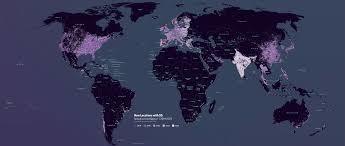
A 5G coverage map is an interactive, visual representation of where next-generation wireless service is available. Checking a 5G coverage map is the most crucial step before switching carriers, buying a new device, or getting 5G home internet, as it confirms whether you can actually access the faster speeds in your home or daily travel areas.
Because 5G performance varies dramatically based on the type of signal (low-band, mid-band, or high-band), simply seeing “5G” on a map is not enough. This guide breaks down where to find the most reliable coverage maps and explains the different layers of 5G you will see.
-
Where to Find and Compare the Most Accurate 5G Coverage Maps
To get the most comprehensive and accurate view of 5G availability, you should consult two main sources: Crowdsourced Maps and Carrier-Specific Maps.
-
Crowdsourced Maps (Best for Comparing Carriers)
Crowdsourced maps use real-world data collected directly from users running speed tests on their mobile devices. They often provide a more realistic picture of the actual performance and signal strength in a given area.
- Speedtest/Ookla: Platforms like Ookla’s Speedtest collect billions of data points to generate maps showing coverage and, more importantly, median 5G speeds for all carriers in a specific location.
- Coverage Map Apps (e.g., CoverageMap LLC): These services aggregate data from multiple users and sources (including the FCC) to provide highly accurate side-by-side comparisons of different carriers’ 5G footprints, often ranking them by speed and reliability in every ZIP code.
- FCC National Broadband Map: The U.S. Federal Communications Commission (FCC) maintains a public map with coverage data reported by carriers, allowing users to select and view maps for specific technologies and providers.
- Major U.S. Carrier 5G Coverage Map Links
When checking a specific carrier, use their official map for the most detailed, predicted coverage footprint.
| Carrier | Primary 5G Coverage Name | What the Map Tends to Show |
| T-Mobile | Extended Range & Ultra Capacity | Largest overall geographic coverage (Extended Range, low-band) and fast mid-band (Ultra Capacity) for speed. |
| AT&T | 5G (Low-Band) & 5G+ (Mid/High-Band) | A balanced approach, with wide low-band coverage and expanding mid-band and millimeter-wave (5G+) in cities. |
| Verizon | 5G Nationwide & 5G Ultra Wideband (UWB) | Wide coverage using Dynamic Spectrum Sharing (DSS) for Nationwide, but often the smallest footprint for its ultra-fast millimeter-wave and C-Band (UWB). |
-
Understanding the Different Layers of 5G Coverage
Not all 5G is the same. The difference in speed and range is determined by the frequency spectrum used. When checking a 5G coverage map, look for areas marked with different colors, which usually represent one of three bands:
| 5G Band Name | Frequency Range | Coverage Characteristics | Speed Characteristics |
| Low-Band (Extended Range) | Below 2 GHz (e.g., 600 MHz) | Widest Area: Travels the farthest, offers the best building penetration, and forms the core “nationwide” 5G coverage. | Slowest 5G: Speeds are often only slightly better than a strong 4G LTE signal (around 50–150 Mbps). |
| Mid-Band (C-Band / Ultra Capacity) | 2 GHz – 6 GHz (e.g., 3.7 GHz) | The “Sweet Spot”: Offers a great balance of speed and range. Covers large parts of cities and suburbs. | Fast: Delivers true next-gen speeds (typically 100–500+ Mbps). This is the key to the fastest modern 5G. |
| High-Band (mmWave / Ultra Wideband) | 24 GHz – 100 GHz | Shortest Range: Limited to small, dense areas (stadiums, street corners, airports). Signal struggles to penetrate buildings. | Fastest: Capable of delivering multi-Gigabit per second speeds (1,000+ Mbps), matching fiber optics. |
-
Comparing Carrier Strengths in the U.S.
When evaluating which 5G coverage map is best for you, consider your location and what you prioritize:
| Priority | Winner | Network Strategy |
| Widest Geographic Coverage | T-Mobile | Leads in overall square mileage covered with low-band 5G. |
| Fastest Download Speeds | T-Mobile | Dominates independent speed tests thanks to its extensive mid-band (Ultra Capacity) network. |
| Best Rural Coverage | Verizon | Maintains the strongest overall network, especially with legacy 4G LTE in remote areas, providing reliable coverage. |
| Balance/Reliability | AT&T | Offers a strong, balanced network footprint with extensive low-band coverage and aggressive mid-band expansion, often favored by business users. |
Frequently Asked Questions (FAQ)
Why is the 5G coverage map different from my actual signal?
Coverage maps are predictive tools based on theoretical signal propagation models and outdoor signal strength. Your actual signal may be weaker due to:
- Indoor Obstruction: 5G signals, especially mid-band and high-band, are severely weakened by thick walls, metal, and certain building materials.
- Terrain: Hills, large trees, and valleys can block signals.
- Network Congestion: If too many people are using a tower at once, your speeds will drop, even if the coverage map looks green.
Should I trust a carrier’s 5G coverage map?
You should trust a carrier’s map as an initial indicator of availability, but always cross-reference it with independent, crowdsourced maps (like those from Ookla or the FCC) to verify performance and compare speeds with other providers in your exact neighborhood.
Is 5G Home Internet coverage the same as Mobile 5G coverage?
No, they are often different. 5G Home Internet (Fixed Wireless Access or FWA) is a specific product offered by carriers like T-Mobile and Verizon that uses the same 5G spectrum but targets specific households near a cell tower with available capacity. Availability is often more limited than general mobile coverage because the carrier must ensure it has enough bandwidth to provide a consistently fast home internet service to that address.
What is the “C-Band” on a 5G coverage map?
C-Band is the popular term for the mid-band 5G spectrum (around 3.7 to 3.98 GHz) that major U.S. carriers began deploying heavily. It is considered the most critical frequency for 5G because it offers significantly faster speeds than low-band 5G while covering much wider areas than high-band (mmWave) 5G. On maps, this C-Band service is usually labeled as T-Mobile’s Ultra Capacity or Verizon/AT&T’s Ultra Wideband/5G+.