
The term “5G availability map” refers to an interactive, visual tool that shows the geographic coverage area of Fifth Generation (5G) cellular networks. These maps are the most reliable way to check if your current location, home address, or travel destination has access to the faster speeds and lower latency of 5G service.
Because 5G deployment is still an ongoing process, coverage can vary significantly from city to city and even block to block. This guide will show you where to find the most accurate 5G coverage maps, how to interpret the different 5G service types, and what steps to take if 5G is not yet available in your area.
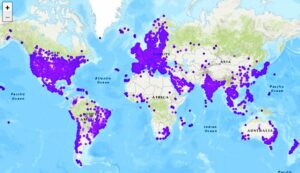
Where to Find the Most Accurate 5G Availability Maps
The most important factor in finding an accurate 5G coverage map is knowing which type of map you need: one published by your specific cellular provider or one compiled from real-world user data.
-
Carrier-Specific Official Maps
For the most precise information about the service you will receive with your current or future provider, always check the official 5G availability map published by the carrier itself.
| Major U.S. Carriers | Service Focus | Key Features to Look For |
| Verizon | Focuses on 5G Ultra Wideband (mid-band/mmWave) and standard 5G (low-band). | Maps typically distinguish between standard 5G and the faster Ultra Wideband service. You can check availability for both mobile and 5G Home Internet. |
| T-Mobile | Focuses on 5G Extended Range (low-band, broad coverage) and 5G Ultra Capacity (mid-band/mmWave, faster speed). | Check the map legend for color coding that shows the difference between the nationwide Extended Range and the high-speed Ultra Capacity areas. |
| AT&T | Distinguishes between standard 5G (broad coverage) and 5G+ (faster speeds, typically mid-band/mmWave). | Look for different shaded areas on their map to identify where the fastest 5G+ service is available, which is often found in dense urban centers and specific venues. |
Actionable Tip: When using a carrier map, type in your exact street address instead of just a city or ZIP code. This provides the most precise coverage prediction for your location.
-
Crowdsourced Global Maps
For a carrier-neutral view or for international 5G availability, crowdsourced maps are an excellent resource. These maps compile data from speed tests run by users in the field, showing real-world performance rather than theoretical coverage.
- Ookla 5G Map / Speedtest: Provides a global view of 5G deployments and network performance data collected from millions of user-initiated speed tests.
- nPerf Map: Offers detailed, user-contributed coverage maps globally, often allowing you to filter by technology (2G, 3G, 4G, 5G) and even see speed measurements.
Understanding Different Types of 5G Coverage
Not all 5G is the same. When looking at a 5G availability map, you will likely see different color-coded zones that correspond to different speed tiers. These tiers are based on the spectrum (radio frequency) the carrier is using.
-
Low-Band 5G (Extended Range)
- Purpose: Provides the broadest coverage, often covering hundreds of millions of people nationwide. This is the foundation of the “nationwide 5G” claim.
- Performance: Slightly faster than 4G LTE, but the primary benefit is the improved network efficiency and reliability. The signal can travel far and penetrate buildings well.
- Carrier Name Examples: T-Mobile 5G Extended Range, Verizon 5G.
-
Mid-Band 5G (Ultra Capacity / C-Band)
- Purpose: This is the current sweet spot for 5G, providing a balance of speed and coverage.
- Performance: Offers significantly faster speeds than Low-Band 5G—often reaching hundreds of Mbps (megabits per second)—with good building penetration and a wide coverage area around a cell tower.
- Carrier Name Examples: T-Mobile 5G Ultra Capacity, Verizon 5G Ultra Wideband, AT&T 5G+.
-
High-Band 5G (mmWave / Ultra Wideband)
- Purpose: Delivers the absolute fastest speeds—often gigabit (1 Gbps) speeds—but with very limited range.
- Performance: Requires a direct line of sight to the tower and can be easily blocked by walls, trees, or even glass. Its availability is limited to small areas in dense urban centers, stadiums, and airports.
- Carrier Name Examples: Verizon 5G Ultra Wideband, AT&T 5G+.
Frequently Asked Questions
Why does the 5G map show coverage, but my phone still shows 4G LTE?
There are three main reasons for this:
- Device Compatibility: You must have a 5G-capable device (phone, hotspot) and a 5G-enabled plan to access the network.
- Signal Type: You may be in an area with Low-Band 5G, which may not be significantly faster than 4G LTE and your phone may default to the stronger LTE signal.
- Indoor Interference: 5G signals, especially Mid-Band and High-Band, are easily blocked by concrete walls or dense building materials. The map usually approximates outdoor coverage.
How often are 5G availability maps updated?
Official carrier maps are generally updated every few months as the network expands, but the frequency can vary. Crowdsourced maps are updated more frequently, sometimes in real-time, based on live user speed tests. However, crowdsourced maps only reflect areas where users have actually run tests.
What should I do if the 5G map shows no coverage in my area?
If the 5G availability map confirms no current coverage at your location, your options are:
- Check for an Upgrade Timeline: Most carriers provide a general timeline for 5G expansion. Check their website or contact customer support for projected coverage dates.
- Rely on 4G LTE: All 5G devices are backward-compatible and will automatically switch to the robust 4G LTE network until 5G is deployed.
- Use Wi-Fi Calling: If both 5G and 4G are poor, enable Wi-Fi Calling on your device for reliable calls and texts indoors via your home internet connection.
Conclusion
A 5G availability map is a critical tool for any consumer looking to upgrade to 5G service or check for performance improvements in their neighborhood. To get the most accurate information, you should cross-reference your location on both the official carrier map and an independent crowdsourced map, paying close attention to the different types of 5G service indicated—Low-Band for range and Mid/High-Band for speed. While 5G networks are continually growing, checking the map ensures you set realistic expectations for the speeds you will receive today.